
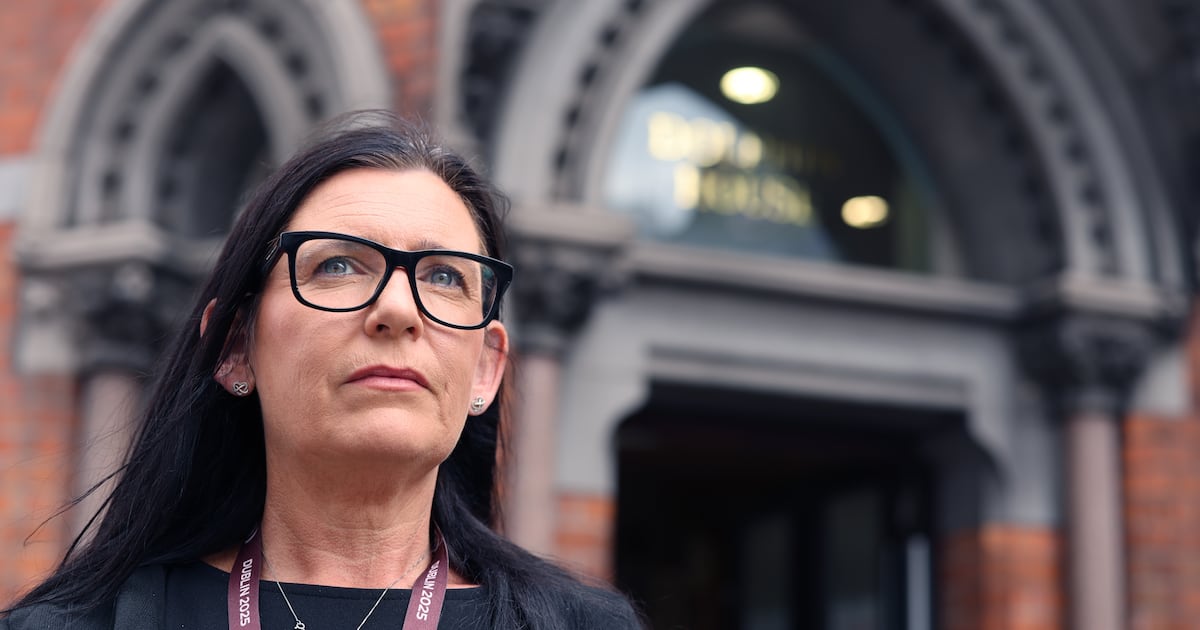
“When I hear the news that another woman is dead, I almost get palpitations, I’m thinking: ‘Please don’t let it be my client,’” says family law solicitor Sandra McAleer.
“I’m also thinking: ‘Please don’t let it be my client who did it.’”
McAleer has acted for many women violently assaulted, in some cases killed, by partners or former partners. She has also represented men who are either victims of domestic violence or the perpetrators of it.
“Some cases still get to me, I’ve had cases that ended in death, I’ve attended funerals,” she says.
“You do sometimes wonder could I have done something that would have helped to stop that. I’ve been horrified by what some people can do.”
Family law is difficult for all involved, with much at stake. Whether it is domestic violence, access or custody disputes over children, separation or divorce, it is often fraught with heightened emotions.
Over almost 20 years acting for clients in the family District Court complex in Dolphin House, the redbrick corner building located in Temple Bar in the heart of Dublin city centre, McAleer has experienced intimidation, warnings and even death threats.
“When things don’t work out, some people turn on the lawyers. Some are really bad, I’ve voice recordings of a man outside Dolphin House threatening to have me executed. I’ve had posters threatening me put up along the quays,” she says.
A man currently serving a prison sentence for a serious crime involving his partner threatened “to bring me up the mountains”, she adds.
Other family law colleagues have also received threats, including a female barrister who had a plastic knife held against her throat by a prisoner.
McAleer was in Dolphin House in December 2015 when Judge Miriam Walsh was violently assaulted by a man during a hearing concerning his elderly parents’ application for a safety order against him.
Gardaí now maintain a permanent presence in the complex and visitors must pass through a security screening.
Unlike many colleagues, McAleer, from Balbriggan in north Co Dublin, has no family background in law.
Her father was a butcher and she grew up in a council house with parents who instilled in her a strong work ethic. “Nothing was ever handed to me on a plate,” she says.
If an unmarried father is looking for access, it can take … a full year by the time the case is processed. That’s one year of a child not seeing their dad. It can have a huge impact on how the child feels about seeing them at all
She studied hard and changed her mind about being an architect when she got enough points in her Leaving Certificate to study law and business.
Along the way, she played rugby and has 65 caps for Leinster and two for Ireland.
McAleer logged her first family court experience in Dolphin House when working for a solicitor in Raheny on Dublin’s northside and later moved to another firm in Baggot Street in the south city centre where the focus was on conveyancing.
After the property crash, she built up a speciality in family law.
“Everyone was separating – when the money goes, the love follows,” she says.
After returning from maternity leave in 2010, she set up on her own.
“I was working in Dolphin House, I started with maybe four to five files a week and it kept getting busier and busier,” she says.
Her firm prospered and legal aid family law work now accounts for under half of its business, which also includes private family law, probate and conveyancing.
McAleer is the top earner in the State from legal aid family work, with recent earnings of about €500,000 annually.
Out of that, she points out, she employs 14 people, paid €70,000 to a team of barristers, runs an office and pays insurance, along with all the other expenses of running a legal business.
Most clients are “the man, and woman, on the street” and other clients are referred to her by domestic violence refuges and the domestic violence charities Women’s Aid and Men’s Aid.
McAleer is among a group of solicitors and barristers who warned this month they will withdraw from family legal aid work unless the Minister for Justice Jim O’Callaghan responds “meaningfully” to their call for a fees increase and reform of a “crumbling” family legal aid system.
Legal fees are in focus right now. The Minister is embroiled in a separate dispute with criminal defence solicitors – unconnected with family law cases – where he is cutting legal aid paid by the State, introducing a flat-fee payment per client rather than paying solicitors for each court appearance.
In family law cases, legal aid payments are structured differently and cover work under three acts that deal with: guardianship/access/custody; maintenance; and domestic violence.
The pay rates, unchanged over 20 years, range from €339 for a single application for one client under one act, such as for access, to €423 for two applications under two different acts, and up to €518 for three applications under three acts.
“You could have 10 summonses under one act, or an access row going on for nine months, but you still only get €339,” she says.
The average fee for a private solicitor for a family law appearance is €800 to €1,500, she adds.
Family legal aid lawyers feel “let down and underappreciated”, she says.
[ If Tusla were a parent it would be prosecuted for neglect, judge saysOpens in new window ]
“We feel because we have done this so long [the] Government just keeps ignoring us. I’m 100 per cent sure unless something is done we will vote with our feet, not just in Dublin but around the country,” she says.
She says there has been a “huge exodus” from family legal aid work because many lawyers regard it as not financially viable.
“I survive because I have a huge volume of cases but it’s not feasible into the future. We get €339 for an access application that could last nine months to a year,” she says.
“The fees for one case in the Circuit Court could range between €15,000 and €20,000. Solicitors are voting with their feet.
“I’m worried for the vulnerable clients, about what will happen to them, if we leave the panel, the Legal Aid Board is overwhelmed.”
Despite the pressures and threats, McAleer loves her work.
“I get great job satisfaction. The legal aid clients listen to me, I have a rapport with them, I often come out of court and give them a hug because I think they are so brave,” she says.
She is dismayed when a client goes back to their abuser believing a promise to change behaviour. “I call it the broken promise,” she says.
Clients in those situations are often embarrassed about seeking a fresh court order.
“I never say ‘I told you so’; I just say my door is always open,” she says.
“We understand that to take a case against your partner is the biggest step anyone may ever take. I tell them: ‘It’s your life, live it in the best possible way, you can’t live like this.’”
Delays in family law cases are “shocking”, she says, noting it may take six months or more to get “section 32 reports” by assessors, costing an average €3,700, who ascertain needs and wishes of children in access and custody disputes.
“If an unmarried father is looking for access, it can take up to six months to get a section 32 report and a full year by the time the case is processed,” she says.
“That’s one year of a child not seeing their dad; it can have a huge impact on how the child feels about seeing them at all.”
In family law, the courts particularly need settlements and lawyers are key to those, she says.
“Most cases settle. We’re often telling people what they don’t want to hear, just explaining the law. Family law is especially about compromise – there are no winners.”