
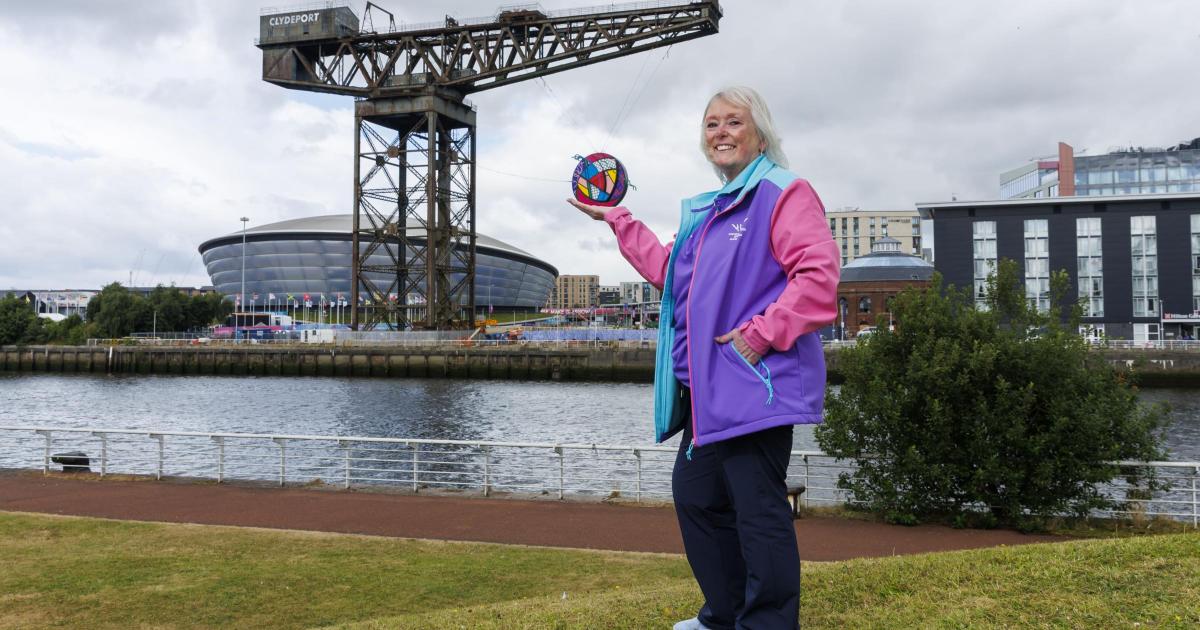
In the mid-1960s Harry McLean controlled the towering, steel titan; admiring from its cab a sweeping vista of a Clyde bustling with steamers, criss-crossing passenger ferries and global shipbuilding.
Now the totemic structure hosts a giant art installation, offering a modern take on the internationally influential rose designed by Charles Rennie Mackintosh and his wife Margaret Macdonald Mackintosh.
Visible across the Clyde throughout the Commonwealth Games, The Glasgow Rose was commissioned as part of Glasgow 2026 Festival, a ten-week celebration of the city’s creativity, culture and communities running alongside the Games.
Harry McLean operated the crane in the mid-1960s (Image: Dorothy Brodie)
As an art lover and fan of the Mackintoshes, Harry would have been elated that the inspiring symbol is now adorning his steel workplace in the sky.
Dorothy said: “When I think of my dad, I think of this crane in Glasgow and I think he would be delighted to see something so beautiful hanging from it. My dad loved art and he really loved the crane. The combination of the rose and the crane is wonderful, like a jigsaw puzzle of Glasgow being pieced together.
“It makes me emotional to see them in unison. There is so much affection here for them and that makes them a perfect combination for a time when the world is looking to Glasgow and the Games.”
As a tribute to her father who died in 2019 at the age of 83 Dorothy volunteered for the 2026 Games.
“I thought it was a nice way to honour him and the city,” she said.
Created by Glasgow artist Emer Tumilty the new rose installation has been a collaboration with creative studio NEWSUBSTANCE who have worked on dramatic installations across the globe, including the legendary Coachella music and arts festival in California.
The new landmark commission unites the city’s artistic influence and industrial heritage as an economic powerhouse of shipbuilding.
Growing up in Glasgow, Dorothy’s childhood was filled with art. She attended drawing classes and her parents regularly took her to the Kelvingrove Museum to peruse the work of the Mackintoshes.
She once harboured ambitions of studying at the Glasgow School of Art until life and motherhood took over.
The Mackintoshes iconic rose motif has been integrated into architectural features and furnishings, incorporated into leaded glass, gesso panels and wood paneling. It is recognised around the world, and their work draws fans to Scotland from countries including Japan, America and Europe.
Dorothy said: “They were Scottish pioneers of art, absolute geniuses ahead of their time. Generations of Glaswegians grew up admiring their work and feeling like it belonged to the city and to them.”
Harry and his three brothers all worked the Clyde shipyards as their father had before them.
When Harry came home from the yards and announced to his wife Annie that he had taken a new job on the crane she was perplexed.
She reminded him he had no idea how to operate the 175-ton structure. Not to worry, he assured her—he’d found a library book telling him all he needed to know.
“They weren’t big on health and safety back then,” laughed Dorothy.
So began Harry’s days of ascending 175ft each morning to his cabin in the clouds.
Read more
It was the only British crane ever to be fitted with a lift but when it broke down Harry had to climb the 130-step internal steel staircase to the top.
His little cab was basic, with no home comforts and it was often brutally cold in the winter. The operator couldn’t descend during his shift, so all calls to nature were answered with a bottle or a bucket.
Dorothy said: “It could be tough but that was just what they had to do and my dad spoke very fondly of that job. He loved having a bird’s eye view of the city and the river.
“It was his opening gambit to people he met that he worked on the crane.”
The crane is now static but back when Harry was in control its 152 ft long ‘jib’, could make a full revolution in only 3.5 minutes.
The giant steel, lattice structure dubbed the Clydesdale horse of the industrial era was built in 1931 to load large locomotives onto ships but in Harry’s time it was used to lift heavy cargo onto boats.
The crane is such a fundamental emblem of the aesthetic of Glasgow that award-winning artist Militsa Milenkova embedded its image into her designs used to make the medals for the 2026 Games.
In 2021 Dorothy was allowed to climb the crane to briefly look through the same window on the world as her father; though his view would have included huddles of tenements and soaring church spires before they were raised by the M8 and Expressway.
Dorothy said:” I wanted to get a sense of what it was like for him. When I think of my dad, I think of the crane. When we laid him to rest, we drove by and the crane was the sight we saw on his final journey.”