
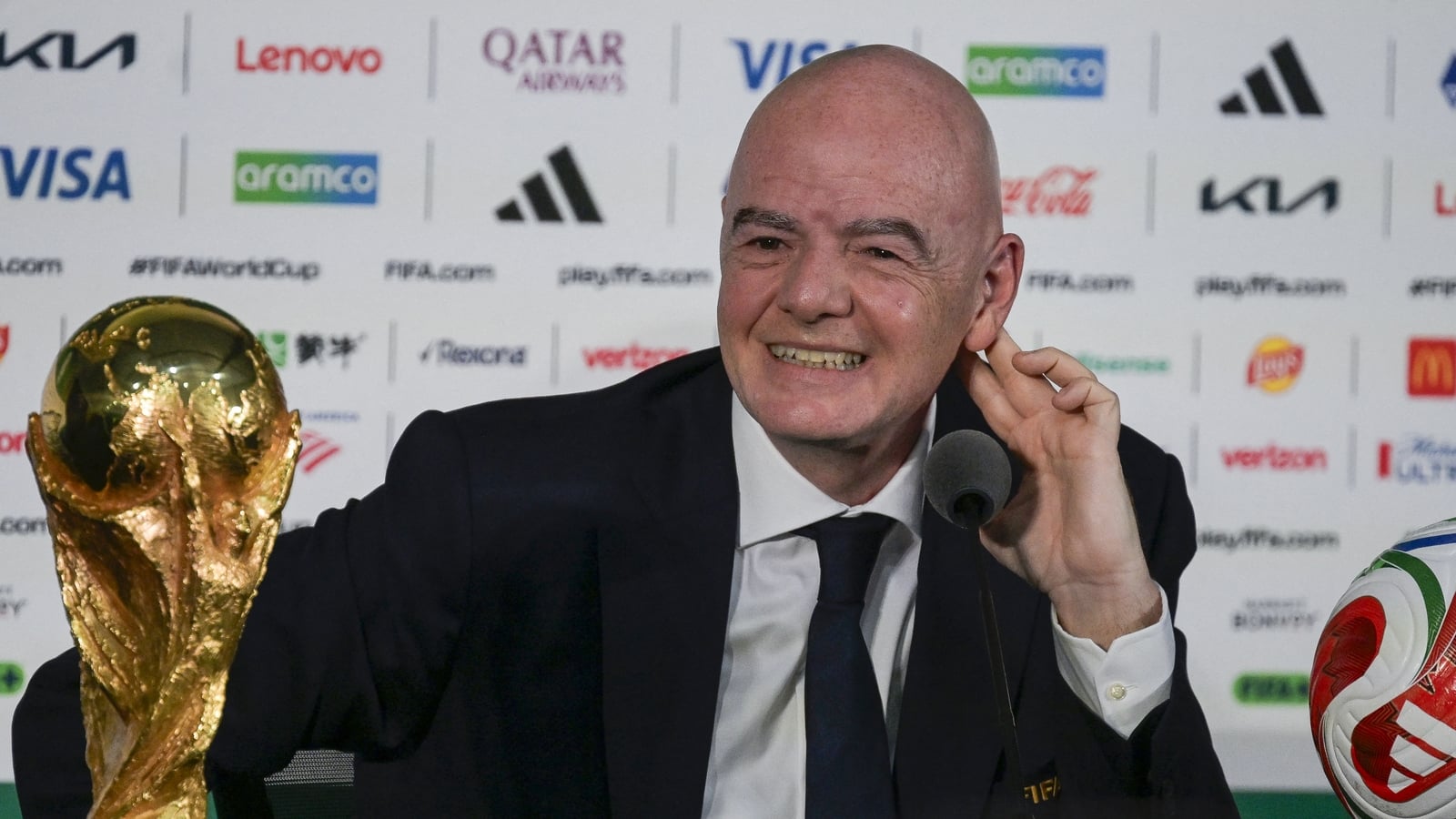
It’s less than a fortnight since the World Cup final and already future tournaments, including next year’s Women’s World Cup, feel like they are a state of flux.
That follows the outrage to FIFA’s proposal to sell a stake in the World Cup and other competitions overseen by world football’s governing body to private equity.
So how did we get here and how could this fast-moving situation play out?
What is FIFA proposing on paper?
Under the proposal promoted by embattled FIFA president Gianni Infantino, the governing body would create FIFA Forward Enterprise (FFE), which would bring the “commercial rights and events operations” aspects of the organisation under its umbrella.
According to FIFA that would cover areas like broadcast rights negotiations, sponsorship, licencing, ticketing and hospitality.
It would be a FIFA-owned – with a majority of at least 80% – and controlled subsidiary to the main organisation with its own board of directors and management. FIFA insists that the establishment of FFE would not move it away from its current not-for-profit status.
However – and this is among the main sticking points – stakes of up to a total of 20% would be open to outside investors – an unprecedented move. FIFA insists that those private investors would have no influence on World Cups or the governing body itself.
“Investors have no role in, and no influence over, decisions on competition format, frequency, or expansion. Such matters remain solely for FIFA’s Congress and Council to decide, in line with FIFA’s existing governance processes,” the governing body says.
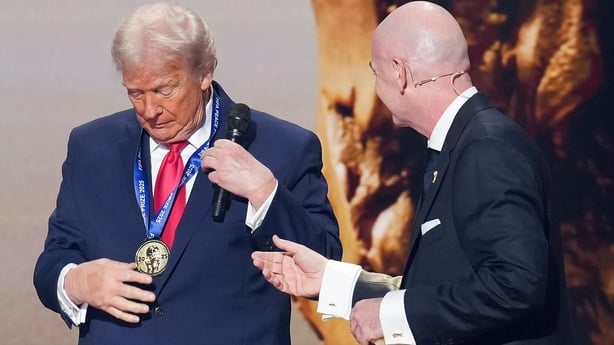
Infantino has associated himself closely with Trump, including the awarding of a FIFA peace prize
One specific investment group linked with taking a stake is led by Thrive Eternal, which was founded by Joshua Kushner in 2009.
If that surname sounds familiar, he is the brother of Jared Kushner, the son-in-law of US President Donald Trump. As has become apparent in recent years, Trump and Infantino have forged close ties in the build-up to the last World Cup and the FIFA president presented his US counterpart with a much-derided peace prize at the draw ceremony late last year.
FIFA has specifically name-checked the likes of Formula One and some European leagues as examples of sporting bodies with their own “dedicated commercial operations”.
What would member associations get out of it according to FIFA?
There are 211 member associations of FIFA including the FAI which governs soccer in the Republic of Ireland.
FIFA claims that the establishment of the FFE would allow any new-found commercial value – to the tune of up to €4.9 billion – to filter down towards its member associations as well as reinvestment back into the wider game.
They claim that it would have the knock-on effect of “better pitches, stronger national teams, more pathways for young players, and greater support for women’s football”.
What would FIFA need to get this over the line?
FIFA would require a majority of its member associations to vote in favour along with approval from the FIFA Council.
The latter is FIFA’s decision-making body and is elected by the FIFA Congress.
Each association has one vote at Congress so 106 from 211 would suffice to get it over the line, which brings us to the next point…
How have the confederations reacted?
Let’s start with the most relevant member association from an Irish point of view.
On Thursday evening, the FAI released a statement rejecting the proposal, “The Football Association of Ireland supports UEFA along with all member associations in rejecting FIFA’s proposal to transfer ownership interests in the FIFA World Cup and other FIFA competitions to private investors.
“The Association believes that decisions of this significance must be founded on strong governance, transparency and meaningful consultation. In solidarity with UEFA’s position, Ireland’s national teams will not participate in FIFA competitions while these proposals remain under consideration.”
At this point, European football’s governing body had already emphatically condemned FIFA’s plans and had gone further in pledging that its 55 member assocations would boycott future FIFA tournaments until the plans are dropped.
Significantly, the vast majority of the leading national teams in the men’s and women’s game hail from Europe which would completely devalue any World Cup that this continent would opt out of.
In a hard-hitting statement this week, UEFA said: “No UEFA national teams will participate in any FIFA competition for so long as these proposals remain alive, unless this proposal has been abandoned in its entirety and binding assurances have been given that FIFA will never again open its governance or competitions to private ownership.
“UEFA and its 55 member associations stand as one. We unanimously and unequivocally reject FIFA’s proposal to transfer ownership interests in the World Cup and other FIFA competitions to private investors.
“The World Cup cannot be treated as an investment product. It is one of football’s greatest sporting legacies. It has been built over generations by players, national teams and supporters across every continent. No part of it should ever be surrendered to private investors. The World Cup is not for sale.”
There have been simmering tensions between FIFA and UEFA in recent years and the latest turn of events has blown that wide open for all to see.
UEFA was the first confederation to show its hand but it has been quickly followed by CONCACAF (which covers North and Central America as well as the Caribbean) and the AFC of Asia of which Australia has also been a member for two decades.
Neither went as far as a boycott threat but both confederations have outlined their disapproval of the plans.
Considering they make up a total of 88 member associations between them, coupled with UEFA’s 55, it leaves FIFA stuck between a rock and a hard place, provided there is unanimity within the confederations themselves.
How does recent events impact Infantino’s position?
The Swiss admininstrator is the ninth president in FIFA’s history, taking over in 2016 after a period of turmoil under his compatriot and predecessor of 17 years Sepp Blatter.
Under current statutes, the presidency is limited to three four-year terms.
The 56-year-old completed the remainder of Blatter’s final term in office before serving his previous (2019-2023) and current (2023-2027) terms, the latter of which is due to expire next year and he is running for reelection for a final term in office.
Should he ultimatelly run and be successful in an election that would bring his presidency to an end in 2031.
On Friday and directly related to the outrage over the FIFA plans, there was a crack in the edifice around him.
His senior advisor, former US Soccer president Carlos Cordeiro, resigned and unequivocally pointed towards this week’s turn of events in his statement.
“As a senior adviser to the FIFA president, a former banker, and a lifelong football fan, I cannot stand by while FIFA considers selling a stake in the World Cup,” he told Sky News.
“Let me be clear: I had no involvement in this proposal, and I oppose it unequivocally. It is a bad deal for FIFA’s member associations, a bad deal for football, and a bad deal for the long-term future of the game.”
For now, there has been no indication that Infantino will climbdown over the matter but Cordeiro’s resignation – along with strong condemnation from the organisation’s chief operating officer – certainly represents a blow and a sign of opposition within FIFA at least towards the proposed plans. So it’s a case of watch this space in this fast-moving situation.
We need your consent to load this rte-player contentWe use rte-player to manage extra content that can set cookies on your device and collect data about your activity. Please review their details and accept them to load the content.Manage Preferences