

It is difficult to know where the US economy stands. While recent data (weekly jobless claims, GDP, personal consumption expenditure, etc.) show a resilient economy, the ADP survey is somewhat out of step. In September, 32,000 private sector jobs were lost, while economists had actually expected 51,000 new jobs to be created.
This unpleasant surprise is compounded by a downward revision of the previous month’s figures: 3,000 jobs were lost in August, compared with 54,000 created in the initial reading.
The week is unlikely to bring any clarity, as the shutdown has led to the closure of many agencies, including the BLS. As a result, the eagerly awaited employment report (NFP: Non Farm Payrolls) is not expected to be published this Friday.
Economists usually focus more on the employment report than on the ADP survey published two days earlier. But since that is all we will have to go on this week, it is interesting to note that the ADP survey and the Labor Department report have been converging in recent months. Both show job creations of around 30,000 per month, when looking at the three-month averages.
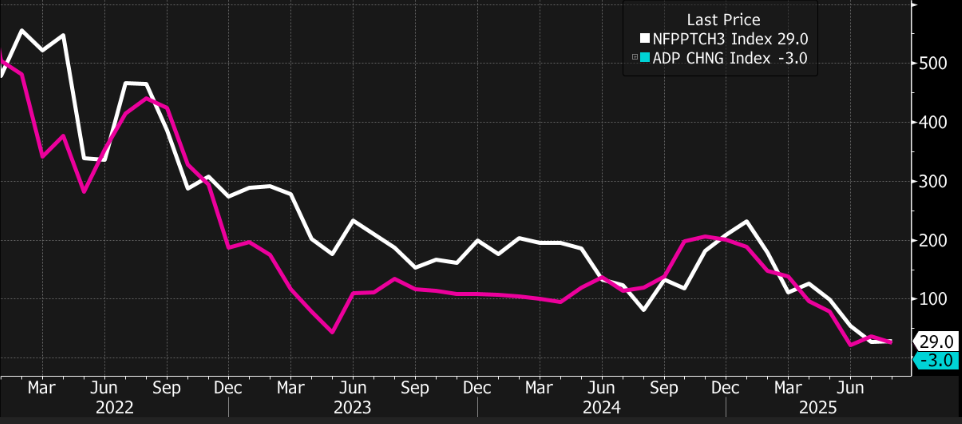
ADP survey (pink) and NFP (white). Three-month average of job creation. Source: Bloomberg
Fed support
Firstly, we are seeing a sharp slowdown in job creations over the past few months. We have gone from around 200,000 at the beginning of the year to just 30,000 now. This slowdown is the result of a somewhat stagnant labor market: companies are more cautious about hiring, and employees are resigning less.
However, it is also the result of a lower supply of labor, due to immigration policy being tightened since Donald Trump’s return to the White House. Attempts to cross the southern border have fallen, while the US administration wants to deport 1 million people a year.
All this has led to a situation where job creation is low (and is likely to remain so) but where the unemployment rate remains relatively stable.
Overall, while the labor market appears to be balanced, it is a strange balance resulting from a marked slowdown in both labor supply and demand. This unusual situation suggests that the downside risks to employment are increasing. And if these risks materialize, they could do so quickly, resulting in a sharp increase in layoffs and higher unemployment. This is what Jerome Powell said in August in Jackson Hole, in a speech in which he opened the door to rate cuts.
Since then, the Fed has embarked on this path with a 25bp cut at its September meeting. The markets expect two further cuts by the end of the year, a scenario that is reinforced by ADP survey figures.