
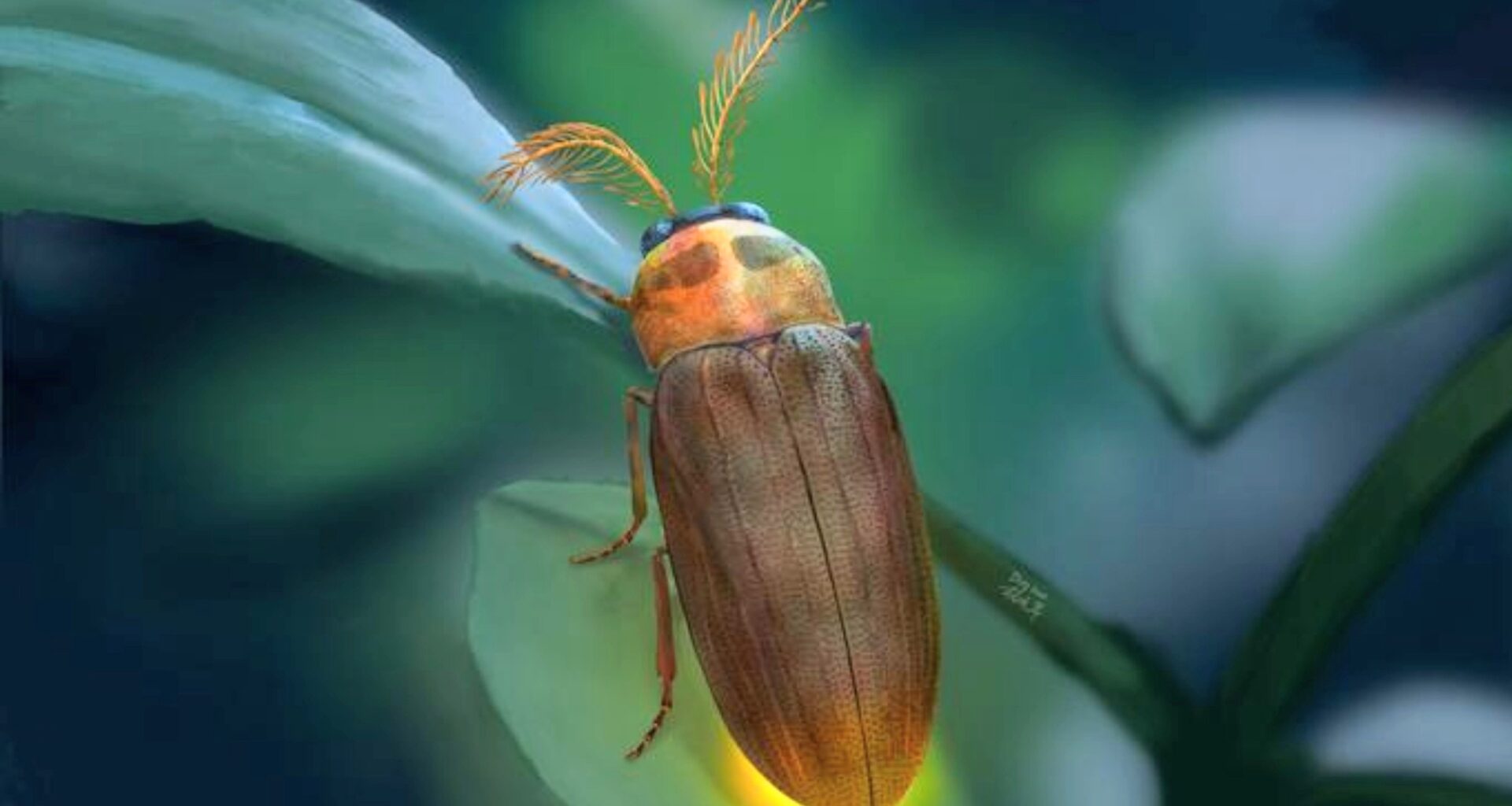
About 100 million years ago, a small beetle crawled across a tree in what is now northern Myanmar and got caught in a bead of resin.
The resin hardened into amber, and the beetle stayed whole inside it.

When a team of paleontologists cut into that amber, they found something no living beetle carries. Its antennae branch, and then those branches branch again into two separate kinds.
Yanda Li, a doctoral student at the University of Bristol, led the work.
He teamed up with Professor Chenyang Cai of the Nanjing Institute of Geology and Palaeontology of the Chinese Academy of Sciences (NIGPAS).
The team named the beetle Icaroramus perisi, after Icarus, the figure who flew too close to the sun. The species name honors the paleoentomologist Dr. David Peris.
Antennae unlike any beetle
The antennae of Icaroramus perisi have 12 segments. Each of the middle eight segments sprouts two separate pairs of side branches.
One pair rises from the base of a segment, longer and slightly swollen at the tip, coated in coarse hairs. The other pair sits nearer the middle, shorter and thinner, with only fine hairs.
No beetle, living or extinct, has had antennae like these. The team calls the pattern quadriheteroramose, meaning four branches of two different types on a single segment.
The extra branches likely trace back to how an antenna forms, dividing into segments in sequence and then stopping.
In Icaroramus, that program seems to have switched back on inside segments already set, budding branches instead of new segments.
Branches built for smelling
An antenna is an insect‘s nose. Fine hairs along it, called sensilla, hold the nerve cells that catch airborne chemicals.
More branches add surface area. That extra area holds more sensilla, which sharpens the sense of smell.
Males often carry the showiest antennae. They have to track the faint pheromone trails that females leave, and finer antennae widen the search.
Males that hunt by scent
The specimen is a male. In many firefly relatives, females never grow wings.
Those females keep a larval shape into adulthood, while the winged males fly off to find them.
That split pushes males to build better scent detectors, which may explain the beetle’s elaborate antennae.
Yanda Li and his colleagues read the branched antennae as a sign that Icaroramus perisi hunted for mates mostly by smell.
The two branch types may have split the labor, one tuned to one class of chemical and the other to a second.
Moths do the same, with the main antennal shaft and its branches carrying different kinds of sensors.
A light organ for defense
The fossil also preserves a light organ on the underside of its abdomen. In fireflies today, such a glow can warn off predators, attract mates, lure prey, or light a path.
That pairing is what makes Icaroramus odd. Fireflies now rarely carry both branched antennae and a working light, because the two usually go with different mating strategies.
Species that flash for mates tend to have plain antennae and large eyes. Species with elaborate antennae usually court by scent and leave the flashing behind.
The researchers doubt that Icaroramus glowed mainly to court.
They argue that the light most likely worked as a warning to predators – a defensive role that came before courtship flashing.
Two signals, one body
If the glow was mainly a defense, then the first firefly relatives probably courted by scent. The heavy antennae on Icaroramus point that way.
The oldest glow of all may have been a young beetle’s trait. In many fireflies the larvae glow to warn predators, and only later did adults borrow the light for courtship.
The light organ still leaves room for a halfway stage. The beetle may have begun folding its glow into courtship without dropping pheromones as its main signal.
Some living fireflies run both channels together. They flash and release scent during mating, a double system that Icaroramus perisi may hint at from far back in time.
A design that disappeared
No living beetle kept these split antennae. The researchers read them as a brief experiment, one that selection dropped or that later conditions ruled out.
A few relatives alive today grow a stray third branch on each segment, but those are short, blunt bumps.
The four branches on Icaroramus are long and fully formed, closer to real sensory tools.
The team places the beetle in an extinct family, Cretophengodidae, though they add that the fit is uncertain.
At about 0.4 inches long, it carried antennae no beetle has matched in the 100 million years since.
The study is published in the journal Proceedings of the Royal Society B.
Image Credit: YANG Dinghua
—–
Like what you read? Subscribe to our newsletter for engaging articles, exclusive content, and the latest updates.
Check us out on EarthSnap, a free app brought to you by Eric Ralls and Earth.com.
—–