
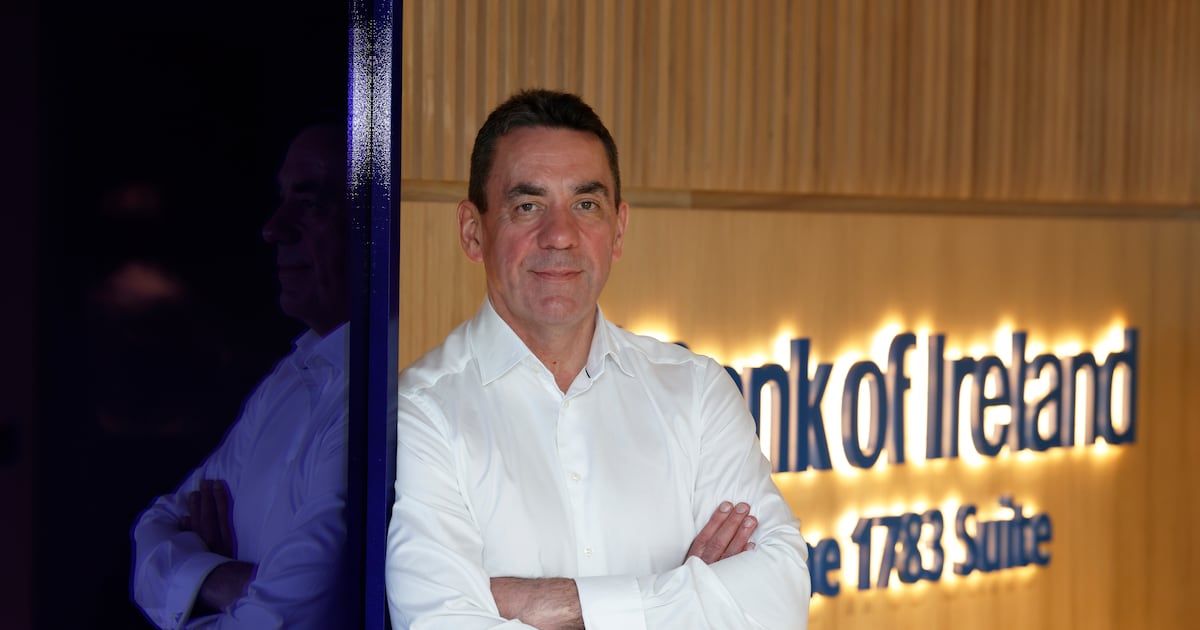
Bank of Ireland has upgraded most of its financial targets for this year after having what chief executive, Myles O’Grady described as an “excellent performance” in the first half.
The group has increased its net interest income forecast by €100 million to about €3.5 billion. It is projecting a return on shareholders’ equity – a key measure of profitability – of more than 14 per cent, up from about 12.5 per cent previously, and expects to take a smaller bad loans charge.
Pretax profit at the lender rose by 33 per cent in the first half to €960 million, beating the consensus call among analysts for 19 per cent growth. Net interest income advanced 2 per cent to €1.7 billion and fee income jumped 6 per cent, helped by an 18 per cent increase in assets under management across its New Ireland and Davy divisions, to a record €65.5 billion.
RBC Capital Markets analysts noted that the outperformance was driven in part by €51 million of gains and valuation adjustments on certain investments and financial instruments held by the bank.
“We remain alert to geopolitical developments and the risks for the global economy. Notwithstanding this, a favourable Irish macroeconomic and demographic environment, combined with our unrivalled position as Ireland’s national champion bank, offers continued momentum and confidence for the remainder of 2026 and beyond,” O’Grady said.
The upgraded forecasts come a day after rival AIB also raised its 2026 net interest income target marginally, with both banks expecting interest rate increases over the next five months as central banks grapple with inflation stoked by the conflict in the Middle East.
Both banks’ interest income lines are also benefiting from the use of financial derivatives – known as interest rate swaps – to smooth the impact of gyrations in market rates.
Bank of Ireland plans to pay €373 million of interim dividends – or 39 cent per share – to shareholders, up 56 per cent on the year.
New Irish lending rose 7 per cent to €2.2 billion. However, lending fell in the UK, where the group has been prioritising “value over volume” for some years.
When planned deleveraging of international corporate portfolios is also included, the group’s overall loan book has grown by 4 per cent so far this year to €84 billion. Customer deposits rose by €1 billion to €108.5 billion.
Bank of Ireland also booked a net loan impairment charge of €32 million.
“The group remains vigilant,” it said, noting that its story of provisions includes €122 million of rainy-day reserves – or what is called a post-model adjustment – after setting aside money to cover expected losses.
“Our customers are in good shape and are weathering the uncertain environment very, very well,” chief financial officer Mark Spain said on a call with analysts.
O’Grady said on the same call that the bank’s New Ireland and Davy businesses “will be ready” from the outset for a new tax-efficient savings scheme the Government is planning to introduce next year to encourage people to invest – even though the initiative will divert some money held by households in low-yielding bank deposit accounts.
He highlighted that the bank is targeting 3 per cent compound annual growth in deposits between 2026 and 2028, even as it sees assets under management soaring by 10 per cent a year over the same period.
The chief executive said the bank has also factored in the effect of growing market competition in the areas of deposits and mortgages and other lending products in its medium-term targets. The bank maintained a market-leading 40 per cent share of the Irish mortgage lending market in the first half.
Shares in the bank were up 0.6 per cent at €18.14 at lunchtime in Dublin.