
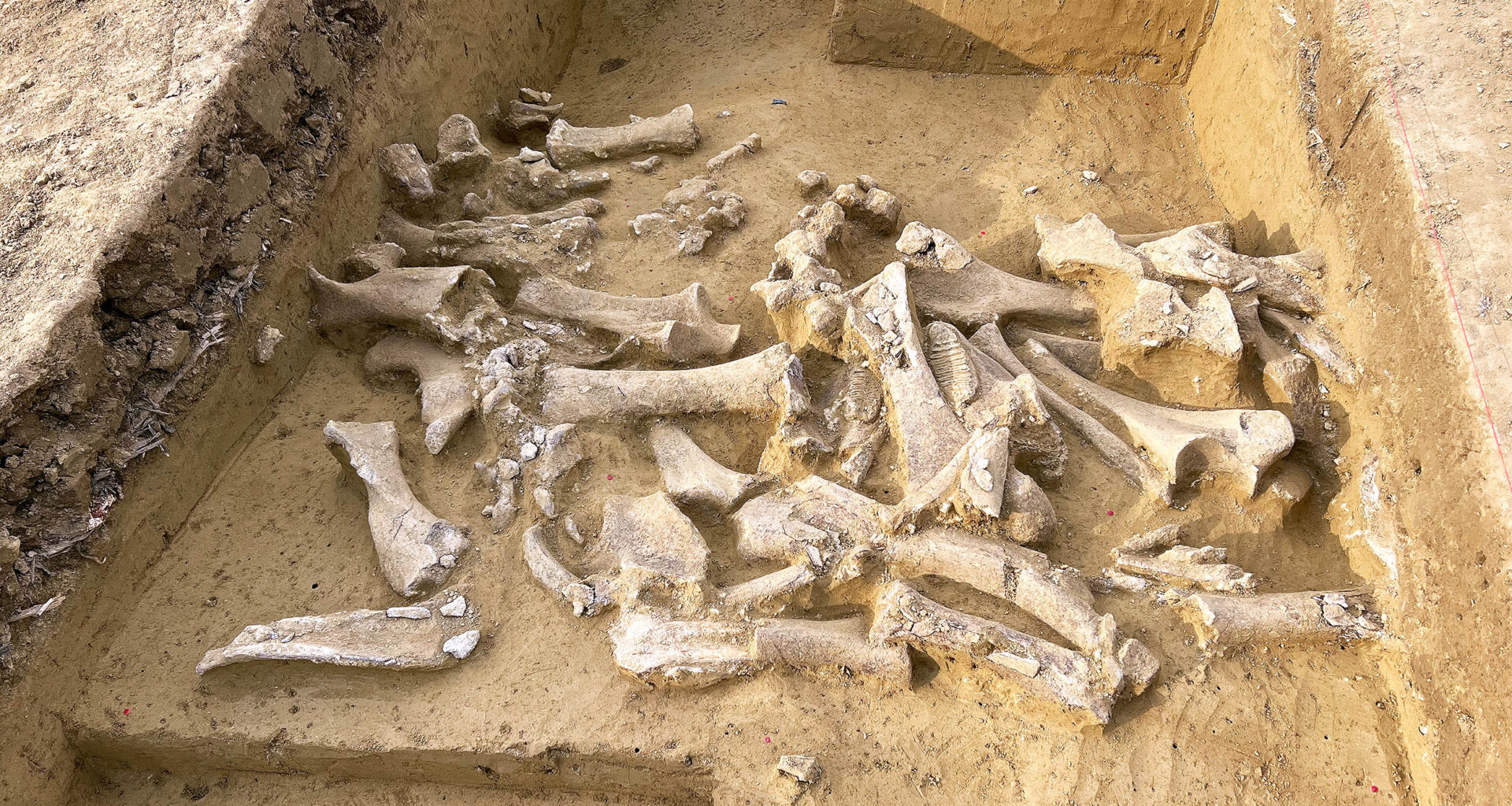
Ice Age people left heaps of mammoth bones behind them, sometimes hundreds of animals in one spot. Most of those mammoths were female.
The mammoths that died far from any camp, out on the open grassland, were mostly male.

Hunters may have chosen the females, or they may simply have met them more often.
Hannah M. Moots of the Centre for Palaeogenetics in Stockholm led the study.
The researchers worked out whether each of 521 woolly mammoths was male or female by analyzing DNA in their teeth, tusks, and bones.
No team had read the DNA of 448 of mammoths before.
Bone piles that couldn’t be explained
The bones of dozens of mammoths lie together at some of these sites. Researchers have been studying them since the 1880s.
“Whether these massive mammoth bone accumulations were formed naturally or by human hunting has been debated for decades,” said David Díez-del-Molino of the Centre for Palaeogenetics.
Piles can form with nobody involved. Animals walk into tar pits like the ones at La Brea, or a slope collapses on them, and the bones survive.
The animals that die that way are mostly male. In 2017, Patrícia Pečnerová and several of the same researchers reported in Current Biology that 69 percent of scattered mammoth finds came from males.
A 2019 survey in the journal PNAS came out the same way for steppe bison and brown bears.
Males roam farther and take more risks, so they are the ones that end up somewhere the bones survive.
A pile made by a natural trap should therefore hold more males than females. A pile left by a river carrying bones from ordinary deaths should be close to even.
More females at every large site
Moots’s team split the 521 mammoths into groups determined by where each bone came from.
The scattered finds numbered 421, meaning bones, teeth, and tusks picked up more than 300 feet (100 meters) apart, or from layers separated by tens of thousands of years.
The other 100 came from 11 sites where mammoth bones lie together alongside traces of people.
Stockholm University dated these sites at roughly 30,000 to 20,000 years old.
Among the scattered mammoths, 280 were male and 140 were female. Among the mammoths from the bone piles, 70 were female and 30 were male.
Kraków Spadzista in southern Poland contributed the largest sample in the study, representing 26 mammoths, and females outnumbered males there as well.
Moots told Earth.com that the consistency was the first of two surprises. Every site with more than five mammoths in it came out the same way, across a huge stretch of Eurasia.
The team had to avoid counting a single animal twice, so they worked mostly from molars. A mammoth carries eight working molars at a time, two in each corner of the mouth.
Two matching teeth from the same corner cannot belong to one animal. Each sample began as 20 to 50 milligrams of powder, about the weight of one or two grains of rice.
Herds are easier to find
Moots believes the pattern reflects people repeatedly hunting or scavenging female mammoths. She shared two possible explanations with Earth.com.
“One possibility is that, if woolly mammoths lived in female-led herds like elephants today and behaved similarly, then they may have moved around the landscape in more predictable, seasonal ways than solitary adult males, making them easier to locate repeatedly,” Moots noted.
According to Moots, researchers have argued that people put some Ice Age camps along seasonal mammoth migration routes.
Female mammoths were also smaller than adult males, which makes size the obvious explanation.
“At the same time, female herds may actually have been more dangerous to approach because of their social behavior, so the answer is probably more complex than simply targeting smaller animals,” said Moots.
Females with calves may also have moved less, which would have made them easier to reach. A group that knew roughly where a herd passed each year also knew where to look for a carcass.
 Hannah Moots, Stockholm University, Department of Zoology. Click image to enlarge.Stone points in shoulder blades
People left marks on these bones that nothing else makes. At Mus-Khaya in Siberia, fragments of stone projectile points are embedded in mammoth shoulder blades.
At Kraków Spadzista, points are stuck in bones as well, and cut marks cover the remains.
Excavators at Langmannersdorf in Austria have recorded impact marks, breaks made while the bone was still fresh, charred fragments, and stone tools.
“We know that Upper Palaeolithic hunter-gatherers sometimes hunted mammoths directly, as evidenced by projectile points embedded in mammoth bones, and they may also have scavenged material from carcasses,” said Jarosław Wilczyński, an archaeologist at the Polish Academy of Sciences.
Tooth marks and gnawing traces from carnivores are scarce in these piles, which suggests people kept other animals off the carcasses while they worked.
These piles are also bigger than the sampled numbers suggest. Zooarchaeologists counting molars at Kraków Spadzista put the site’s total at 113 mammoths or more, and the team sampled 26.
At Předmostí I in the Czech Republic, molars from more than a thousand mammoths have been counted, and three were sampled.
One mammoth had a single X
One animal in the set had neither of the usual two patterns. About half of its cells carried a single X chromosome, and the rest carried two. The bone came from Wrangel Island, in the Arctic Ocean off northeastern Siberia.
Asked by Earth.com what surprised the team most, Moots named this animal as the second of the two.
In people, Moots noted, the same mix is similar to a rare condition called Turner syndrome. “We certainly weren’t expecting to find that,” she said.
Earlier work compared the X chromosome against the rest of an animal’s DNA. Moots’s team added the Y, which is why they spotted the animal at all.
The bone was too broken up for anyone to look for physical signs of the condition.
Researchers have found the same mix in ancient human skeletons over the past few years. As far as the authors know, nobody has reported it in an extinct species before, and they expect more to appear as these studies get bigger.
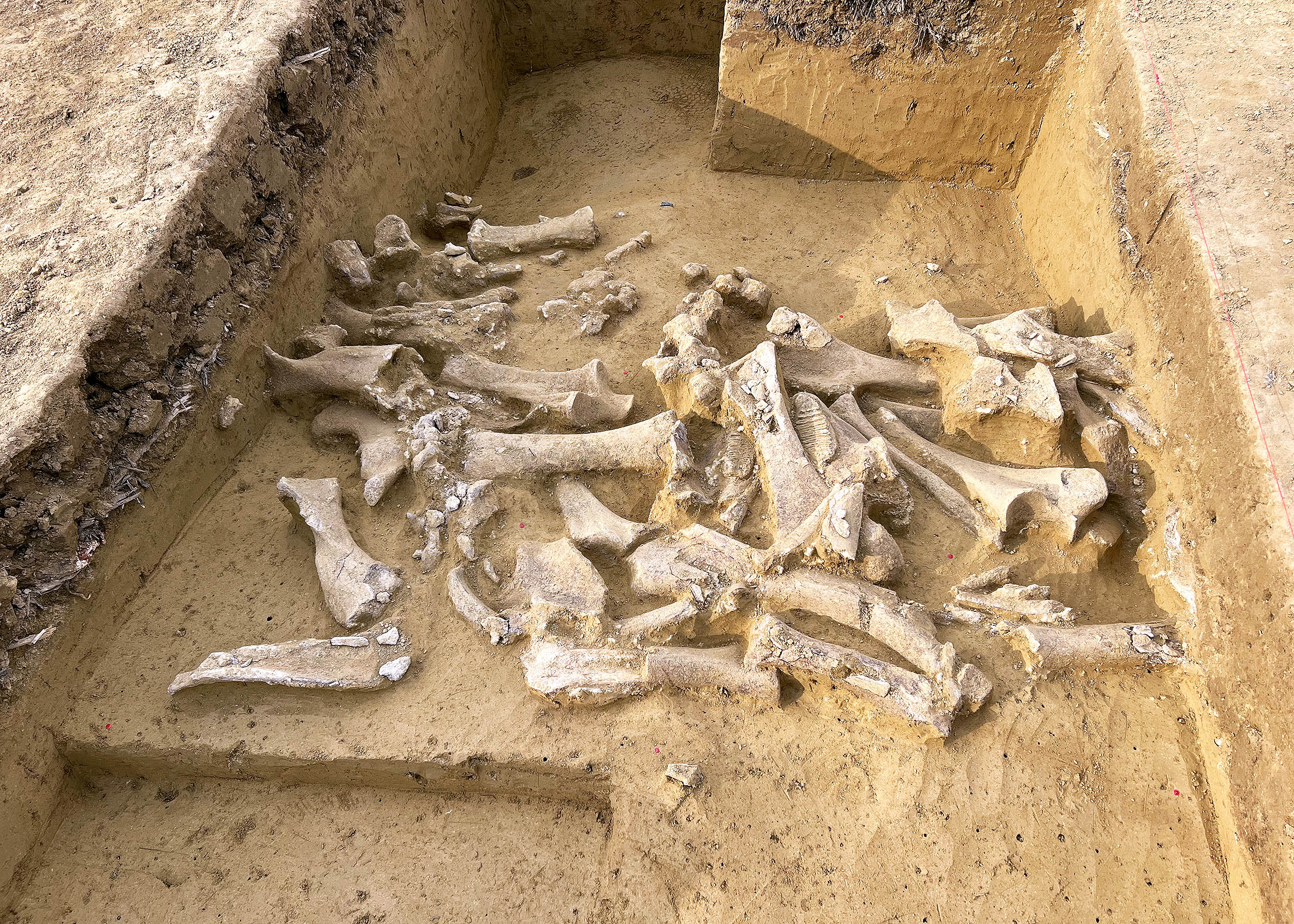 Excavation in Langmannersdorf 2025. Photo: Marc Händel/Austrian Academy of Sciences. Credit: Marc Händel/Austrian Academy of Sciences. Click image to enlarge.No natural pile to compare against
No one has yet run the same test on a mammoth bone pile that everyone agrees formed on its own. There is no natural pile to hold these 11 sites against.
Researchers have run the test on one comparable set: Columbian mammoths, a different species, from an old river deposit in the Basin of Mexico. Eighteen were female and 25 male, close to even.
Some of the scattered mammoths may have been killed by people too. The team left out every find with a known link to human activity. But a bone with no such link can still have come from a hunt nobody can detect now.
A pile full of females does not prove anyone hunted herds, either. The animals may have behaved in ways that produced the same pattern with no people involved. The country they lived in could do the same.
Furthermore, some bones survive to be dug up while others rot, which changes what any count of this kind can show.
Moots’s team did not work out how old the animals were when they died, and age would test the herd idea directly.
Ages and travel routes come next
Male elephants leave their mothers’ groups at around 13 to 15 years. If the males at the scattered sites turn out to be older animals traveling alone, that fits the herd explanation.
The team is now reading DNA from more animals at Kraków Spadzista, Dolní Věstonice in the Czech Republic, and Langmannersdorf.
“We’re also planning to integrate our results with other types of information, so our team includes a zooarchaeologist who is estimating the age of each mammoth and another colleague who is using strontium isotopes to study mobility,” said Moots.
“And our colleagues are continuing to excavate these sites, so there is new archaeological evidence to incorporate as well.”
Strontium comes out of the local bedrock into plants, then into the animals that eat them, and it gets built into a tooth as the tooth grows. Researchers can read that record back to work out where an animal traveled.
One team has already traced a female woolly mammoth’s lifetime movements to an ancient hunter-gatherer camp in Alaska.
The full study was published in the journal Current Biology.
—–
Like what you read? Subscribe to our newsletter for engaging articles, exclusive content, and the latest updates.
Check us out on EarthSnap, a free app brought to you by Eric Ralls and Earth.com.
—–