
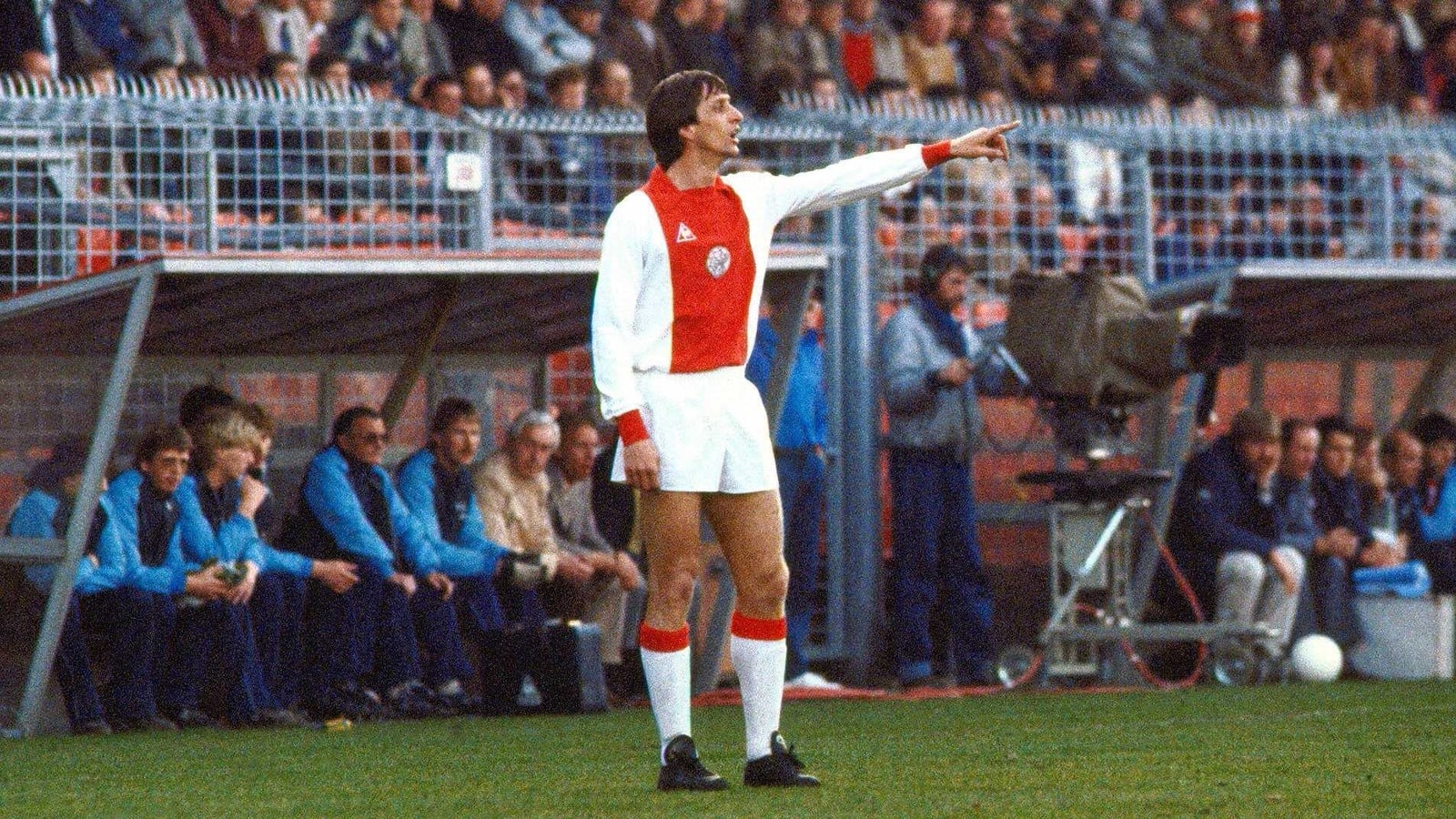
When Shelbourne step onto the pitch at the Johan Cruyff Arena for the first time, John Russell and his players will warm up underneath banners representing different moments in Ajax’s history.
There’s banners dedicated to their 36 league titles, others to their European Cup successes and some to show their victories in the Intercontinental Cup. The unifying theme is how they were achieved, with the club’s guiding philosophy.
It’s based around the manipulation of space, pressing high, and passing the ball while giving youth a chance. Rinus Michels was the pioneer, Stefan Kovács took it to the next level and Louis van Gaal brought it into the modern age.
Johan Cruyff was its greatest disciple, with the midfielder using it to win Barcelona their first European Cup in 1992.
It’s the Ajax DNA, something that is instilled in young players in an environment designed for progression to senior football. Proof of its success is the academy boasting stars like Dennis Bergkamp, Frank Rijkaard, and Marco van Basten as alumni.
This is the Ajax everyone knows, and was reminded of in 2019 when the club reached the semi-finals of the Champions League by knocking out Real Madrid and Juventus under the instructions of Erik ten Hag.
Shelbourne played in the League of Ireland First Division that year, their sixth season in the basement. All the club wanted was promotion, and an opportunity to live up to the history promised by their trophy cabinet and previous European bouts with clubs like Barcelona, Atlético Madrid, Rangers, and Rosenborg.
This week, Shelbourne will get that chance when they step out to face Ajax at one of the great cathedrals of world football.
There was a time when both clubs existed in different worlds. Now they exist on a level playing field, in the same competition.
How Shelbourne got to this point is simple – the club finished third in the League of Ireland and overcame Nõmme Kalju over two legs.
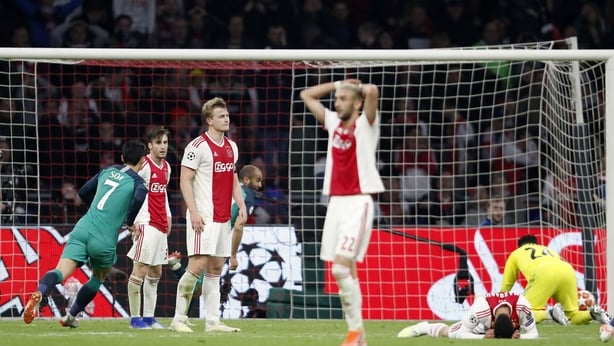
Ajax were dramatically beaten in the 2019 Champions League semi-final
It’s different for Ajax, and goes beyond a pathway that involved the Eredivisie’s European competition play-offs and a victory over Serbian side Vojvodina.
Their slow slide from the semi-finals of the Champions League into the third qualifying round of the Conference League involves a long term sense of malaise combined with a desperation to win again.
The first symptom of this sickness was the quick departures of the Class of ’19. Matthijs de Ligt and Frenkie de Jong were the first, signing for Juventus and Barcelona. Lasse Schöne and Daley Sinkgraven followed, joining Genoa and Bayer Leverkusen. More left during the summer of 2020, as Joël Veltman moved to Brighton & Hove Albion and Hakim Ziyech to Chelsea.
One by one they were picked off, while Ajax struggled to keep up with the pace of the brain as they sought to combine proven talents with academy prospects.
Some would say this was Ajax regressing to the mean after flirting with the modern Gods of European football, where the flags are mostly English, German, and Spanish.
Then came the resignation of Marc Overmars as director of football over inappropriate behaviour towards female colleagues.
Ten Hag left shortly after, to take over Manchester United after leading Ajax to three league titles in four seasons.
The following year saw Edwin van der Sar step down as CEO, just as Feyenoord claimed their first national championship since 2017.
Ajax weren’t their closest rivals that season, they finished 13 points behind the Arne Slot machine in Rotterdam.
Instead of the summer of 2023 being a fresh start – Overmars and Van der Sar leaving actually made things worse, according to De Telegraaf journalist and Dutch football expert Marcel van der Kraan.
“Two of the big giants, both former players, with the DNA of Ajax and knowing how it works falling away led to other people becoming in charge,” he told BBC Sport.
“That, when you want to keep the culture of a club together, has cost them a lot.”
The centre could not hold and Ajax unravelled over the next three seasons, while PSV claimed a hat-trick of titles between 2024 and 2026.
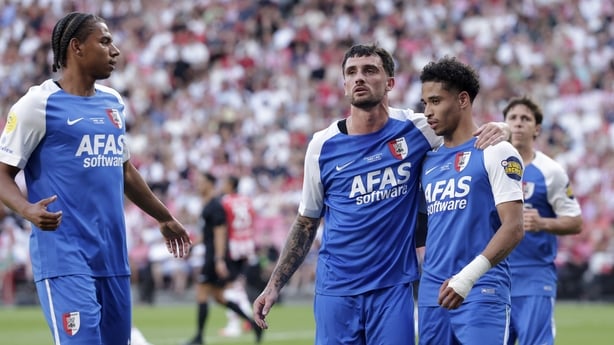
PSV have replaced Ajax as the top side in the country
This cut off a straightforward path to the Champions League, meaning less prize money and broadcast revenues.
The finance side of things was already a concern at that point. Sven Mislintat, during his brief stint as director of football in 2023, was tasked with cutting expenditure after the club fell into the Europa League earlier that year.
It all felt like a massive snowball and each new season seemed to mark a new low for the club.
The 2023-24 campaign saw just two league wins in ten games, including a 4-0 hammering by Feyenoord at the Johan Cruyff Arena.
There was a small uptake in form in 2024-25, but the club ended up blowing a nine-point lead at the top of the league and lost the trophy to PSV on the final day.
Last season was all about just qualifying for Europe, something achieved through the play-offs while the major domestic honours went to PSV and a Troy Parrott-inspired AZ.
Coaches were made to pay, with ten different figures sitting in the dugout between 2022 and 2026. No one seemed to have the right answer, as the squad seemed to get younger and younger.
It became a cycle, where a young unproven squad met expectation and no one was able to take control of the situation.
Jordi Cruyff, the son of club legend Johan, has now been installed as director of football, with the long term aim of realigning the club’s structures with their overarching philosophy.
The Premier League winner with Manchester United has a massive job on his hands, and it will be measured by how close Ajax gets to following in their own footsteps.
Shelbourne are their latest obstacle, a club that have come back and know how long that journey takes.
Dylan O’Connell is the author of ‘The Ajax Way’