
The scheduling of the intercounty season has always been one of the most difficult puzzles facing Gaelic games.
You’re trying to fit 5 litres of water into a 4-litre jug; something is always going to overflow.
This weekend’s All-Ireland camogie finals complete a run of four consecutive Sundays featuring the biggest days in Gaelic football, hurling, ladies football and camogie.
While that creates a feast of action for supporters, it also leaves the four codes competing for attention during a condensed summer calendar. Extending the intercounty season further into the year would then narrow the window available for club competitions.
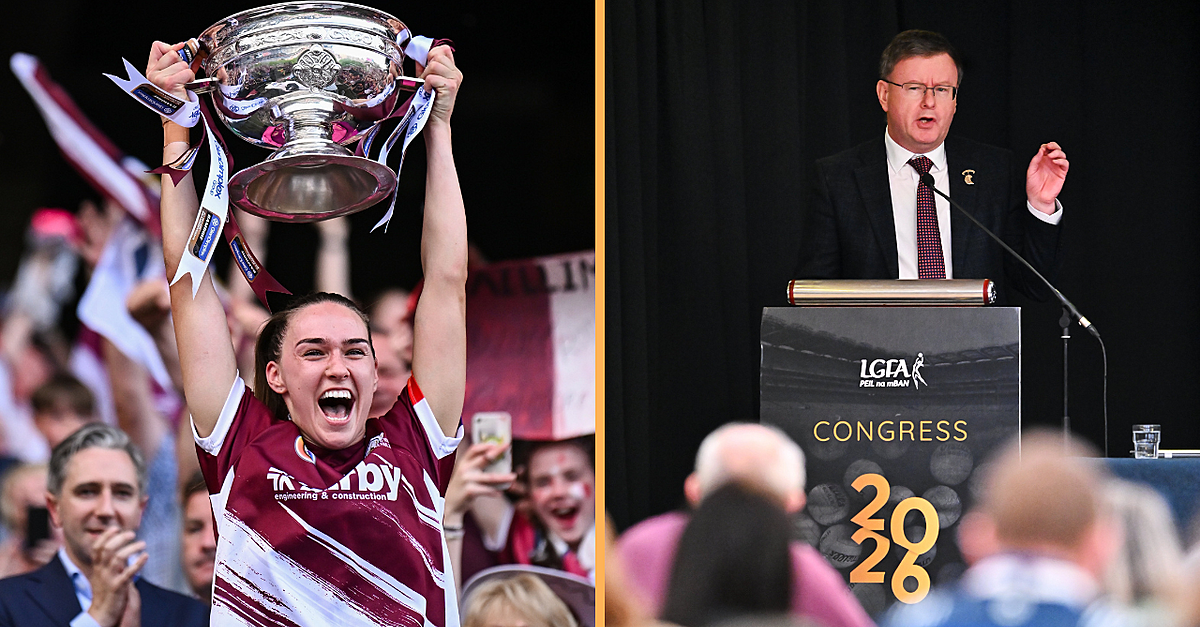
Camogie Association president Brian Molloy believes one potentially radical solution may be worth revisiting: flipping the camogie calendar entirely.
Under that model, the club championship would take place during the summer before the intercounty championship began in autumn and concluded with the All-Ireland finals in early winter.
It would place camogie’s flagship competition at the opposite end of the calendar to the GAA and LGFA seasons, providing it with a clear window largely free from competing intercounty fixtures.
Radical Camogie Proposal Could Bring Drastic Change To All-Ireland Final Date
Recommended
Speaking ahead of Sunday’s All-Ireland finals at Croke Park, Brian Molloy explained that the Camogie Association had previously explored such a change.
I think there are things we can look at.
Camogie put forward a proposal – most people would have forgotten about it – whereby we were going to operate on the basis of switching or flipping it over, playing our club games during the summertime and switching the championship to the autumn and early winter.
It is interesting that I think some of the players now would think that makes sense, but at the time there was pushback from the GPA. They did not want that, and we put it out to our members at that stage.
We may look at things like that again. We will look at anything within reason that we can do which does not put too much load on a club player, but at the same time gives our games the maximum opportunity to get coverage, participation and attendance.
A winter All-Ireland would inevitably bring challenges. Poorer weather and the absence of the traditional summer build-up could make attracting a large crowd to Croke Park considerably more difficult, it would also make life very difficult for dual club players and totally untenable for dual county players.
However, it could also offer camogie a valuable period in which there would be far less competition for media coverage and public attention.
The idea is not entirely without precedent. The delayed 2020 championship took place during the closing months of the year, with Kilkenny defeating Galway in an All-Ireland final played behind closed doors at Croke Park on December 12.
There is value to it.
We had All-Ireland finals during Covid. We had an All-Ireland final at that time of the year and there was no attendance, obviously, because of Covid, but it worked in terms of the overall season.
It is not that it cannot work at that time of the year. It is not as easy to get people out. If we are lucky enough to get a sunny day on Sunday, you get a lot of walk-ins. Are you going to get walk-ins in the first week of December? Not so much.
On the other hand, there are no competing fixtures going on at that stage of the year. There are pros and cons to whatever you do. It is very hard to get the absolute right balance.
The current split season has provided greater certainty for club players, but it has also created a squeeze on intercounty action.
Molloy outlined how moving the All-Ireland finals back into September would shorten the club season. Extending the club campaign into the opening months of the following year would then cause difficulties for the National League and third-level competitions.
If you push the finals out into September, for example, then you have a very narrow club season.
If you then say, ‘We will extend the club season so the finals are not played until January, February or March,’ you have a problem regarding when you start your National league and how you manage third level.
There is no easy way of doing it when we have moved to a split model.
No decision on such a change is imminent, and Molloy stressed that players and counties would be central to any future discussion.
However, he confirmed that the association remains willing to consider a significant departure from the traditional Gaelic games calendar if it can provide camogie with a stronger platform.
Are we open to looking at alternatives? Absolutely.
We will do it in conjunction with the players and the counties and make sure that we are all on the same page whenever we do it.
Tickets for this Sunday’s All-Ireland Camogie Finals are available here
SEE ALSO: From Barely Ten Players To Croke Park: Cavan Camogie’s Remarkable Revival
SEE ALSO: Shauna Healy’s Remarkable Galway Return Just Four Months After Giving Birth