
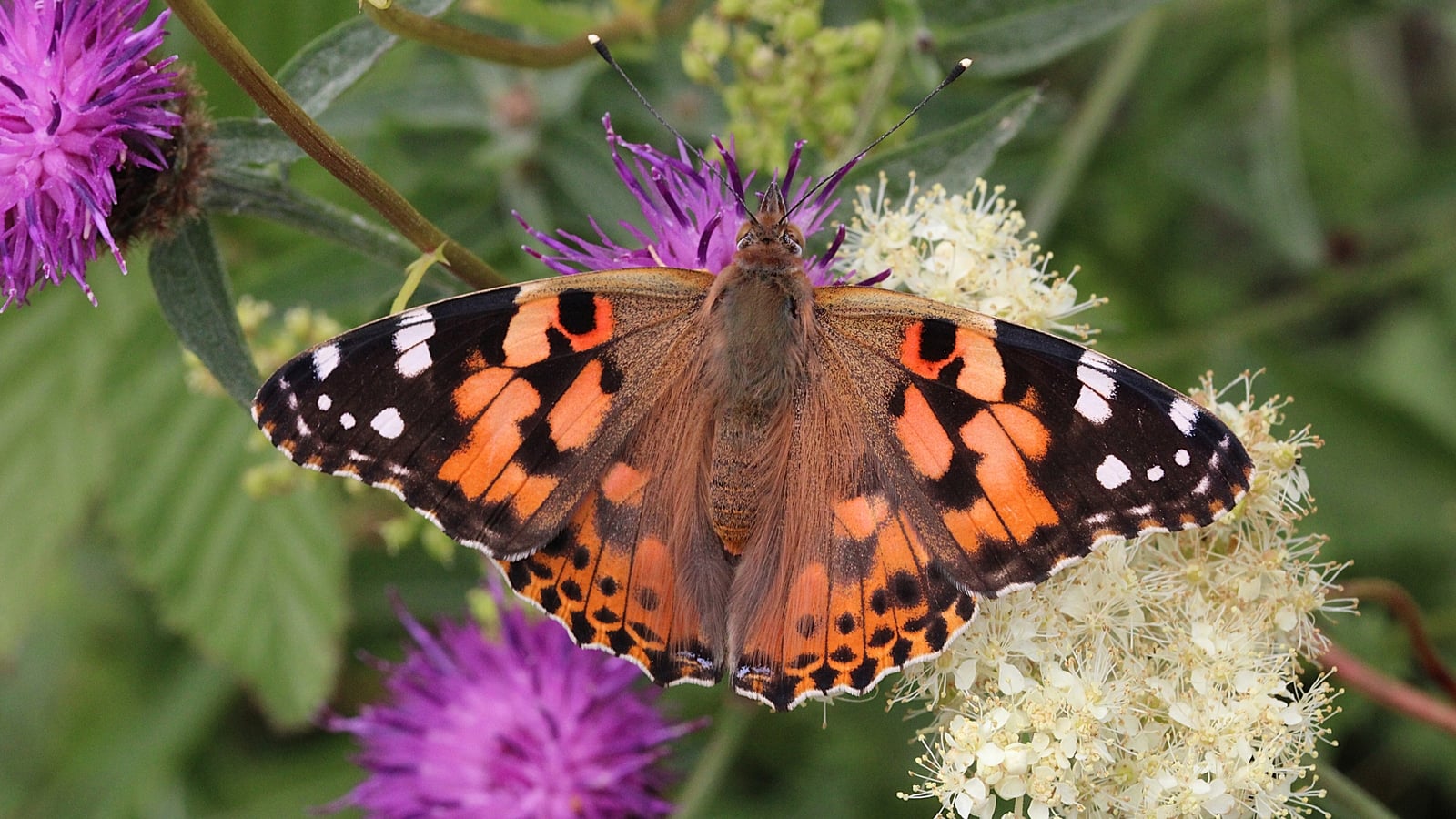
Analysis: Native Irish butterflies may have declined in population since 2008, but migrant butterflies are increasingly attracted here by weather, climate and habitat
By Jesmond Harding, Butterfly Conservation Ireland
Last year, in my article for RTE Brainstorm entitled, ‘Why are we seeing more butterflies in 2025?’ I wrote:
After a wet summer in 2023 and a cold summer in 2024, when butterfly numbers crashed, a rebound in butterfly numbers in 2025 was certain to be noticed and appreciated by nature lovers. The decline in 2024 was strongly evident in butterflies that visit our gardens and parks so the extent of the 2025 increase must be considered against our experience during the summer of 2023 and 2024. However, the increase in populations in 2025 is real.
I added that weather is a key impact on butterfly populations, with the warmth allowing adults to feed, mate and lay eggs, and the immature stages develop more quickly in warm conditions, shortening development time, reducing losses from predation. In 2025 we avoided extreme winter heat, and prolonged extreme rainfall, and drought, which damages butterflies. Warmth with normal rainfall during spring and summer is generally a positive for Irish butterflies.
Butterflies entering 2026 had the advantage of 2025’s beneficial weather conditions. However, a deeper and more relevant issue is how are our butterfly species performing over the longer term. We assess butterfly populations in Ireland against 2008’s populations, because 2008 is the year that systematic population monitoring began.
In that year, the National Biodiversity Data Centre established transect monitoring. This involves counting butterflies encountered within an imaginary 5m2 ‘box’ along a fixed route once a week between 1 April and 30 September. When this standardised counting methodology is applied on the same site over time, a clear picture emerges of the population trends in our commonest, more widespread butterfly species. Using this transect method, we have robust data on the populations of our 15 commonest butterflies (Ireland has 35 species, three of these are annual migrants, 32 are year-round residents).
We need your consent to load this rte-player contentWe use rte-player to manage extra content that can set cookies on your device and collect data about your activity. Please review their details and accept them to load the content.Manage Preferences
From RTÉ Radio 1’s CountryWide, Jesmond Harding makes the case for conserving habitat for creatures like the Marsh Fritillary butterfly
Weather and climate exert its influence, but butterflies are extremely sensitive to habitat availability and quality. Resource availability is crucial to any living thing, including butterflies. The Status of EU Protected Habitats and Species in Ireland 2025, a report required by the European Commission under Article 17 of the Habitats Directive, published every six years, found that that 90% of habitats remain in Unfavourable status, with half showing ongoing declines.
Many of these habitats, such as Molinia meadows, Alkaline fens, Orchid-rich calcareous grassland and the various dune and heath types listed are very important for butterflies. The unfavourable condition of EU priority habitats, together with highly intensive farming systems in most of Ireland, suggest that butterfly populations should be struggling. The most recent data from the National Biodiversity Data Centre confirms the ongoing decline in our butterfly populations.
What is the butterfly count data telling us?
No resident Irish butterfly has shown an increase in its population since 2008. Only one butterfly, the handsome migrant Red Admiral Vanessa atalanta, has increased its population. That’s one out of 35 species.
We need your consent to load this rte-player contentWe use rte-player to manage extra content that can set cookies on your device and collect data about your activity. Please review their details and accept them to load the content.Manage Preferences
From RTÉ Radio 1’s Mooney Goes Wild, are butterflies finally flying high again?
Results from multi-species index of the 15 most common butterfly species show a decline of -65% in the population of butterflies in 2025 when compared to the baseline year of 2008.
In most common butterflies, the declines are alarming. The figures for two white butterflies that most of us know, commonly called the ‘cabbage whites’ underline the falls. The Large White Pieris brassicae has declined by -70% during the period 2008-2025. The Small White Artogeia rapae is down by -75% and one of Ireland’s commonest butterflies, the Green-veined White Artogeia napi, showed a decline of -84% from the 2008 baseline. Fourteen out of 17 species showed declines in 2025. Three were stable.
When assessing population status for red lists, declines greater than or equal to 50% meet criteria drawn up by the International Union for the Conservation of Nature (IUCN) for the ranking of Endangered, while a decline greater than or equal to 80% meets the criteria for Critically Endangered. Applying the IUCN criteria to the percentage declines during 2008-2025, 12 of our 35 species are Endangered or Critically Endangered, or 34% of our butterflies. This does not include those ranked Vulnerable (declines greater than or equal to 30%).
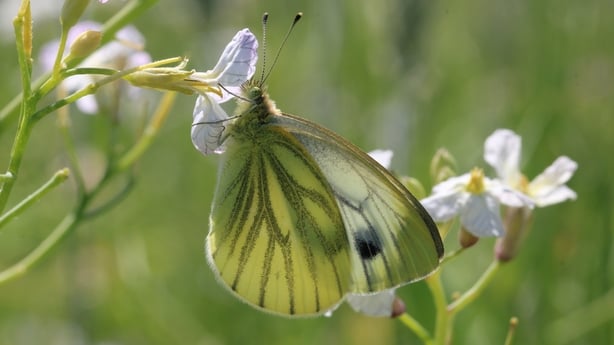
The Green-veined White is a widespread species in serious decline. Photo: Jesmond Harding
The strong decline of widespread butterflies is of great importance because it shows that the environment in general is in poor condition. It is part of the ‘great thinning’, the steep but often unnoticed loss of everyday abundance in the natural world, a concept expressed by Michael McCarthy in his remarkable book, The Moth Snowstorm, an ironic title referencing the absence of the greasy film that once coated car windscreens following a rural drive at time when insect life was abundant.
We lack sufficient data to assess the population of our more localised (and habitat specialist) species, like the Hedge Brown Pyronia tithonus which An Atlas of Butterflies in Ireland 2010-2021 shows has lost 40% of its pre-2010 distribution. This butterfly now exists in the south of just four counties: Wexford, Waterford, Cork and Kerry and we fear it might since have been lost from County Waterford and is confined to a single site in Wexford (Ravenwood, where a threat to change its habitat by clear-felling trees was recently averted).
Why you’re seeing lots of butterflies this summer
We are seeing plenty of butterflies, but many of them are migrants. As of 2 August, 8,733 individual butterflies have been reported to the National Biodiversity Data Centre, Waterford. However, 24% of this total are three migrants: Clouded Yellow Colias crocea 163, Red Admiral 807, and Painted Lady Vanessa cardui 1135.
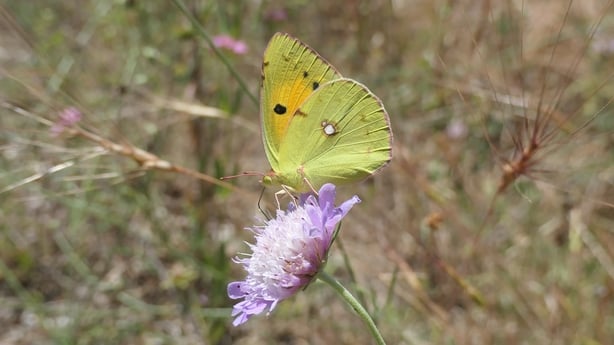
The Clouded Yellow is showing in higher numbers in Ireland than it has for over 20 years. Photo: Jesmond Harding
Their arrival in Ireland depends on circumstances outside Ireland. The extreme heat and drought in southern and central Europe desiccate their larval foodplants which means they must move to cooler, wetter places to breed, because these species have no rest phase (like hibernation or aestivation (a state of dormancy when an animal’s metabolic rate drops significantly in response to heat and or dryness)) in their life cycle.
That is not to say that Ireland does not provide excellent conditions for these migrants to breed. All three migrant butterflies are habitat generalists, which means they can appear anywhere. The Clouded Yellow and Painted Lady have many larval foodplants, while in Ireland the Red Admiral relies on one common plant for its caterpillars, the Common Nettle. All three are mobile, beautiful and charismatic. All visit cultural environments, enjoy nectar and will happily breed in our gardens and parks provided trefoils, clovers, thistles and nettles are spared the mower’s pursuit of geometric uniformity.
We need your consent to load this rte-player contentWe use rte-player to manage extra content that can set cookies on your device and collect data about your activity. Please review their details and accept them to load the content.Manage Preferences
From RTÉ Radio 1, how to attract bees and butterflies to your garden
Threats to our butterflies
Indeed, landscape simplification is a major threat to our butterflies. Landscape simplification refers to the reduction of natural diversity and structural complexity in an environment, often driven by intensive human land use like industrial agriculture or urbanization. This process involves the loss of varied habitats, and native species, leading to uniform ecosystems with lower resilience. This damaging simplification should cease and there is no reason to apply this to our farms, gardens, parkland and public land.
Ireland had the tenth highest rate of fertiliser sales among the 27 EU Member States in 2020 at 85 tonnes per 1,000 hectares of agricultural land. These inputs reduce plant diversity in grasslands, bringing the loss of nectar and larval foodplant resources for many of our butterflies and other invertebrate groups. In north-western Europe, habitat loss resulting from the intensification of agricultural grasslands and nitrogen deposition and pesticides in nature reserves are the biggest causes of the decline in grassland butterflies.
Some butterflies need more room
For some of our butterflies, simply having a site with the nectar for the adult butterfly and foodplants for their caterpillars is not sufficient for long-term survival. We have a group of butterfly species that live in separate locations but within connected networks. One example is the Marsh Fritillary Euphydryas aurinia butterfly. This is the only insect in Ireland that is legally protected.
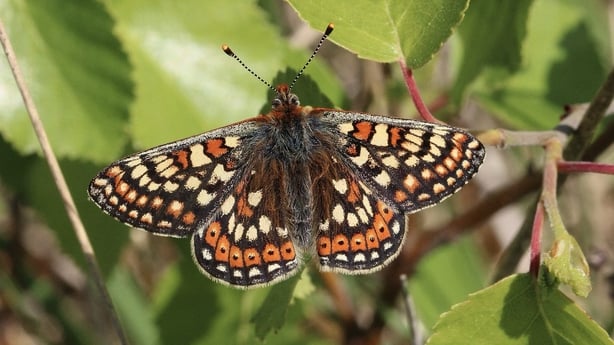
The Marsh Fritillary butterfly, the Bog of Allen. Photo: Jesmond Harding
The research indicates that this lovely black, cream, orange and red chequered butterfly exist as a metapopulation. This means that the butterfly lives in a colony, but it is connected to other populations within the landscape by dispersal of individual butterflies. The Marsh Fritillary can often go extinct on a site, often in response to adverse weather conditions or an explosion in the populations of parasitoid wasps. The site is re-populated when a mated female leaves her colony and lays her eggs in the unoccupied site. Reoccupation is likely if there are several habitat patches within a landscape within reach of the Marsh Fritillary, which is unable to fly long distances.
However, the butterfly disappears if the distance between colonies becomes too large. This occurs when land use changes and the habitat is removed. Protecting the Marsh Fritillary means protecting the landscape, not individual sites. It is no accident that it is rare or completely absent from areas of intensive farming, where grazing land is heavily fertilised and often re-seeded. The Marsh Fritillary is therefore absent from most the east of Ireland and intensive dairying areas in Cork, Limerick and Tipperary. In England, the figure of 50ha (½ km2) of suitable habitat within an area of 16km2 is indicated by Bulman et al. (2007) as required for the Marsh Fritillary’s long-term survival.
We need your consent to load this rte-player contentWe use rte-player to manage extra content that can set cookies on your device and collect data about your activity. Please review their details and accept them to load the content.Manage Preferences
From RTÉ Radio 1’s Mooney Goes Wild, Éanna Ní Lamhna speaks to David James, co-author of The Lives of Butterflies: a Natural History of our Planet’s Butterfly Life
Conserving species at a landscape scale is a considerable challenge given the intensification trajectory in Irish farming. However, high-native value state-owned land, especially wetlands such as the Bog of Allen in Northwest Kildare and East Offaly, can be used for the conservation of sensitive species. This is especially relevant as the state considers how to apply the Nature Restoration Regulation requiring the restoration of 20% of terrestrial (and marine) habitats by 2030. A national park established in the midlands, a region without a national park, would make a vital contribution to the conservation of rarer butterflies, moths and habitats.
A final point; the wet and warm conditions in June 2026 provided ideal conditions for the caterpillars of the Small Tortoiseshell Aglais urticae butterfly. From later in August, look out for large populations of this cheerful butterfly with an orange ground colour patterned with yellow, white, black markings topped off with blue shells edging the upper side of its wings, in our flower-rich places, including gardens. When fully-fed, this butterfly will enter hibernation, often in our houses, to wait for better times in spring.
Follow RTÉ Brainstorm on WhatsApp and Instagram for more stories and updates
Jesmond Harding is secretary of Butterfly Conservation Ireland. He is the author of The Irish Butterfly Book
The views expressed here are those of the author and do not represent or reflect the views of RTÉ