
Around 113 million years ago, most of the tiny, shelled plankton near the ocean surface died out.
Their shells became smaller and thinner before many species disappeared from the fossil record.

A deep ocean core shows that their close relatives living on the seafloor came through the same stretch almost unchanged.
Plankton stopped growing shells
Planktic foraminifera are tiny, single-celled organisms that drift through the upper ocean and build shells from calcium carbonate.
Some are no wider than a grain of sand, and they still fill the oceans today. They matter beyond just their own family.
Marine life builds about 5.8 billion tons of calcium carbonate a year, and this one group may account for up to half of it. Shells that small do a lot of the work in the carbon cycle.
Large plankton species with thickly built shells were common late in the Aptian age. However, in the Albian age that followed, those species were gone from the rock. What took their place is small and thin-walled.
Jonathan Chen and his colleagues at Northwestern University measured the calcium in shells from plankton on both sides of that boundary.
Calcium comes in slightly different weights, and the mix an animal locks into its shell depends on how fast it works. Slow builders end up with more of the heavy kind.
The Albian shells hold far more of the heavy kind than the Aptian shells do.
Plankton shells get smaller
Chen’s team has measured calcium in other periods when the oceans turned acidic. None of them looked like this one.
“The most striking finding from our analyses was the sheer magnitude of the increase in calcium isotope ratios of planktic foraminifera across this event,” Chen told Earth.com in an exclusive interview.
“Our team had already observed changes in calcium isotopes in studies of other ocean acidification events, but the shift in foraminiferal calcium isotope ratios across the Aptian/Albian boundary appears to be six to seven times larger than those previously documented changes.”
The physical fossils tell the same story. Shells get smaller, and fewer species remain.
The same stretch of rock holds the second-largest die-off in this group’s history. Other ocean extinctions played out in stages rather than all at once.
A single core off the Falklands
All of it comes from one hole in the seafloor, drilled on the Falkland Plateau in the southern South Atlantic.
The Deep Sea Drilling Project’s Site 511 holds a nearly unbroken record across the boundary, and the shells in it survived in good enough shape to test.
Chen’s team worked through plankton shell samples from about 1,690 to 1,465 feet (515 to 447 meters) below the seafloor, spanning 113.8 to 107.2 million years ago.
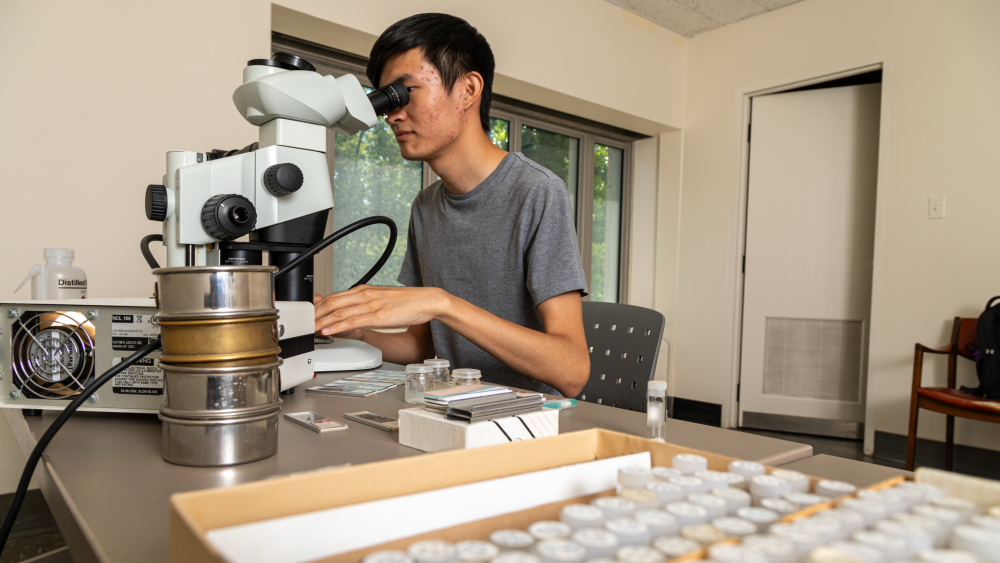
Brian Huber of the National Museum of Natural History and Kenneth MacLeod of the University of Missouri handled the fossils. Anna Waldeck, now at Penn State, ran the isotope work with Chen.
These are the first calcium measurements of their kind for the boundary.
Why the seafloor was spared
The carbon dioxide likely came from the Kerguelen Plateau, a volcanic province the size of a small continent in what is now the southern Indian Ocean. Much of it erupted in open air rather than underwater.
That detail matters. Gas erupted into the air reaches the ocean from above, so the surface turns acidic first and the deep water much later. Modern acidification is following the same route.
Foraminifera living on the bottom changed far less, and Chen’s team thinks the dying plankton above them were the reason.
Building plankton shells pulls alkalinity out of seawater, and alkalinity is what neutralizes acid.
When surface plankton sharply reduced their shell-building, more alkalinity remained in the water and eventually circulated downward, providing additional buffering capacity for the deep ocean.
The seafloor did not escape entirely. Near the boundary, a larger share of the bottom-dwelling foraminifera were species that glued sediment grains together to make their shells instead of building them from calcite.
Implications for today’s ocean
Ocean chemistry is changing again, and the surface ocean has already crossed a threshold researchers had set as a limit.
Andrew Jacobson, one of study’s the senior authors, said acidity has risen by about 30 percent in the past 200 years.
“More research is needed to quantitatively compare paleo-ocean acidification to modern-day ocean acidification,” Jacobson told Earth.com.
“We do not yet have a way to directly scale change in calcium isotope ratios to a percentage change in acidity, but we do know that the observed change in the calcium isotope composition of planktic foraminifera at the Aptian/Albian boundary is among the largest documented over the past 600 million years.”
There are still several things missing. No one has measured how much carbon dioxide was in the air at the time, and the Kerguelen eruptions need a firmer date.
The same calcium work also has to be done on other rock sections that cross the boundary, on land and at sea.
Chen’s team is already running those measurements at other extinction intervals, including the one where the dinosaurs died.
Jacobson said their records there “appear strikingly similar to the one documented for the Aptian/Albian ocean acidification event.”
If that holds up, the asteroid hit an ocean that was already in trouble.
The full study was published in the journal Science.
Image Credit: Northwestern University
—–
Like what you read? Subscribe to our newsletter for engaging articles, exclusive content, and the latest updates.
Check us out on EarthSnap, a free app brought to you by Eric Ralls and Earth.com.
—–