
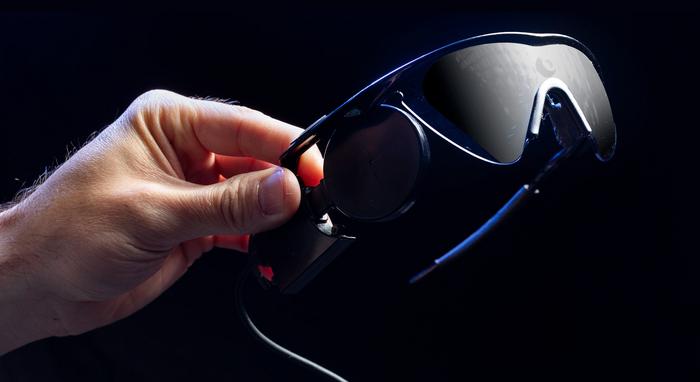
 © Matt Perko, UC Santa Barbara
Researchers from UC Santa Barbara, ETH Zurich, and Miguel Hernández University demonstrated that artificial intelligence models can optimise electrical stimulation in visual cortical prostheses (bionic eyes), improving the accuracy, efficiency, and predictability of artificial vision
Visual cortical prostheses or bionic eye skip the eyes and optic nerves entirely, delivering electrical stimulation directly to the visual cortex at the back of the brain. This approach offers potential benefits for individuals who lost vision due to traumatic brain injury, stroke, or neurodegenerative disease but retain a functional visual cortex.
Key mechanical challenges of traditional prostheses include:
Non-pixel behaviour: The brain does not process electrode signals as simple pixels; adjacent electrodes interact, and neural responses fluctuate over time.
Perceptual disconnect: Standard electrical stimulation settings fail to reliably predict what a user actually perceives (phosphenes, or spots of light).
AI-driven neural control and human trial
Published in Neuron, the study tested a deep-learning model on a 27-year-old blind participant in Spain implanted with a 96-channel cortical electrode array:
Predictive modelling: Researchers trained a deep neural network on actual brain activity responses rather than fixed electrical parameters, incorporating the participant’s resting brain state immediately prior to stimulation.
Improved efficiency: AI-designed stimulation patterns reproduced target brain activity more accurately while requiring significantly lower electrical current.
Perceptual accuracy: Recorded neural responses served as a far stronger predictor of perceived phosphene features (shape, size, brightness, colour) than raw electrode settings alone.
Adaptive systems for long-term usability
By integrating resting-state measurements and closed-loop neural feedback, the deep-learning framework allows the prosthesis to adapt to the individual user’s shifting brain states in real time, moving away from rigid, one-size-fits-all stimulation protocols.
“A useful visual prosthesis cannot rely on a fixed recipe,” Beyeler said. “It has to learn how an individual brain responds and adapt the stimulation accordingly. Ultimately, the device should adapt to the person, not the other way around.”