

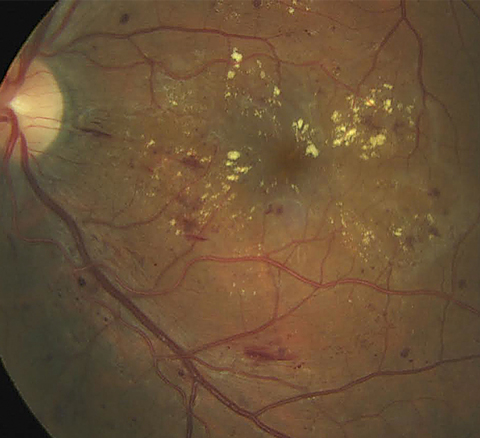
These findings suggest that encouraging patients to achieve better glycemic control and collaborating with endocrinologists before and during anti-VEGF treatment may improve the likelihood of a favorable response. Photo: Erik Hanson, MD. Click image to enlarge.
Despite being the first-line treatment for diabetic macular edema (DME), intravitreal anti-VEGF therapy isn’t effective in all patients; in fact, the authors of a recent study stated that “real-world survival analyses indicate undesirable treatment outcomes develop in approximately 50% of DME patients within 2.3 years of initiating therapy.” To help clinicians anticipate which patients are more likely to be non-responders, the team assessed various independent systemic risk factors and identified two key predictors: systemic metabolic status and baseline ocular morphology.
To conduct the retrospective cohort study, researchers analyzed 1,039 eyes from 691 patients with DME treated at a single center in China. All participants had type 2 diabetes and underwent three monthly intravitreal conbercept injections (0.5 mg). Researchers used OCT to measure central macular thickness (CMT) at baseline and one month after the third injection. Eyes were classified as responders if CMT fell by more than 10% from baseline.
The cohort had substantial metabolic burden at treatment initiation: mean age was 59.5 years, mean hemoglobin A1c was 8.87% and median fasting blood glucose was 172.63mg/dL. Hypertension was present in 48.19% of patients and coronary artery disease in 19.97%. Baseline median CMT was 325μm, and baseline median best-corrected visual acuity (BCVA) was 0.30.
After treatment, median CMT decreased from 325μm to 291μm, a median reduction of 17μm, while median BCVA improved from 0.30 to 0.40. However, only 41.5% of eyes were responders, while the remaining 58.5% were non-responders.
Analysis of the data revealed several independent predictors of poor anatomical response—defined as “failure to achieve a greater than 10% CMT reduction at three months”—including lower baseline CMT, higher baseline BCVA, elevated fasting glucose and elevated hemoglobin A1c.
“Collectively,” the authors wrote in their paper, “these findings underscore a fundamental principle: the local anatomical response to anti-VEGF therapy in the eye is not an isolated ocular phenomenon, but is intrinsically modulated by the patient’s systemic metabolic milieu.”
According to the researchers, it’s not surprising that markers of poor glycemic control (i.e., elevated fasting glucose and hemoglobin A1c) correlated to greater risk of inadequate treatment response. As they explained, “Sustained elevation of blood glucose drives the continuous overproduction of VEGF, thereby creating a state of persistent VEGF excess that may pharmacologically overwhelm or rapidly replenish the VEGF pool targeted by a three-injection loading course of anti-VEGF therapy.”
The authors conclude that these findings “underscore the importance of achieving favorable baseline metabolic and retinal conditions prior to initiating anti-VEGF loading therapy.” They added, “Future prospective studies are needed to evaluate whether targeted pre-treatment metabolic optimization—encompassing both glycemic and lipid control—can translate into measurable improvements in anatomical and functional outcomes in DME patients undergoing anti-VEGF loading therapy.”
Click here for the journal source.
This article was developed by the editorial staff in conjunction with experts in the field. In the process, AI may have been among the editorial tools used to meet the goals of human editors, who approved all content.