
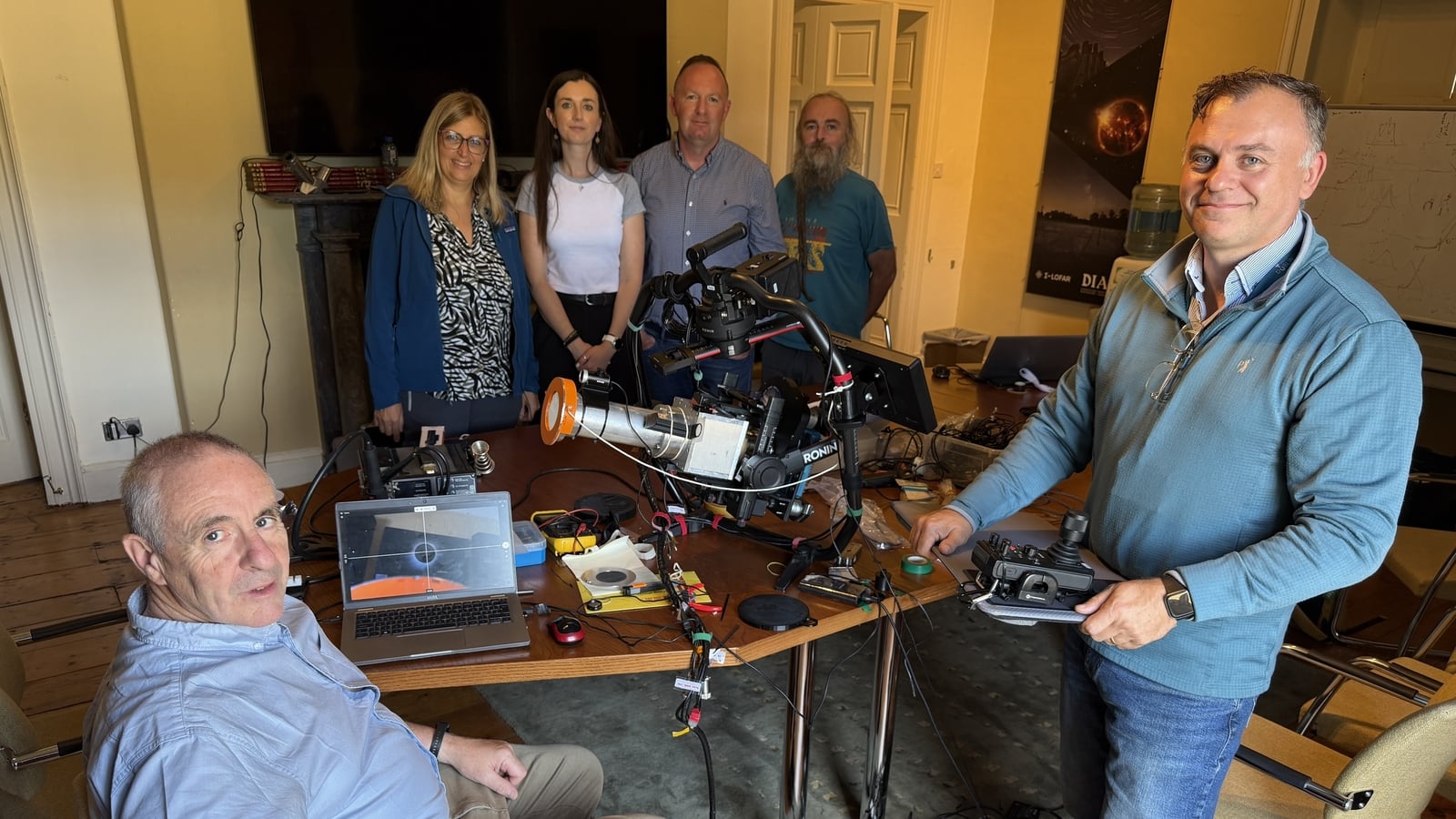
A group of Irish scientists are preparing for an aerial mission during tomorrow’s solar eclipse that will gather new information about the Sun.
The group, including astronomers from the Dublin Institute of Advanced Studies, will be flown towards Iceland by the Air Corp to record images of a total solar eclipse.
They are working with colleagues from the European Space Agency and Italy’s National Institute for Astrophysics to capture images of eclipse and help solve one of the great mysteries about the Sun.
The Air Corps is contributing by flying them out towards Iceland on a C295 Maritime Surveillance Aircraft.
Once in the right area to capture a total eclipse, the plane descends to 10,000 feet and the team opens a window.
This is so their specialised camera can get a clear shot of the eclipse without the distortion caused by filming through glass.
Preparations have been under way for more than a year and the team will have just two minutes to capture their data.
Dr Laura Hayes, Assistant Professor at DIAS, will be holding the camera on a specially designed gimbal.
“So it’s of course a bit nerve-wracking, but we’ve been preparing,” she said.
She added: “We’ve already had two test flights and our camera will actually work in a pre-programmed sequence and taking all these images in sequence.
“So the plan is, even though it’s only two minutes, we’re going to be there early.”
The camera they are using has been specially designed to capture images of the corona, the inner part of the Sun’s atmosphere which is clearly visible as the disc is obscured during an eclipse.
This is an area which has puzzled scientists for decades.
Temperatures in the corona reach millions of degrees, thousands of times hotter than the surface of the Sun.
Scientists in Italy designed a camera which captures images of the corona, which will help to analyse the magnetic fields which are an active feature.
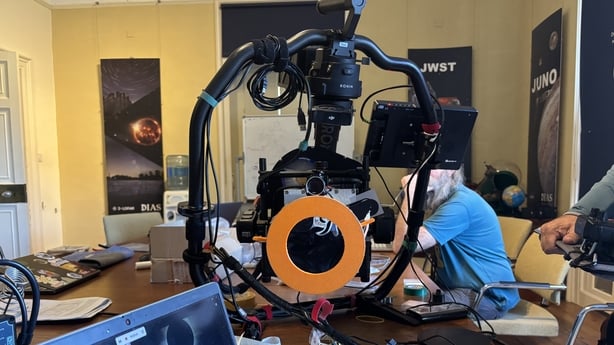
Dr Lucia Abbo, from Italy’s National Institute of Astrophysics, is one of two Italian scientists working on the eclipse flight.
Dr Abbo said: “This camera, this telescope, is called E Cormag, and it is for observing in white light with two filters in white band and in a specific spectral line called Iron 14.
“The green line, which is very famous for the high temperature which (it) reveals in in the corona.
“Another important point of this instrument is the polarisation because we catch the light from the solar corona during the solar eclipse, and thanks to the polarimeter inside the instrument, we filter some special photons in a special angle polarisation, and from that we can have information about the morphology of the magnetic field.”
E Cormag was constructed using parts made for space telescopes, including those on the Solar Orbiter.
The orbiter will also be recording images from space during the solar eclipse and NASA will also be using an airplane to get data from another angle.
Peter Gallagher, Director of the Dublin Institute of Advanced Studies at Dunsink Observatory, said that the agencies will share their data.
“The mission of DIAS is to do international research, to do the best international research and to do that we work with the European Space Agency and with NASA and we work with the biggest telescopes in the world,” he said.
The hope is that pooling of research data will help solve that long standing solar mystery.