
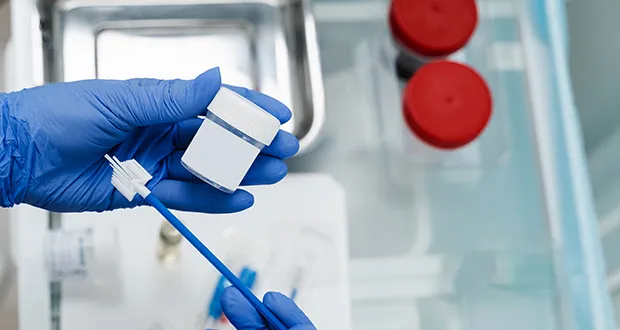
Plans to ramp up national testing after CervicalCheck controversy highlighted a lack of oversight of overseas laboratories
Almost one-in-four CervicalCheck samples were tested in Ireland last year, new figures reveal.
The National Cervical Screening Laboratory (NCSL) processed 22.85 per cent of samples taken in both community and colposcopy settings across the country last year. The remainder were taken to laboratories outside Ireland for testing.
The 2025 figure shows that the proportion of samples kept in Ireland for initial testing has risen since the NCSL opened its doors in December 2022.
In 2024 15.3 per cent of samples were tested there, while in 2023 this figure was just 3.63 per cent.
The data was supplied by the National Screening Service (NSS) after a parliamentary question from Social Democrats TD, Jen Cummins.
In the response, NSS chief executive Fiona Murphy said that, over time, the NCSL will become the ‘primary lab provider for CervicalCheck’.
The 2018 CervicalCheck controversy – where more than 200 women with cervical cancer had the results of an audit highlighting previous incorrect smear test readings withheld from them – shook confidence in the system and highlighted the high dependency the service has on US-based laboratories.
A scoping inquiry by Dr Gabriel Scally, carried out in the wake of the crisis, found that CervicalCheck had ‘insufficient understanding’ of the testing process being carried out abroad. However, it did find that laboratories used by the service met their country’s regulatory requirements.
Since then, the opening of the NCSL, located on the campus of Dublin’s Coombe Hospital, has allowed for more samples to be tested in Ireland.
Each sample is tested for 14 types of human papilloma virus (HPV) that can cause cervical cancer.
When HPV is found two specialist medical scientists examine the sample for abnormal cell changes. Where an abnormality is detected by either medical scientist, a consultant cytopathologist reviews and authorises the result.
“We also CervicalCheck samples to Quest Diagnostics Inc. in the USA,” added Ms Murphy. “A second laboratory is key to the delivery of a quality-assured national population cervical screening programme.
“This approach ensures the necessary safeguards in the event of the primary laboratory ever being disabled and is endorsed by the Review of the Implementation of Recommendations of the Scoping Inquiry into the CervicalCheck Screening Programme (2022).”
She added: “Both laboratories meet the same quality-assurance standards and women can be reassured that the same high-quality level of service is provided by both. Having the services of two screening laboratories provides in-built contingency arrangements where one provider can act as a contingency if there is a prolonged service outage in the other.”
Through screening and HPV vaccination, the incidence of cervical cancer in Ireland has fallen from 15 cases per 100,000 women in 2009 to 10.4 cases per 100,000 today.
Ireland has committed to eliminating cervical cancer in this country by 2040. Marking the first World Cervical Cancer Elimination Day last November, health officials said that the country is on target to bring cases of the disease down to four per 100,000 within 15 years – the threshold required for cervical cancer to be considered eliminated.