
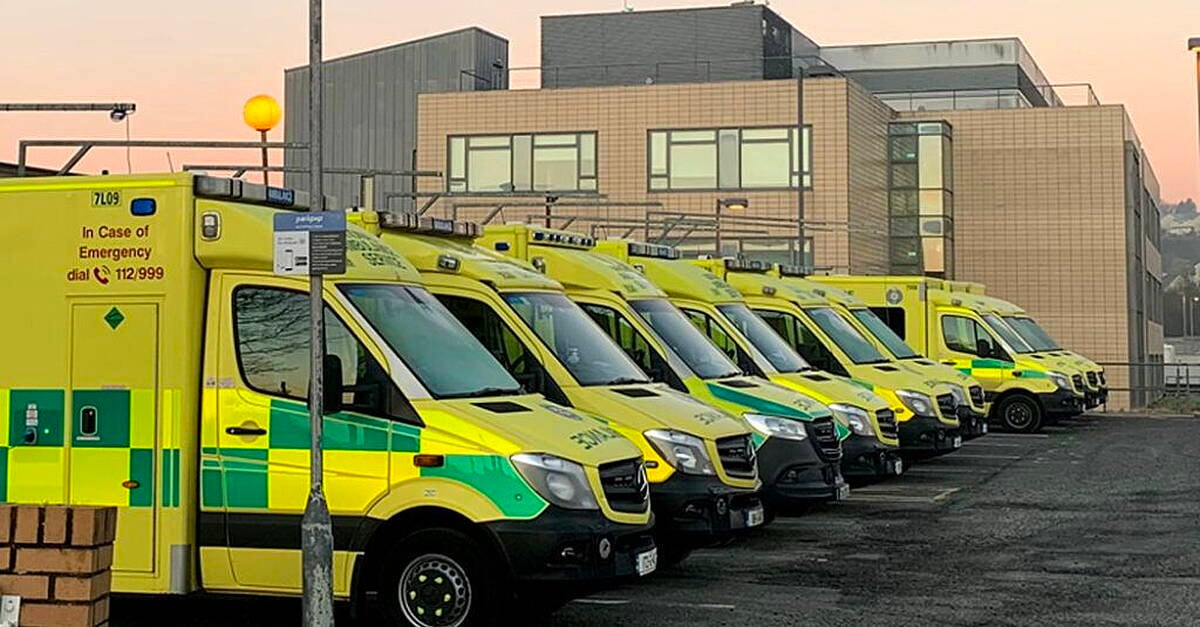
Average ambulance response times for red-category calls have climbed to almost 24 minutes in Donegal.
Just 52% of the red-category ambulance calls were responded to within the 19-minute target between January and May this year.
The red category calls cover life-threatening illnesses and injuries other than cardiac or respiratory arrests.
In the same period, the average response time was 23 minutes and 44 seconds, it has been confirmed.
The HSE figures, released to Donegal Daily under the Freedom of Information Act, show that the average response time has deteriorated from 21 minutes 43 seconds in the whole of 2023.
The average response time was 22:02 in 2024 and 22:56 last year, but in the first five months of 2026 that time shot to 23:44.
There were 3,188 red-category calls recorded between January and May.
In the whole of last year, there were 7,710 red-category calls in Donegal, compared to 7,788 in 2024 and 6,861 in 2023.
You may also be interested in


For purple-category calls – which involved immediately life-threatening cardiac or respiratory arrest – the average response time from January-May 2026 was 14 minutes and 24 seconds, with 78% of the 95 calls responded to within 19 minutes. For red calls, the average was more than nine minutes longer.
In 2025, there were 18% of the 235 calls (42 calls) which were outside of the 19-minute target.
The HSE’s National Ambulance Service also used its response to the FOI request to raise questions about the way ambulance performance is measured.
It said time-based targets are a “crude and ineffective” way of determining the effectiveness of ambulance services and argued that clinical outcome indicators are a more appropriate measure.
For example, it said that an ambulance arriving after 22 minutes when the target is 19 minutes could be taken as a failure even if the patient has a good outcome, whereas a 10-minute response could technically be a success even if the patient dies.
However, the figures released by the HSE show that the 19-minute target is being missed in almost half of red-category cases in Donegal.
The HSE also highlighted increasing pressure on the ambulance service nationally.
According to the FOI response, demand through the 999 service has increased by 25% since 2019, with demand rising by 9% in 2024 and a further 4.6% in 2025.
The National Ambulance Service said a previous capacity review had identified a deficit equivalent to 90 emergency ambulance crews every day, or 1,080 whole-time equivalent staff.
They pointed out that the need for additional capacity is “a matter of public record”.
Its Workforce Plan subsequently identified a requirement for 2,579 additional whole-time equivalent staff by 2028.
The HSE said additional resources are being provided through 2026 service developments, but warned that it will take “several years of sustained consistent investment” to reduce the gap between rising demand and available capacity.
Donegal Daily also sought internal reports, briefings or correspondence relating to ambulance delays in this county over the last couple of years, but the HSE has said that no such records could be found following a search.