
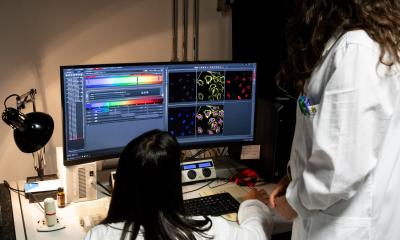
When [the MLL4] protein is less abundant or altered, as in Kabuki syndrome, the nucleus becomes more fragile, making cells more susceptible to nuclear envelope rupture
Alessio Zippo
The study – the result of a four-year effort and a multidisciplinary approach involving international collaboration among research centers specialized in genetic diseases, cell biology, and molecular biology, alongside physicists specializing in photonics, mechanics, and computational modeling – provides a new perspective on the syndrome, including potential therapeutic avenues. It proposes a new paradigm in chromatin biology: for the first time, it identifies the role of chromatin factors (such as the MLL4 protein) in regulating the cell nucleus’s response to mechanical stress and modulating tissue and organ function. Furthermore, the research demonstrates for the first time how altered nuclear mechanics is directly linked to the pathogenesis of Kabuki syndrome, explaining some of its most common clinical manifestations.
The study stems from a collaboration among numerous Italian and international research institutions and universities the University of Trento (with the Department of Cellular, computational and integrative Biology Cibio and the Department of Physics), Fondazione Bruno Kessler (FBK), Italian Institute of Technology (IIT), the Airc Institute of Molecular Oncology, ETH Zurich, the University of Naples Federico II, and the University and Hospital of Montpellier.
The paper features Sarah D’Annunzio as first author, followed by her colleagues from Alessio Zippo’s research group at CIBIO, together with Raffaello Potestio from the Department of Physics. The study analyzes cells as the “mechanical engine of our organism,” fundamental to tissue organization. “Cells are subjected to various mechanical stimuli,” explains Alessio Zippo, Associate Professor at the Department of Cellular, computational and integrative Biology at the University of Trento. “They are compressed, stretched, and deformed to regulate various physiological functions. To respond to these stresses, the cell nucleus, which safeguards our genetic material, must adapt without losing its structural integrity.”