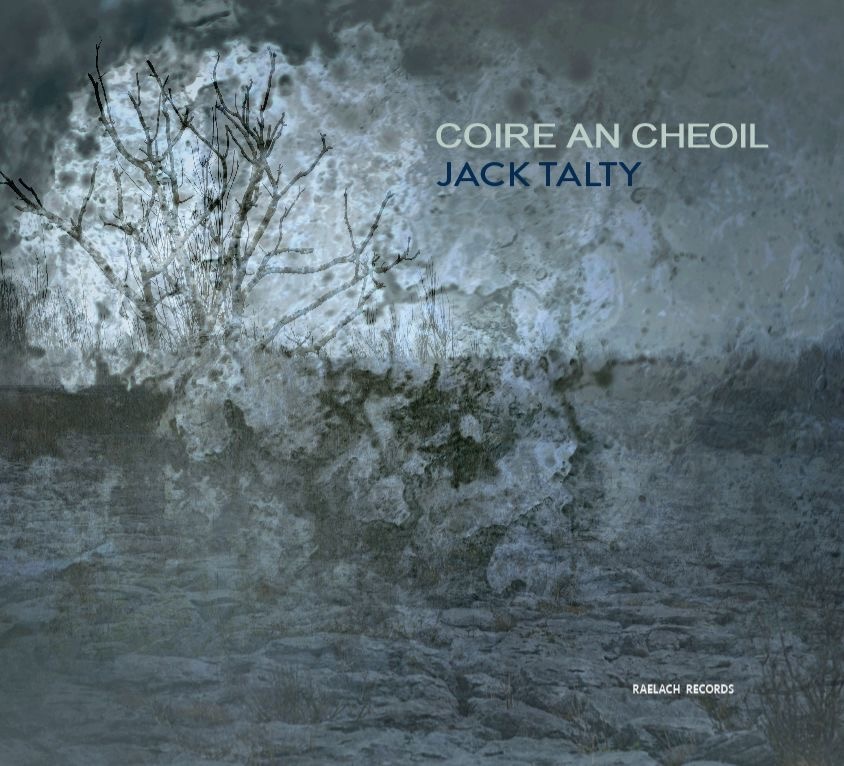
The Clare musician, producer and academic Jack Talty has already made a telling contribution to Irish traditional music, and with the release of his new CD Coire an Cheoil makes his strongest statement yet as a composer. His compositions have been previously included on his solo and duet recordings, on Ensemble Ériu’s Stargazer (2017), and feature in a number of films and installations, including Duala (2020), made by Talty and Maurice Gunning for the Irish Traditional Music Archive. This new album, whose title (translating as ‘cauldron of music’) reflects its collaborative nature, features many musicians who have already recorded for Talty’s Raelach Records label, as well as other musical friends and colleagues.
I recently reviewed Conal Ó Gráda’s Anú Abú album of new tunes and commented on how the compositions seemed to emerge from the musician’s style itself: these were good ‘flute tunes’, inseparable from the instrument and Ó Gráda’s musical idiolect. In contrast, what makes Coire an Cheoil stand out from other CDs of newly composed material is that the crew of musicians that Talty has enlisted often give voice to his music, so to speak, so that Talty’s playing – while very present on the CD – isn’t always to the fore. He only includes two solo sets, with the remainder of the album split between duets and group sets featuring his concertina playing, and tracks where he’s absent or in the background as an accompanist. Because of this, many of the tunes take on very different shapes and styles according to the guest musicians.
Coire an Cheoil opens with a duet, fiddler Aidan Connolly adding his signature bowing and intonation to a sunny set of slides, with Steve Cooney backing on guitar. This is contrasted by one of the few solo concertina tracks on the album, a pair of sterner reels that both begin in E minor and move towards different major keys. Two more duets follow, which again are shaped by the collaborating musicians. Uilleann piper Mark Redmond joins on a set where the immediately attractive ‘Jimmy & Eve’s’ jig (one of those ‘earmarked to learn’ tunes, as Toner Quinn mentions in his notes) is placed between two unusually structured tunes. ‘Na Fir Bolg’, a barndance, reprises Talty’s concertina duet with Cormac Begley, followed by a hornpipe previously recorded on Talty’s solo album in 2016. The lack of accompanying instruments on this track allows the reedy chords of their concertinas to shine, especially in the drones underneath the concluding polkas.
Two other duets with alumni of Raelach Records are among the highlights of the album. Harnessing the recent ‘dark folk’ turn, Talty’s duet with Saileog Ní Cheannabháin begins with the sort of textured drone that is fast becoming a signature technique of 21st-century traditional music. Ní Cheannabháin is a fine composer in her own right, and these tunes seem to me to be very sympathetic to her style. I also liked how both musicians charted their own way through the tunes, which, as well as giving a sense of spontaneity, creates a mesh of polyphonic sound that is augmented by an increasingly prominent drone. In a different vein, there are two tremendously lively and voguish hop jigs with accordion player Damien O’Reilly, the second of which is cleverly transformed into a driving reel.

Jack Talty (Photo: Maurice Gunning)
Refraction and remembrance
The first set not featuring Talty is given to At the Racket, whose refraction of the music of the 1920s and 1930s has always been attractive – it’s hard to believe that it’s almost thirty years since their debut album. The music is doubly nostalgic – it evokes an imagined nostalgia for the music of the golden age of New York, and a more experiential nostalgia for older listeners familiar with the band’s first recordings. Although the two waltzes are reminiscent of the feel of tunes such as ‘The Tax Max Mazurkas’ or ‘Marcus Hernon’s Waltzes’, and the reel seems designed to fit the strengths of John Carty’s banjo and Séamus O’Donnell’s saxophone, this is not an exercise in pastiche, but emanates from a real regard for the band’s music. A similar sort of remembrance (and something closer to pastiche) is embedded in Diarmuid Ó Meachair’s exuberant playing of two barndances, which Talty wrote in emulation of the Flanagan Brothers and John J. Kimmel.
Finally, the hornpipe for Aoife Ní Bhriain is matched to her bimusicality. There might not be many fiddlers who can bring this exactness of tuning and clarity of tone to a tune that is complex in its transpositions, and which sometimes seems to reference the implied polyphony that Bach employed in his solo violin music, combined (in the third part) with harmonic progressions also evoking the Baroque style. I did feel there was a missed opportunity here as it would have been interesting to hear Ní Bhriain expand on the tune (à la Tommie Potts) and create something more developed and imaginative from the source.
The album finishes with two larger group sets. ‘Brú na Boirne’ is an elegant planxty in the vein of the more Irish and direct tunes of Carolan. However, I felt the recording became increasingly cluttered as it progressed, and it might have been more effective to have split up the different harmony lines and accompaniments rather than layering them together at the end (in a way, this is quite a rigid approach compared to the often very quick shifting between textures that is the hallmark of contemporary traditional groups and bands).
The first part of the final track, ‘Fan sa Cheo’, is the only time that we hear more direct echoes of the minimalist-inspired approach of Ensemble Ériu, in the long introduction and subsequent backdrop to the hornpipe. The stacking of motifs in the opening works well, but once these became accompanying figurations, I wasn’t totally convinced that they gelled with or enhanced the tune. This is made up for, though, by the wonderful exuberance of ‘O’Flynn’s Reel’, which is a high point of the album. Eoghan Ó Ceannabháin’s lilting of the tune lifts the track, although all the musicians are on top form in bringing the album to a close.
The focus on collaboration, the granting of space for other musicians, and the range of instruments (both lead and accompaniment) make for a richly varied and substantial recording. It also has a reflective and even cathartic quality, as the sleeve notes explain how it was created in the wake of the passing of Talty’s mother Colette in January of this year. The plaintive air ‘Coire an Cheoil’ was composed in her memory, and is sensitively played by Talty on piano (with assistance from Neil Martin on cello and Matthew Berrill on bass clarinet). It’s a fine performance, and I couldn’t help but hear echoes of some of his predecessors at UCC in his lyrical ornamentation of the melody. The album reminds us how traditional music often serves as a form of remembering and memorialisation, and that the creation of new music is as much about delving back into tradition as it is about cutting new paths for future musicians.
Coire an Cheoil by Jack Talty is released on Raelach Records. Visit https://raelachrecords.bandcamp.com.