
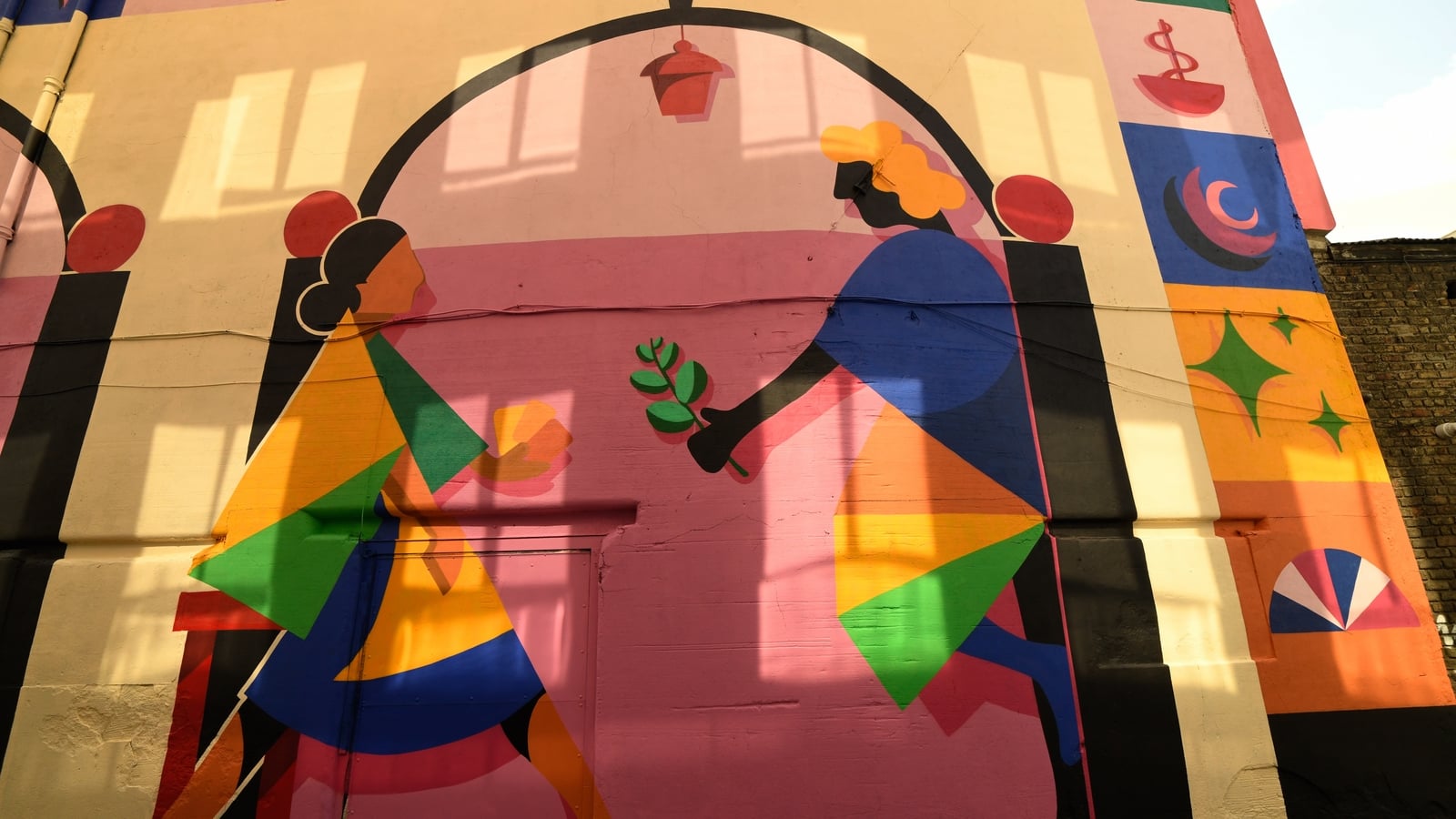
In a side street off Talbot St, a vibrant new mural is shedding light on the women of Monto, once one of Europe’s largest red-light districts during the late 19th and early 20th centuries, bringing to life a rich but often forgotten part of Dublin’s history.
Muralist Holly Pereira has painted the striking artwork on Mabbot Lane, a small section of street that features in James Joyce’s Ulysses, described as “the entrance to Nighttown”.
Here, Pereira details the inspiration behind the piece.
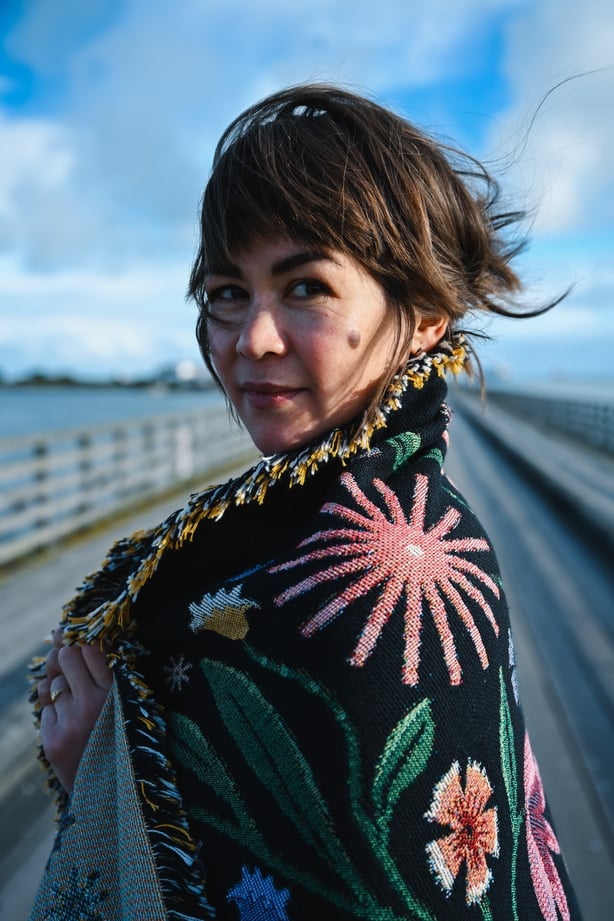
Holly Pereira. Photo by Ruth Medjber
Tell me how you got into this kind of street art?
I have been practising as a muralist for 11 years, having worked as an illustrator before that. The first big mural I painted was coming up to Repeal the 8th referendum in 2016. From that moment, I was hooked on the scale, vibrancy and potential for communication within murals.
What drew you to the history of the Monto and the women who worked there?
I have always been interested in feminism, women’s history and the histories of marginalised communities. Having lived in Dublin for many years, I was surprised to learn about Monto only five years ago. It baffled me that such a significant part of Dublin’s history could be so little known.
Walking down Foley Street, formerly Montgomery Street, I found myself thinking about the women, children and men who created the social fabric of the North Inner City. Their stories are about far more than prostitution – they are about poverty, class, gender, housing, work, family and survival.
I believe these histories should be remembered honestly. To exclude them because they are uncomfortable, shameful or difficult risks creating a sanitised version of the past. Remembering Monto does not mean romanticising its hardships or exploitation. Rather, it allows us to understand the circumstances in which people lived and the choices available to them.
Times were hard then, as they remain for many people today. If we only preserve the histories of those considered respectable or acceptable, we lose a vital part of our understanding of Dublin and its people.
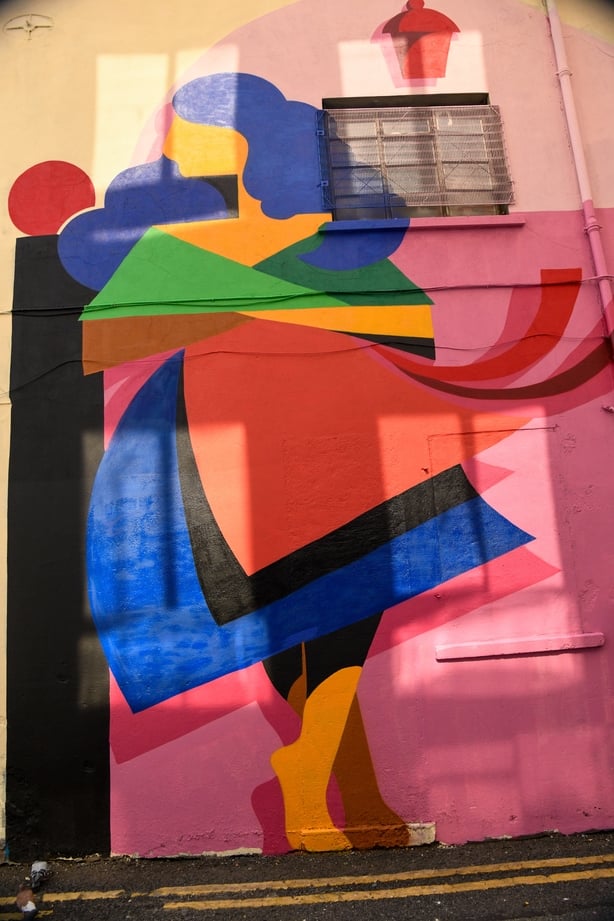
Photo by Crevan Schutte
What were the key elements of their stories and their time that you wanted to bring to life, and how did you do it?
Creating an artwork like this does not rely solely on historical research; it also involves imagination. My process is to take elements from the research and explore how they can be combined with my own visual language.
A key element I wanted to convey was the solidarity and camaraderie I imagine existed among the women of Monto. Despite the hardships, they may have looked after one another and found support through their shared experiences. I depicted two women playing cards in the arch to represent this sense of companionship. Another woman is shown passing herbs to a neighbour, referencing the possibility that women relied on folk medicine or local midwives at a time when societal judgement could prevent them from receiving medical care.
Some photographs from Terry Fagan’s Monto Walking Tour show women leaning in doorways, and this image stayed with me. It suggested the endless combination of waiting and watching — waiting for work, watching for danger, and the boredom and alertness that came with it. I wanted to capture that feeling through a larger-than-life woman from Monto, standing watch over Talbot Street across the years.
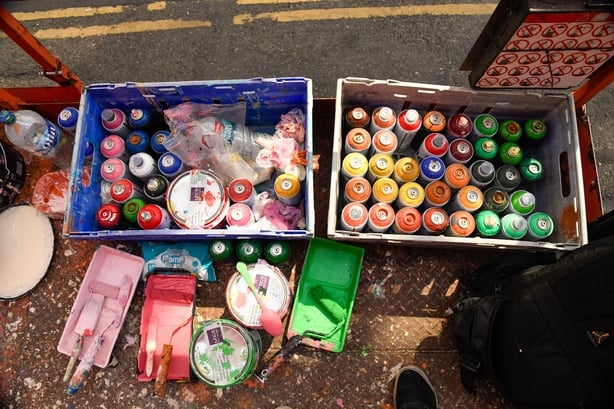
Photo by Crevan Schutte
You drew inspiration from the Monto Walking Tours and Dr Caroline West when researching this, were there any tidbits that resonated with you the most?
I went on the Monto Walking Tour in April, which was detailed and full of personal anecdotes. I haven’t met Dr West, but I really enjoyed her book on Monto, Wrong Women. Two aspects of Dr West’s research particularly struck me.
The first was that “the culture of the time saw 13-year-olds as legally capable of giving consent” (West, 2025, p.22), which is horrific to contemporary ears. It made me think about the vulnerability of being a girl, particularly a poor girl, and how children around the world are still victims of sexual exploitation and trafficking today.
The second was the role of economic circumstances in the growth of Monto. Money was flowing through Dublin, with the British army barracks at Aldborough House, the busy port and the fashionable area around Mountjoy Square. Following the Famine, widespread rural poverty forced many women to seek work in Dublin. In desperate circumstances, prostitution could offer an income and, for some, a means of surviving grinding poverty.
Tell me about the process of making the mural, how long did it take, and what steps does a project like this involve?
Once I felt I had a handle on the historical elements and the tone of the place, I looked for the points where they intersected with my own artistic concerns — feminism, human rights, and forgotten or overlooked histories.
I then began drawing in my notebook and seeing what emerged. I think of this stage as a kind of sausage factory: impressions, thoughts, images and anecdotes are mixed together, and what comes out through the drawing is the “art sausage”. I measured and photographed the wall on Mabbot Lane before developing the composition digitally. I wanted a bold, colourful palette, which was the only stipulation from Dublin City Council, along with a border incorporating additional details.
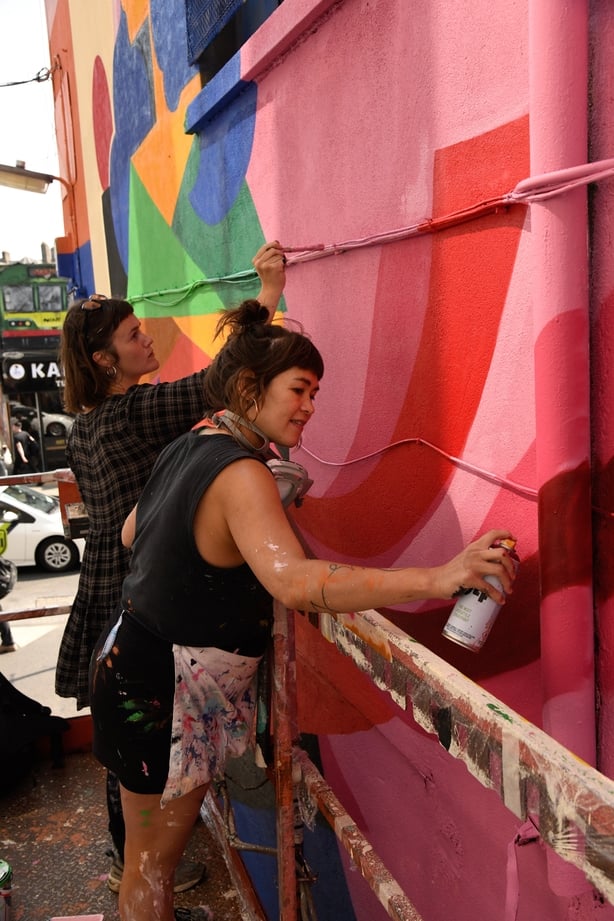
Photo by Crevan Schutte
Once the general design was agreed with DCC and the building owner, I refined the composition, adding shadows and adjusting the palette to create greater depth and contrast, making the mural more impactful from different points along the street.
Finally, I was able to paint the mural with the help of talented artists Chloe Winders Mowlds and Jorge Ruiz. The installation took ten days. It was challenging – not least because of the heat and the fact that the laneway is frequently used as an unofficial public toilet. The smell was overpowering, particularly in the heat. I wholeheartedly advocate for public toilets in Dublin city centre. It is not pleasant to watch someone urinate on a mural you have just painted, which happened almost every day.
How did you collaborate with Dublin City Council, what was that part of the process like?
I had worked with David Forde and Catherine Brophy from Dublin City Council the previous year on the “Dublin” mural on Upper O’Connell Street, and I had a very positive experience working with them, so I was happy to work with them again.
Too often, local authority projects can require artists to tick a predetermined number of boxes, incorporating references to whatever themes are currently considered important — biodiversity, cycling, local history, sports teams and so on. The result can feel like a Frankenstein: a collection of disconnected images that satisfy a committee but don’t necessarily work as a cohesive artwork. In the process, the opportunity for an authentic artistic response can be lost.
Thankfully, David and Catherine didn’t impose this kind of approach. Their brief was simply: “something bright and colourful, possibly to do with local history.” This was an ideal brief for me. It allowed the research to inform the work while leaving room for imagination and interpretation — which, in my view, is essential to making successful art.
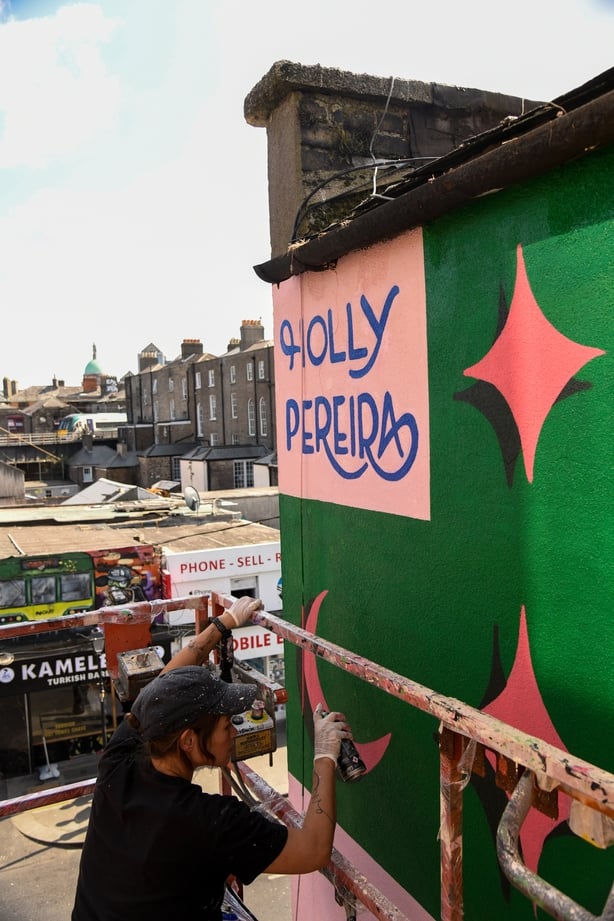
Photo by Crevan Schutte
Why do you feel now is the right time to spotlight this part of Dublin’s history?
I only learned about this very local history relatively recently. I think now is a good time to re-examine the past through a wider lens, particularly as we continue to confront the legacy of the Mother and Baby Homes, and the exploitation and abuse carried out within the Catholic Church.
I believe it is time to acknowledge the role women have played in shaping Irish culture and history. We rightly celebrate Irish writers, artists and musicians such as James Joyce and Luke Kelly, both of whom wrote about Monto, but the patriarchal structures of the past have meant that women’s experiences have often been less visible or documented.
And this principle extends beyond women’s history. I want to know more about the experiences of people of colour in Ireland, the LGBTQIA+ community, the Traveller community, and others whose stories have been sidelined or overlooked. These experiences are just as much a part of Irish history.
I want a broader, more inclusive picture of what it has meant — and still means — to be Irish and to live in Ireland. I think now is the time to start looking for those stories.
If you are affected by any of the issues raised in this article, visit https://about.rte.ie/ie/helplines/