
50 years in, Ireland’s favourite ceramicists reflect on the importance of handmade art, the fire that nearly ended the business and a new collaboration with JW Anderson. Kate Demolder writes.
Even if you don’t know him, you certainly know Nicholas Mosse.
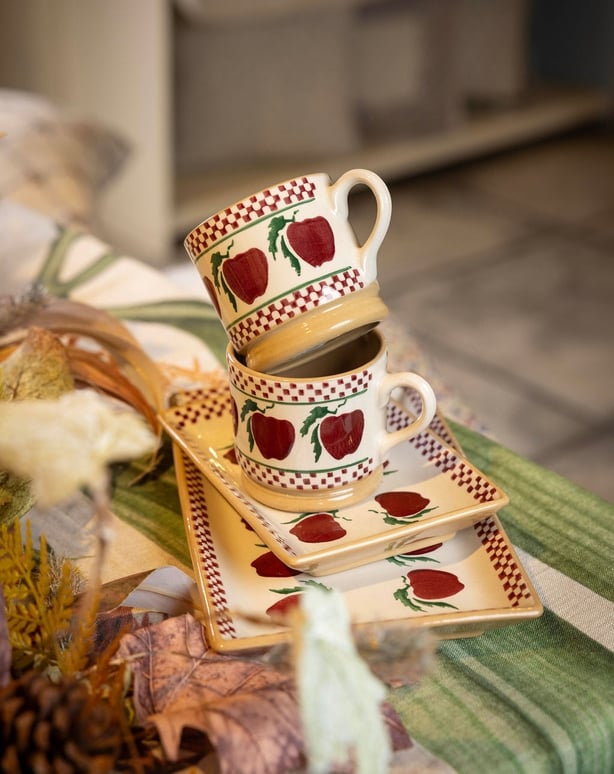
Through bowls, mugs and saucers adorned with hand-sponged roses, clovers, or forget-me-nots, the Kilkenny-based potter’s work has evolved from simple household items to beloved monuments of celebration in Irish homes.
This is, in part, due to the company’s legacy: this year, the Kilkenny brand boasts a golden anniversary, celebrating 50 years at the epicentre of Irish craft, all while remaining stubbornly, beautifully handmade.
“We never thought back in the 1980s that we’d be here today,” Nicholas and his business partner, Susan, say from a wooden seat in the café at their Bennettsbridge location.
“We thought when we started that we would probably get about 10 years out of it, and then the interest would die,” he says. “But in actual fact, you people continue to have an interest in the new pieces and patterns, which keeps the whole thing alive.”
Nicholas Mosse Pottery was founded in 1976 in Bennettsbridge – though in reality, the story starts much earlier.
“My family were in the milling business originally, but my father advised me not to go into it,” Nicholas smiles. “It was a dying business, and he himself had spent his life wanting to be a stonemason.”
“Kilkenny around that time suddenly became filled with European craftspeople,” Susan says. “And there was a community around the Mosses, which encouraged their interest in collecting vernacular furniture and traditional Irish pottery.”
Fuelled by a family passion for handcrafted homewares, Mosse shaped his first piece of clay at 7-years-old. “And I haven’t really stopped since,” he smiles, wiping dust from his hands to pour tea.
As a teenager, he studied at the famous Harrow Art School in North London, travelling to Japan thereafter to hone techniques from global masters. There, he became inspired by Japanese ceramics’ functionality and simple beauty, a consideration he brought home to shape his own business.
“I always knew I wanted to set up in this country,” he says. “And I wanted to use the techniques we used here; I didn’t want to start doing something that I’d learned abroad. We decided on sponge-decorated earthenware, which was available all around the country at one stage but had died out, and so we were trying to generate that.”
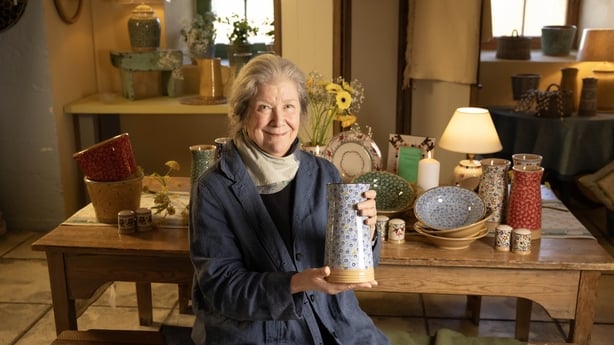
It was around this time he met Susan, a New York City-by-St Louis transplant who also came from a family of millers. Stories of their first meeting differ, but both agree it was in Co Clare, where Susan had been living after “falling in love” with the Burren.
“A friend of ours was coming to stay in my house to do a show for a gallery, and Nick drove him there,” she smiles. In the early days, all of the couple’s work took place in their yard, a stone’s throw from the brand’s impressive facility just outside of Kilkenny City.
“No one likes going down there,” Nicholas laughs. “Because it’s so dirty.”
The first Nicholas Mosse products were stoneware dairy pans and cream settling pots for farmers milking cows, as well as bread baking pans to provide moisture to bread rising in ovens. “Rough country stuff,” Susan smiles.
“Eventually, we started making things that were a little bit more, shall we say, elegant. Cheerful, happy, pottery – because nobody knew about pottery in Ireland when we first started.”
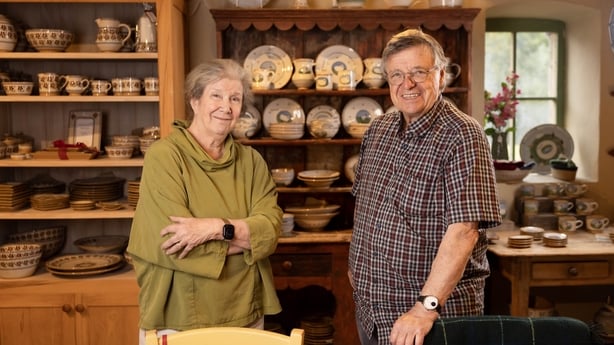
This pivot to ceramics was bolstered by Nicholas’ buying back of his family’s mill – where the workshop, café and shop are located today – which had closed years earlier. At this stage, business was booming, and electricity bills soon were, too.
However, with a proactive approach to the environment, nurtured in part through Mosse’s Quaker upbringing, he restored the mill’s historic hydro-electrical system.
To this day, the entire five-story pottery operation is completely powered by the rushing waters of the river running right beneath its floors. “Green was just a colour in those days,” Nicholas laughs. “But we had always had turbines in the mill, so we just put generators on them to start making electricity.”
In 1985, the entire mill went up in flames overnight. “It was just like a big tinder box,” Nicholas says. “It absolutely decimated the place. And it took about 10 years for the building you see today to be built back in its entirety.”
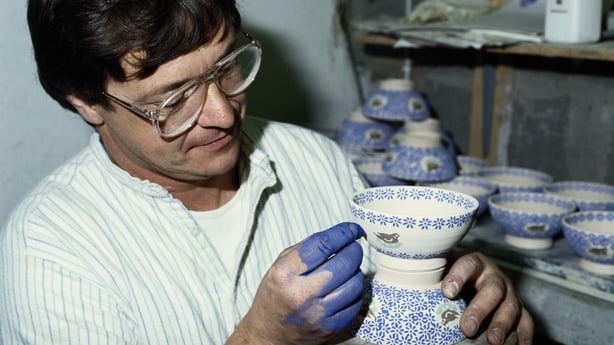
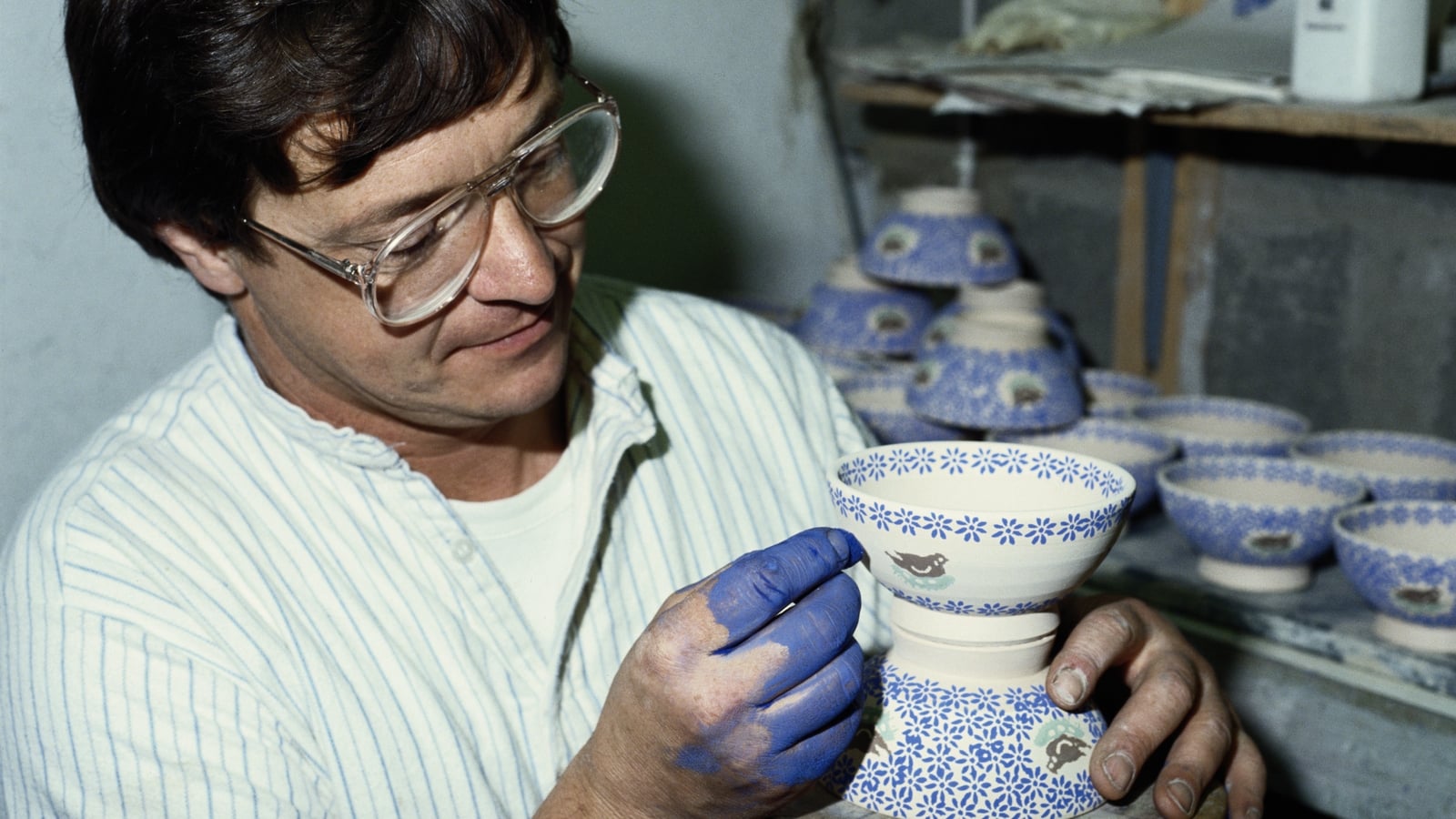
Nicholas Mosse decorates spongewear at the Nicholas Mosse pottery, Bennettsbridge, County Kilkenny, Ireland circa 1990. Getty Images.
During that time, though, the Mosses continued to work, creating collections for the likes of Kilkenny Design and figuring out what worked along the way.
“We switched to colourful spongeware,” Susan says, “drawing inspiration from all things nature for the decoration”. Today, Susan decides the entire decoration process, selecting one new pattern a year. Though a suite of superfans rush the building when new collections are rumoured, the overall bestseller remains Old Rose, the design Susan calls the “classic” Nicholas Mosse print.
“Our designs are simple,” she says. “They’re not challenging. They make people happy.”
One such superfan is Dior Creative Director Jonathan Anderson, the Derry native who recently asked the Mosses to collaborate on a design for his six JW Anderson stores.
“He contacted us because he remembers our designs on his kitchen table when he was growing up,” she says. “So it was a real honour to create a design for him. The new designs are out soon.
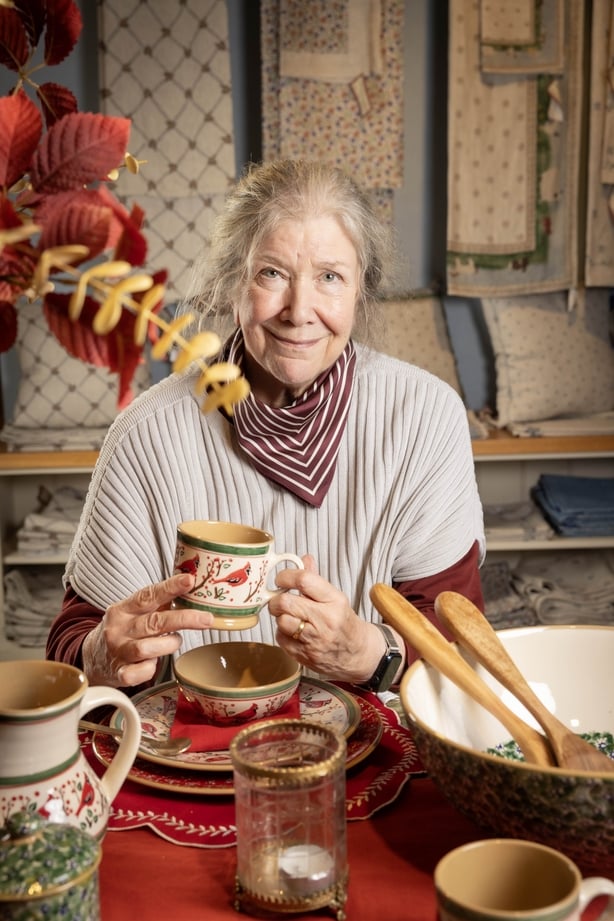
Susan Mosse
Every single Nicholas Mosse Pottery product is made from clay which is sourced from beneath bogs, shaped and dried on-site, then hand-stamped with sea sponges dipped in ink. Altogether, the process includes 20 steps – shaping, blending, dehydrating, rehydrating, glazing – an undeniably intriguing bent in a time of automated mass production.
“We were brought by Enterprise Ireland to China to have a look at mass production about 15 or 20 years ago, but we hated it,” Nicholas laughs. “You know, it’s a nice place to go on a holiday, but it just didn’t work for us.” “They didn’t make it nicely enough,” Susan interjects. “And the whole thing about our products is that they last, whereas these products didn’t.”
Of course, handmade products come with their own insurance issues. Human error insists that not all products are created equally, but when issues arise in the workshop, the Mosses have found a cost-efficient way to deal with them.
Within the on-site shop, a section entitled Seconds leads customers to an area full of slightly imperfect Nicholas Mosse products. There, cups, bowls, saucers and even tables with slightly misaligned decorations or tiny bubbles obtained in the glazing process sell for a fraction of the price. And as for the products that get broken during production, “we recycle them for future pieces.”
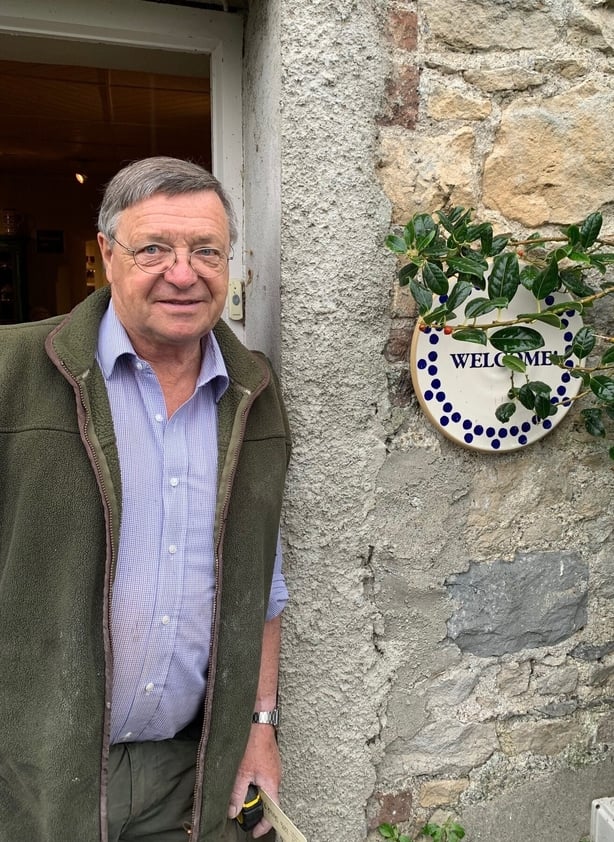
Nick Mosse outside the shop
At a time when so much of our lives can feel increasingly intangible, Nicholas Mosse’s handmade crafts offer something very real and enduring, according to Design & Crafts Council Ireland CEO Mary Blanchfield.
“At the heart of it all is something that is increasingly valuable: the relationship between the hands of the maker and the person who receives the finished piece; its provenance, the story behind it, and the knowledge that it has been made by a person with skill, care and intention.”
While his success comes “from a rare combination of dedication, business acumen and technical skill,” there is no question that the personal touch had a part to play, Blanchfield continues. “Nicholas has also demonstrated how Irish themes and traditions can remain relevant, contemporary and collectable.
“His work continues to evolve and engage with contemporary design, most recently through his collaboration with Jonathan Anderson. In this, he is a testament not only to his own craft but to the wider potential of Ireland’s craft and design sector.”
You could make a perfect Nicholas Mosse piece in three days, but the process typically takes about three weeks. “Because the process requires control of the heat and moisture of the outside air, you’re constantly checking on the products to see if they need those elements adjusted,” Susan says.
Thankfully, they’re not alone. A team of 70 populates the Bennettsbridge facility, in various admin, decorating and finance roles. That’s without counting the two geese who roam freely outside. “It gives the guys something to look at,” Susan laughs.
Despite working with the likes of Tiffany’s, Ballyfin Demesne, and Bloomingdale’s, Susan and Nicholas remain steadfast in their beliefs that Nicholas Mosse is a wholly Irish product. Indeed, half a century in, both Mosses are proving that there is still boundless joy to be found in the everyday objects we hold in our hands.
“I’m proud of what we’ve done,” Susan says. “And I think it’s nice to give back to this lovely little country.”
The best bit though, Nicholas insists, is teaching a whole new generation the crafts of the past.
“You know,” he says. “You set up a business, first as a one-man show, and then two, three and so on… And each time you train somebody, they’re not very good, but after a while, they’re way way better than you could have ever been. That’s really nice to watch. Of course, some come, and some go, but the nucleus is still there. And we hope that it remains that way forever.”