
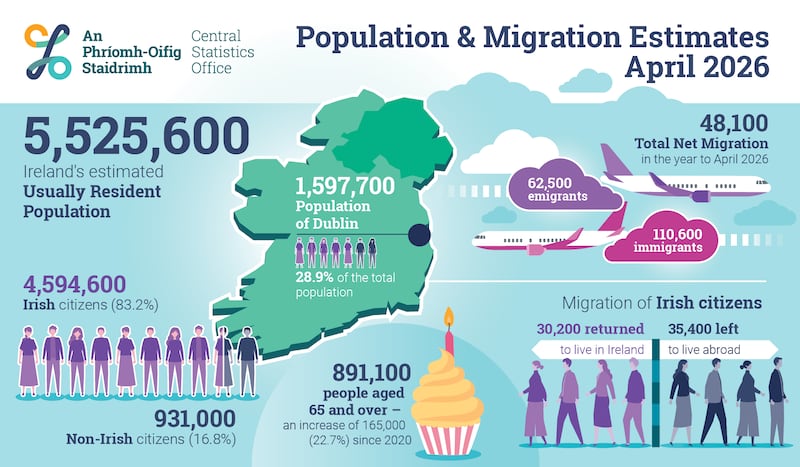
The population of the Republic increased by 66,900 people in the year to the end of April, rising to 5,525,600, according to Central Statistics Office (CSO) figures.
An estimated 110,600 immigrants arrived in the State during the same period, the data show. This marks a 12 per cent decrease from the corresponding period ending April 2025, but was the fifth successive 12-month period where more than 100,000 people immigrated to Ireland.
Fewer people emigrated from the Republic in the year to April, with an estimated 62,500 people departing the State. This was a decrease of 5 per cent (3,100 people) when compared with the same period a year earlier.
More than half (53 per cent) of those who emigrated were aged between 25 and 44 years (32,900 people), while 32 per cent (19,900 people) were aged between 15 and 24 years.
About 48,100 more people arrived in Ireland than left, a decline of 11,600 people (19 per cent) on the total for the same period a year earlier.
 Source: CSO
The number of immigrants arriving fell by 14,700 in comparison to the previous 12-month period, with the total including 30,200 returning Irish citizens, 20,700 other EU citizens, 4,300 UK citizens and more than 55,000 others.
The number of emigrants in the same 12-month period decreased slightly and comprised of 35,400 Irish citizens, 8,700 other EU citizens, 2,000 UK citizens and 16,400 others.
In the 12 months to this April, 11,800 people left Ireland to go to Australia, a decrease of 1,700 from the previous year. Similarly, the number of people coming to Ireland from Australia decreased from 10,100 to 8,300.
The number of people in the Republic aged below 14 years fell to 992,400 in April, the first time this age bracket fallen under one million people since 2014.
“This age group had a fall in population share between 2020 and 2026, reducing from 20 per cent to 18 per cent of the total population, a decrease of 21,300,” CSO statistician Conor J Crowley said.
The number of people in the Republic aged 65 and over rose to 891,100 over the 12-month period.
“Those aged 65 and over showed an increase in population share between 2020 and 2026, increasing from 14.4 per cent to 16.1 per cent of the total, which was a volume increase of 165,000 people,” Crowley said.
Since 2010, the number of births in the Republic has been in decline. About 55,000 people under the age of one year lived in Ireland in April, a decrease of 19,900 people or 27 per cent in 16 years.
In the 12 months leading up to April, there was a natural increase (births minus deaths) of nearly 19,000 people in the State.
The population of Dublin has risen from 27.6 per cent of the country’s total in 2011 to 28.9 per cent this year, with 1,597,700 people residing in the capital. The southwest and mideast had the second and third highest population by region in April, with 792,900 and 788,400 people respectively.
The region with the highest population growth year on year was Dublin, which had an increase of 29,700 people, followed by the west region, which had a rise of 11,500 people.
The only region not to see an increase in population since April last year was the southeast. In April 2026, the southeast had a population of 485,400 people, down 1,000 (or 0.2 per cent) in a year.
The region with the lowest contribution to the total population this year was the midland region, with 339,400 people (6.1 per cent).