
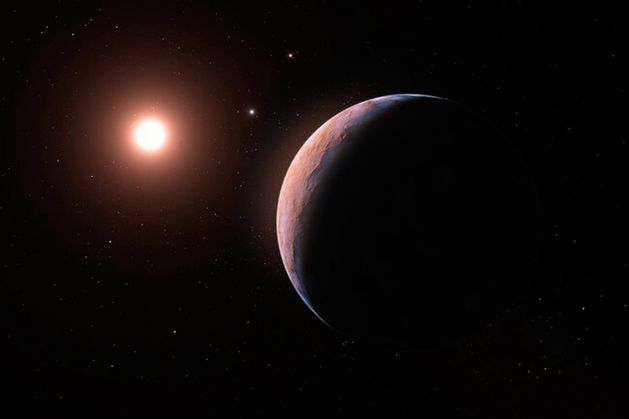
The free-floating planet is currently consuming gas and dust from its surroundings at a rate of six billion tonnes a second – the strongest growth rate ever recorded for any planet, according to physicists.
The new observations, recently published in The Astrophysical Journal Letters, were made at the European Southern Observatory (ESO) in Chile’s Atacama desert.
“People may think of planets as quiet and stable worlds, but with this discovery we see that planetary-mass objects freely floating in space can be exciting places,” Victor Almendros-Abad, the study’s lead author, said.
The orb, officially named Cha 1107-7626, has a mass five to 10 times that of Jupiter’s, and is located about 630 light-years away in the constellation Chamaeleon.
The team of researchers found the rate of accretion – the process by which the planet is fed by the surrounding materials – is unstable. By August 2025, the planet was growing about eight times faster than in previous months.
“This is the strongest accretion episode ever recorded for a planetary-mass object,” Dr Almendros-Abad said.
The team also used existing data from the US-operated James Webb Space Telescope, European and Canadian space agencies and SINFONI spectrograph.
This discovery blurs the line between stars and planets
The revelations still leave many questions unanswered.
Study co-author Aleks Scholz, an astronomer at the University of St Andrews, said: “The origin of rogue planets remains an open question: are they the lowest-mass objects formed like stars, or giant planets ejected from their birth systems?”
By comparing the light emitted before and during the burst of growth, scientists were able to uncover insights about the formation process. They found magnetic activity appears to have played a role in eating up the surrounding mass, which has only ever been discovered in stars previously.
This suggests even low-mass objects can process magnetic fields strong enough to power accretion.
The findings suggest at least some rogue planets may share a similar formation path to stars.
Belinda Damian, another co-author and astronomer at the University of St Andrews, said: “This discovery blurs the line between stars and planets and gives us a sneak peek into the earliest formation periods of rogue planets.”