
As I sit in the Metro train heading towards South Los Angeles on the morning of September 2nd, I find my destination is evoking all kinds of childhood memories, writes Brian Lally.
I have been invited to a media preview of the new Lucas Museum, a sprawling, futuristic building dedicated to narrative art. But what exactly do we mean by the term narrative art? It is art whose main purpose is to support a story, whether that takes the form of designs for spaceships for Star Wars films, or magazine and comic book illustrations from throughout the twentieth century, or even prehistoric cave art, and just about everything in between. Many of these exhibits in the museum are drawn from the massive personal collection of George Lucas himself.
Despite the breadth of this collection, the Star Wars section dominates my anticipation; I find myself thinking back to all the films I have seen. Which is my favourite? Is it the first one from 1977, A New Hope, or the bleak 1980 sequel, The Empire Strikes Back? It’s certainly not the one with the Ewoks, nor that second wave of films from the late 90s, though they did have their moments. Some of the more recent ones are good, but I saw them as an adult, not as a wide-eyed child, so the experience was never going to be magical, no matter how well made they were.
Watch: A sneak peek at the Lucas Museum
Then a chill ran down my spine. Oh, no, what about Jar Jar Binks from The Phantom Menace? — The most irritating character in the Star Wars universe. He might be there somewhere. It’s like you are going to a party and you start to realise that someone you despise might be there and can’t be avoided. Please George, no Jar Jar today.
The E line Metro takes me to Exposition Park, an area of LA which contains several museums and a football stadium. As I crossed the road towards the Lucas Centre, above the trees, I get a glimpse of its distinctive curved roof and then it starts — a feeling of schoolboy-like excitement. As a world-weary, middle-aged man, this sensation was both nostalgic and pleasant. Having attended primary school way back in the 1970s, I remember the various waves of near hysteria that used to grip our classroom in relation to the Star Wars films. I remember one boy was accused of shouting “Star Wars, here I come!” as his parents took him to the Savoy cinema in Dublin. Even amongst excitable schoolboys, over-excitement of that calibre was considered naff, and he spent the rest of the term denying he ever said that. As for me, as I was ushered past security, I did find myself privately thinking “Lucas Centre, here I come”, and my general state could be described as – if you’ll pardon the language – giddy as f**k.
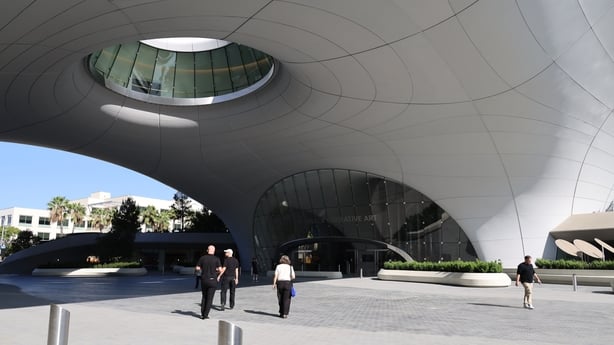
The entrance to the new Lucas centre
The first thing that impresses is the Lucas Centre building itself. It looks like a spacecraft has just hovered over LA and softly landed in Exposition Park. The flowing, streamlined form reminds me of the sleek, aerodynamic spacecraft of the Planet Naboo from The Phantom Menace, which look like they had been somehow designed in the 1940s. As the place is full of media people, television reporters and podcasters, I hear certain phrases being eagerly shouted into cameras and microphones. One sentiment is clearly being repeated — the building itself is a work of art. I would agree with that. The building is a pleasing organic spectacle of flowing curves, totally devoid of right angles, straight lines, or hard edges, and set in green parkland — an antidote to LA’s many forgettable LEGO office blocks, soulless strip malls, and the asphalt parking lots which this site once was. The architect would later speak at the event and said the building was inspired by a cloud.
Soon, I am sitting in a crowded auditorium and we are shown a short promo film about the new centre. In the film, a young George Lucas tells us that he sees art as a way of judging a culture and informing us about what was going on at a particular time in history. He makes the claim that once there is an emotional connection between the viewer and the art, then it is art. It’s that simple. In another talk about the centre, he champions illustrative art such as comic books and periodicals, often dismissed by art critics. Then he neatly wraps it all up by saying the centre is a temple to the people’s art. Hollywood director Ron Howard also appears in the film and calls the centre “George’s magnum opus”.
The crowd seem to like the promo film. Then various other people involved in the museum get up and speak. It’s all very interesting, but then excitement breaks out, as George Lucas himself and his wife Mellody Hobson suddenly appear on stage. This wasn’t in the programme. Photographers start rushing around and jostling for position.
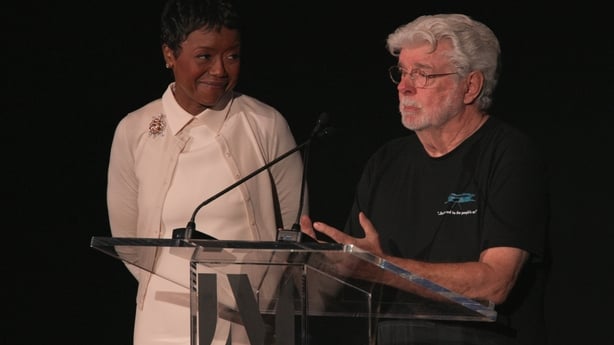
George Lucas and wife Mellody Hobson
A weary-looking George Lucas told the audience that getting this museum off the ground was a long haul of 17 years, with 8 years spent getting it built in Los Angeles. The cities of San Francisco and Chicago had rejected his early plans. George candidly said that he is used to doing the impossible, but this project nearly broke his will. He seemed understandably relieved that his museum was finally open and was more than happy to pose for photographers.
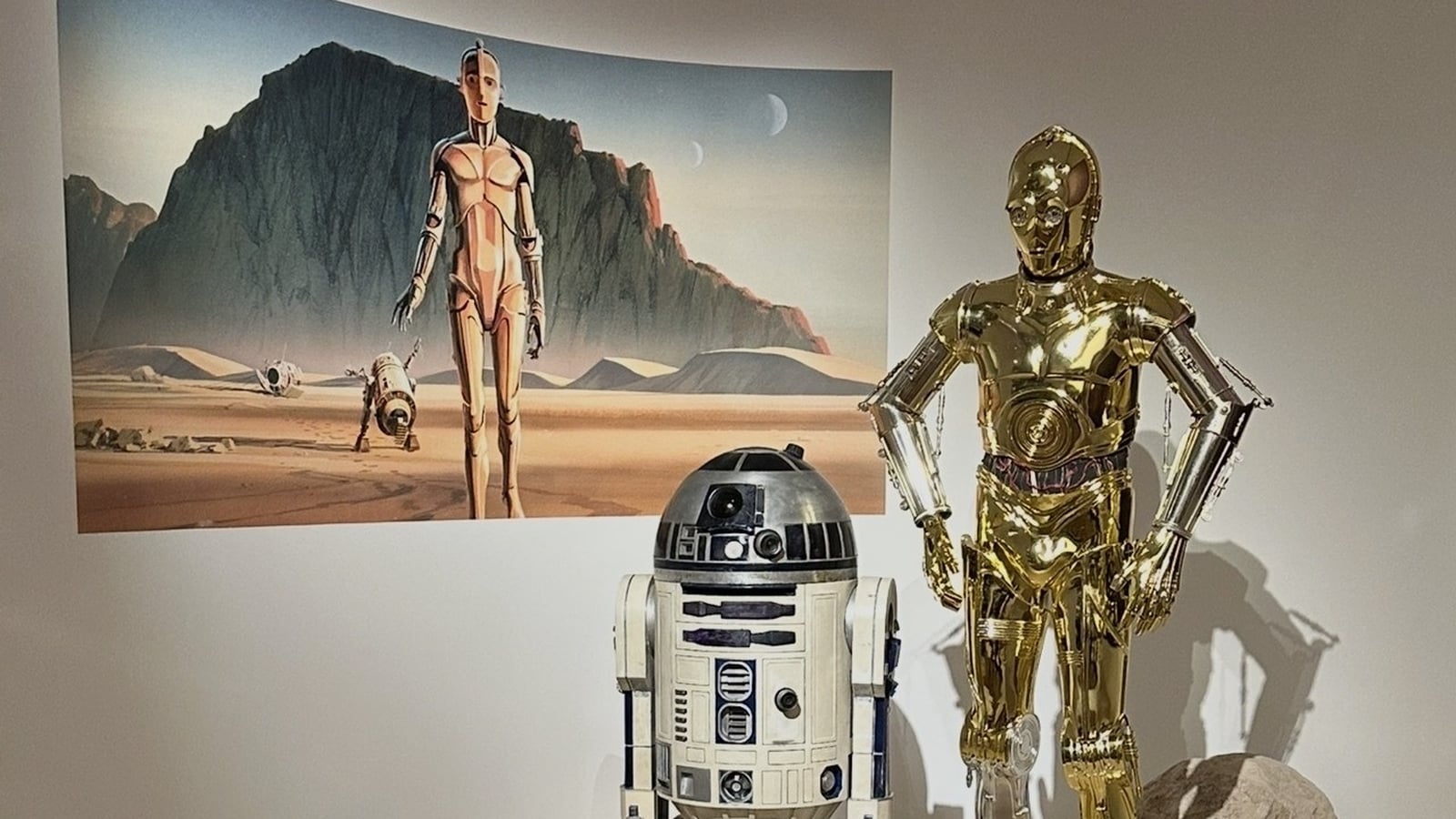
After the talks, everyone dispersed and I tried to navigate the building. I learned that the Star Wars section was up on the first floor, so that was my first call. It was clearly the most popular floor, with camera crews from all over the world filming the exhibits. The one that caught everyone’s eye was the diorama of C-3PO and R2-D2 standing together, with concept art by the legendary Ralph McQuarrie showing an early design for C-3PO hanging on the wall behind them. The walls of most of this section have multiple concept art works from the Star Wars universe on display, many of them beautifully painted.
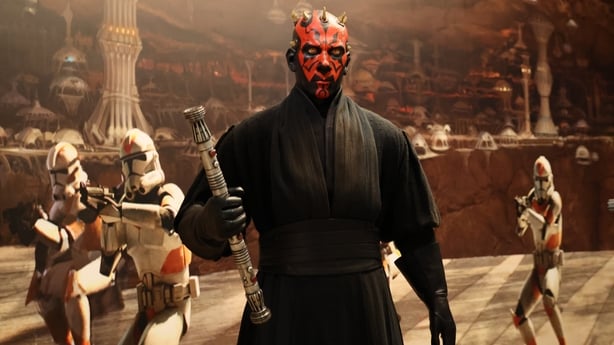
Darth Maul welcomes you to the Lucas Museum
There are some very large-scale Star Wars exhibits which are impressive — a massive pod racer from The Phantom Menace with the figure of young Anakin Skywalker at the controls, a figure of Princess Leia from Return of the Jedi on a speeder bike with a stormtrooper in hot pursuit, and a life-sized replica of the demonic Darth Maul, again from The Phantom Menace.
And as for Darth Vader, he was there, of course, standing tall in a glass case, surveying the scene, looking down at all of us in cynical judgement, almost on the verge of coming alive and telling us: “I find your lack of faith disturbing”.
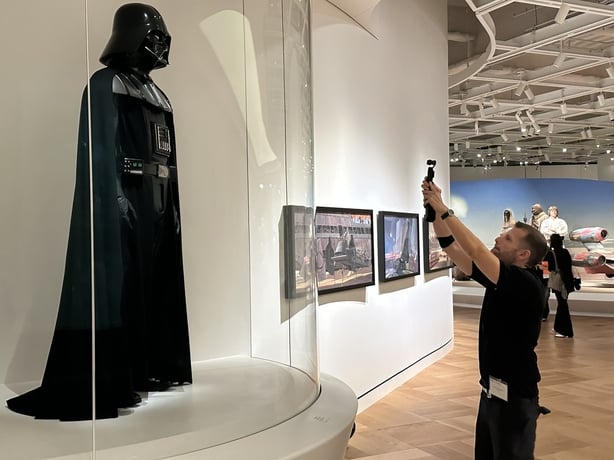
Darth Vadar, judging silently
Along with all that, more glass cabinets displayed models of Imperial Walkers, various other crafts and even those monk-like small creatures (Jawas) from the first Star Wars, the ones that lived in the desert and collected broken droids for spare parts.
Yes, I confess, we were given a limited amount of time to explore the vast Lucas Centre and I spent about two hours of that in the Star Wars section. It was remarkable to see so many objects from that universe collected in one place. I asked one of the museum attendants which parts of the museum were the most popular and she said by far, it was the Star Wars section. Some people are aready calling the centre the Star Wars museum and more or less ignoring the rest of the exhibits, but as I was soon to discover, that would be a big mistake.
Watch: A young George Lucas on narrative art
Much of the museum is devoted to different types of illustrative art and there is a particularly large collection of works by Norman Rockwell, which George Lucas personally collected before the museum existed. American artist Rockwell is most famous for the many illustrations he created for the Saturday Evening Post magazine over many decades. Many of these are on display and are large, detailed works which depict, celebrate, and sometimes critique various aspects of American life, mainly from the 40s, 50s, and 60s. I didn’t find his large works that interesting, and hurried through that section as there were other things I wanted to see, and then one of his smaller, more atypical works stopped me in my tracks.
So what did I think of George’s museum? I thought it was wonderful, in its form, its collections, and in the curation of the exhibits.
Perhaps this is where the museum really shines; due to the diversity of its collection, you may well encounter a work that completely surprises and captivates you. The Rockwell piece that I found quite striking was atypical of his sometimes sentimental or idealised depictions of American life. It was a portrait of President John F Kennedy from 1963, depicting a troubled president under pressure, probably a reaction to the Saturday Evening Post’s story at the time, ‘A Worried President: The Crisis in his Foreign Policy’. Of course, with hindsight, the sombre nature of the portrait seemed to foreshadow what was to come for JFK. I spent a long time studying this work; it was disarming and deeply affecting.
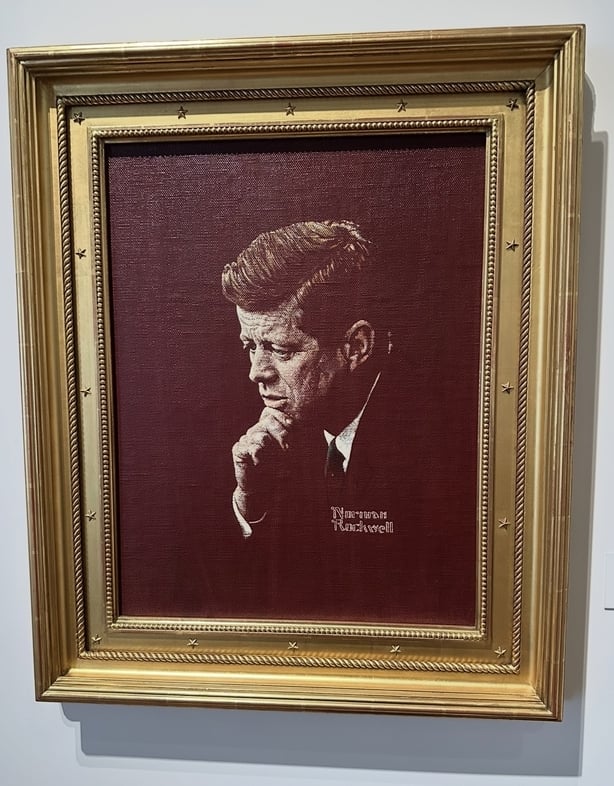
Norman Rockwell’s ‘A Worried President: The Crisis in his Foreign Policy’
The photography section was indicative of many of the collections in the centre. It was understated, not flashy, minimalist in its presentation — blink and you might miss it. I found it was a section to take in slowly, spend time to study each photo, and reflect on its significance both in terms of the image itself and also in terms of its social context. In this section, there are many famous works from people like Gordon Parks, Henri Cartier-Bresson, and the one I found particularly striking was ‘Migrant Mother’ (1936), by Dorothea Lange. This is a famous image of a destitute American farm worker and her two children who are barely surviving. It became a defining image of the 1930s and managed to define the Depression era.
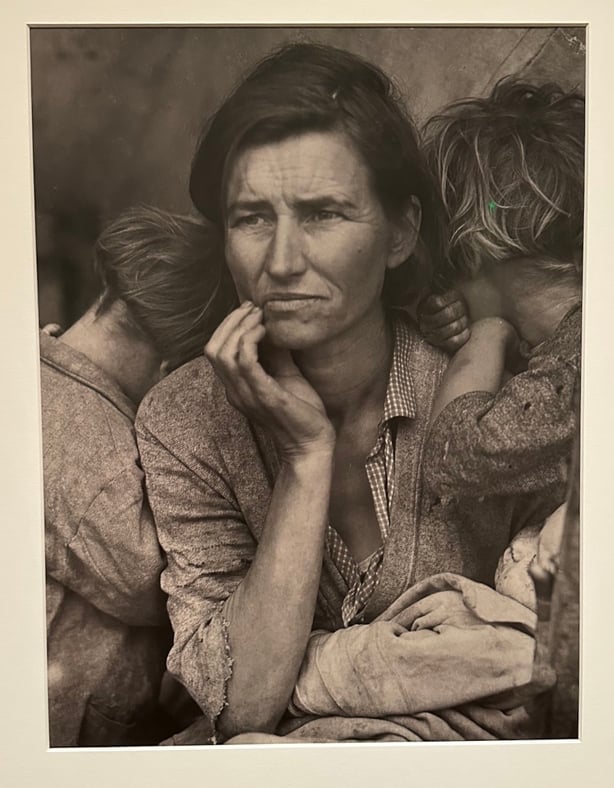
‘Migrant Mother’, by Dorothea Lange
The media preview day was closing at 2.00 pm and I began to realise I was not going to see everything I wanted to. In fact, I had spent most of my time on just the one floor and, such is the scale of the collection, I did not even manage to see everything even on that floor alone. One of the museum attendants told me that there was a collection of murals up on the fifth floor that was well worth seeing. I took his advice and took the elevator. Initially, that section just seemed OK. On entering, there were some interesting murals, but nothing that exciting. Then you turn a corner and without any fanfare, you enter a striking series of works by UK street artist Banksy.
For me, this was one of the highlights of my visit. I had seen many examples of Banksy’s work online and in magazines etc., but never in real life. What struck me was the scale of the works and, of course, a reminder that they were originally public works of art, sprayed onto walls. They were large and much more impressive in real life than in any reproduction. The standout piece for me was his Girl with Balloon — a sad little girl looks on as her red heart-shaped balloon blows away out of reach. There are so many readings you can make of this work: a loss of innocence, a loss of something else precious in life, the death of hope. It’s a simple but compelling work that totally blindsided me.
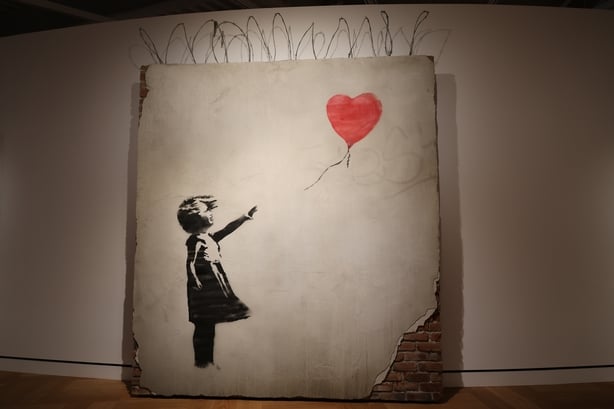
For me, the unexpected Banksy moment was the perfect icing on the cake for George Lucas’s remarkable and well-judged collection of art works. A collection that champions underrated work, especially the work of various illustrators, which despite being popular with the general public had long been dismissed or simply not taken very seriously.
What did I not get to see? Actually quite a lot. The centre has two cinemas, and they present a rolling film programme where you can drop in whenever you like – the programme runs all day. For their inaugural slate, they included the works of silent film pioneer George Melies, the experimental films of Man Ray, Looney Tunes cartoons, the experimental films of Stanley Brakhage and Kenneth Anger, and the early student films of George Lucas himself. Another programme was showing landmark documentaries about cinema such as Howard Suber’s excellent The Power of Film.
Watch: Introducing the Lucas Museum Inaugural Film Program
The centre also has a very large library which is open to the public. One attendant told me that the library was “sick”, which in LA slang means that it’s really quite good.
And some honourable mentions for works that I did not get to see during this visit, but I will return and get to see them next time. The paintings of Frida Kahlo are there somewhere — I must look harder. There are also the works by renowned fantasy illustrator Frank Frazetta, and there was talk of a Batman section as well — I didn’t find that either.
So what did I think of George’s museum? I thought it was wonderful, in its form, its collections, and in the curation of the exhibits. I think it will become very popular, particularly with young people, and become one of the major tourist attractions in Los Angeles. Those other cities that turned it down will, I believe, regret their decisions.
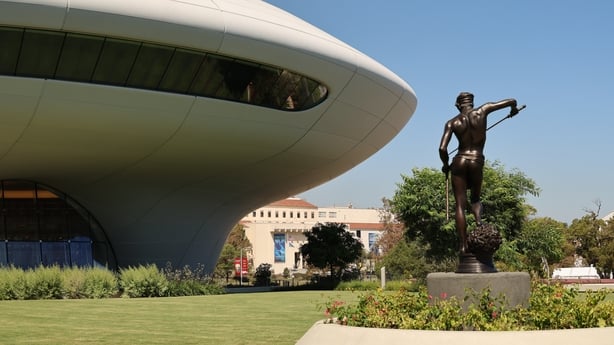
The gardens outside the Lucus Museum
As the media preview comes to an end, I find myself relaxing outside in the lush green parklands that surround the centre. The park includes bronze statues of various fictional characters, including a particularly large one of Princess Leia strangling Jabba the Hut, who is particularly grotesque in bronze form. I noticed that the Jabba statue was particularly popular as people were taking selfies in front of it. Somewhere on the grounds there is a statue of Yoda, and somewhere else, a waterfall – but again, that’s for the next visit.
Find out more about the Lucas Museum of Narrative Art here