
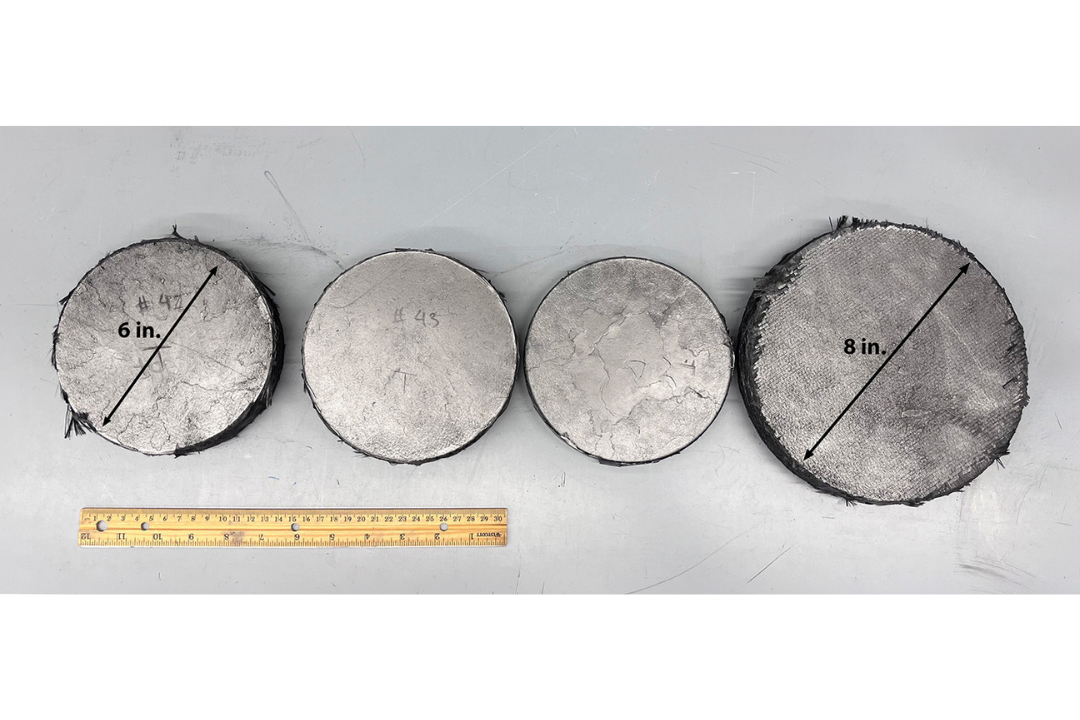

Demonstrating the FAST CAR2 method’s scalability to produce a larger and more market-relevant sample, the team used it to manufacture 6-inch (shown here on the left) and 8-inch carbon-carbon (C/C) samples earlier this year. Current efforts are underway to validate the technique for even larger scales. Source | Johns Hopkins APL/William Fahy and Wes Chapkin
The Johns Hopkins University Applied Physics Laboratory (APL, Laurel, Md., U.S.) has developed a novel manufacturing approach for carbon-carbon (C/C) composites that compresses production timelines from months to days. The technique, called the Field-Assisted Sintering Technique for Carbon-Carbon, or FAST CAR2, uses a single-step densification process in place of the multicycle methods that have long constrained the material’s availability and cost.
C/C composites combine carbon fibers with a graphitic matrix and can remain structurally stable at temperatures exceeding 5000°F (≈2800°C), making them central to rocket nozzles, missile nose cones and hypersonic vehicle thermal protection systems (TPS). Conventional production methods densify the material by bathing it in carbon vapor or repeatedly infiltrating carbon-rich resins and burning off non-carbon material — approaches that require multiple cycles over many months to reach usable density. Demand for the material has grown over the past two decades, but supply has struggled to keep pace largely because of that manufacturing bottleneck, according to APL.
“C/C is one of the most important materials available for the TPS that help high-speed flight vehicles survive extreme heat,” says William Fahy, an APL materials engineer who co-led the FAST CAR2 project. “It was crucial for the heat shield on NASA’s Parker Solar Probe, the spacecraft flying closer to the Sun than any human-made object. It’s indispensable.”
Rather than gas infiltration or repeated resin infusion, FAST CAR2 introduces a carbon-bearing material into a fiber scaffold and applies field-assisted sintering technology — a rapid, high-current pressing method — to consolidate it into a dense final form within minutes. Fahy and Wes Chapkin, a materials scientist and co-investigator on the project, developed the process after Chapkin encountered the limitations of conventional methods during prior work in commercial industry, where a common workaround is adding parallel furnaces rather than addressing the underlying bottleneck.
“We’re aiming for something revolutionary — to change the mechanism itself so we can get there orders of magnitude faster,” Chapkin says.
The team built its first system and produced an initial C/C sample within 3 months. It later produced a 1-inch-wide cylinder in a few days — under a tenth of the time required by conventional methods — and, with access to larger presses, went on to produce several 6-inch cylinders and later an 8-inch cylinder, demonstrating scalability. Microscale analysis found the FAST CAR2 samples nearly uniform with pores just micrometers wide, compared with pores up to a millimeter wide in industry-produced C/C (watch video below). “You want to see a lot of gray because that means the material is fairly uniform — no cracks or pores,” Chapkin says. The samples also passed high-velocity oxygen fuel testing, indicating performance comparable to industry-standard material.
APL is now working with external partners to access larger presses to scale the process further. “Scaling is always the hard part,” Fahy says, “but seeing how quickly this all came together and how successful it has already been, we feel optimistic about where it can go.”