
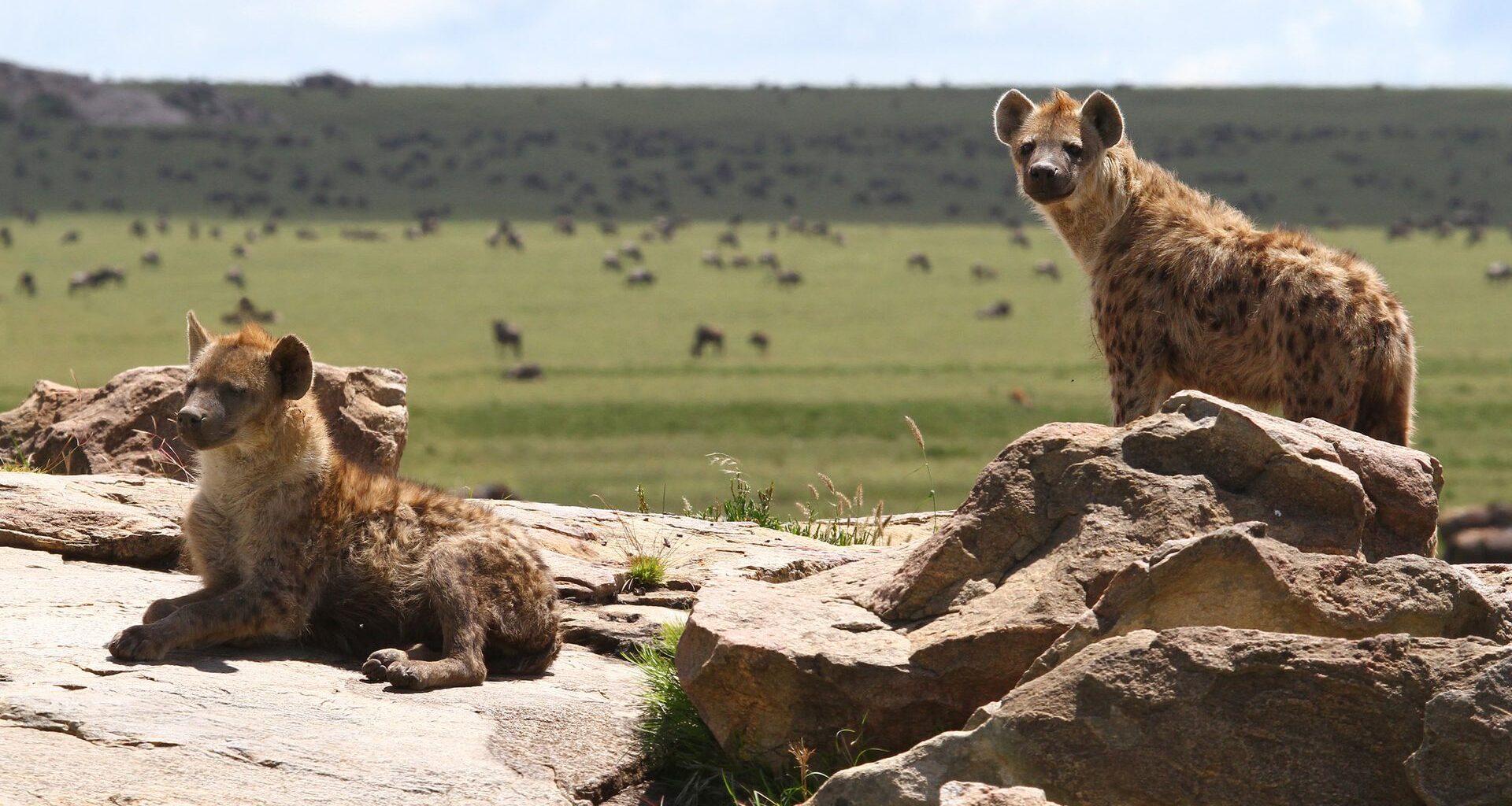
Lions and hyenas are famous rivals, but GPS collars show much of their competition happens without a confrontation.
Hyenas have a reputation as the animals that trail lions and wait for leftovers. At a carcass, that’s often what happens. Between meals, though, spotted hyenas tracked in two southern African ecosystems were more often moving away from nearby lions than toward them, while the male lions tended to approach.
Much of this rivalry plays out at distances where neither animal can see the other. That conclusion rests on GPS collars on 17 lions and 14 spotted hyenas, a small group by the researchers’ own account. The male-lion half of the pattern is a trend that more collars will have to confirm.
Nancy Barker of the University of KwaZulu-Natal in South Africa, the study’s lead author, had seen the behavior herself before any collar recorded it.
“During my Master’s, I lived in the bush while studying brown hyenas,” Barker said. “I repeatedly observed lions actively tracking hyenas.” Other researchers told her she had the relationship backwards, she said, and that what she had seen was a run of chance encounters, but “I felt there was more to the story.”
GPS collars tracked both species
Barker spent months in Etosha National Park in Namibia and in Chobe National Park and the neighboring Linyanti Conservancy in Botswana, learning which lion prides and hyena clans lived where. She then collared one high-ranking animal from almost every group, the kind least likely to leave its territory.
The collars logged a position every five minutes for two hours after sunset and two hours before dawn, when both species are most active. Her team, with co-authors at the University of California, Berkeley, Virginia Tech, and San José State University, set a strict rule for which GPS positions counted in their analysis.
A lion and a hyena counted as a pair only at the moments when both had a real GPS position logged at the same time, and again five minutes later. At each of those moments, the team asked whether each animal was heading toward the other, away from it, or off to the side.
Of the 349,163 positions the collars recorded, only the ones with a matching position from a second animal counted. That left 23 pairs of animals, ten of them a lion and a hyena, tracked between 2013 and 2018.
Hyenas moved away from nearby lions
In the ten lion-hyena pairs, the hyenas did most of the retreating. Within about three miles (5 kilometers), every one of the nine pairs with enough data had the hyena moving away from the lion more often than toward it. In none of the pairs did a hyena clearly approach a lion, and in none did a lion clearly retreat from a hyena.
The clearest case was a male lion and a female hyena in Etosha. Among the matched GPS positions, she was heading away from him about seven times out of ten, and he was heading toward her about as often.
Barker has watched it happen on the ground, and it’s less dramatic than people imagine. “A male lion moves deliberately in the direction of hyena activity, and the hyena, detecting him by sound or scent long before any human would notice anything, adjusts course and keeps the distance open,” she told Earth.com. “And that’s the striking part: it usually ends with nothing happening.”
“The dangerous clashes people film at carcasses are the rare exception; the everyday version of this rivalry is a chase that never becomes one,” she added.
None of this means the old picture was wrong. “Hyenas really do follow lions at times and take scraps; we observed it ourselves in both ecosystems,” Barker said. “The two behaviors are complementary, not contradictory.”
Male lions tended to approach hyenas
Taken together, the lions showed no consistent direction. The team then split them by sex, as Barker’s own field observations had suggested they should.
In all three pairs with a male lion, he moved toward the hyena more often than away from it. In five of the seven pairs with a lioness, she did the reverse.
Barker saw the same on her night follows, when she trailed the collared animals by vehicle after dark. Male lions repeatedly tracked hyenas, and lionesses reacted differently depending on who else from the pride was around. But those three pairs involve just two males, so the researchers call the sex difference a trend rather than a firm result.
Asked by Earth.com why a male lion would go after hyenas when there’s no carcass at stake, Barker began with a caveat. “GPS tells us what animals did, not why,” she said.
“Even without a carcass on the table, hyenas are worth a lion’s attention: hyena activity is information – hyenas find food efficiently and advertise it, so keeping track of them can lead a lion to its next meal,” she added.
Courting lions showed up in the data too
The collars also recorded behavior the study was never designed to detect. Two of the collared lion pairs in Etosha were mating couples, and the tracks alone showed it before the team confirmed it by watching them.
At 160 to 650 feet (50 to 200 meters) apart, the male was mostly heading toward the female and she was mostly heading away from him. Within about 50 feet (15 meters), she moved toward him instead.
Hyenas kept a very different spacing from their own kind. Over four years of tracking, no two collared hyenas were ever logged at the same moment within about 0.6 miles (1 kilometer) of each other. They came from different clans, and spotted hyena clans hold exclusive territories.
The two ecosystems differed, though. In Etosha’s dry savanna, rival clans that met watched each other and backed off. On the Chobe and Linyanti floodplains, the team sometimes saw hyenas from different clans feeding at the same carcass within minutes of each other.
Keeping a buffer takes a big landscape
Barker was most surprised by the distance. The hyenas’ avoidance of lions was detectable from miles away, she said, far beyond the point where the two animals could see one another.
“This coexistence is written in space,” she said. “Hyenas manage the risk lions pose by keeping a buffer, and a buffer of kilometers only works in a landscape big enough to hold it.”
That space is what’s under threat, Barker said. Fences, water concentrated at fewer points during drought, and carcasses gathered together during anthrax control all shrink the area in which lions and hyenas operate, the authors wrote. Any of them could shorten the distance at which the avoidance works.
Whether a hyena that keeps its distance actually lives longer or raises more cubs is the question the collars can’t yet answer. Barker would like to run the same analysis on cheetahs, wild dogs, leopards, and other big carnivores that share space with lions.
For now, that work has stopped. The tracking phase ended years ago, several collared animals were lost to poaching, Barker said, and there’s no funding to collar more. Until more lions are tracked, the male-lion pattern is based on just two lions across three lion-hyena pairs.
The full study was published in the journal Frontiers in Ethology.
—–
Like what you read? Subscribe to our newsletter for engaging articles, exclusive content, and the latest updates.
Check us out on EarthSnap, a free app brought to you by Eric Ralls and Earth.com.
—–