
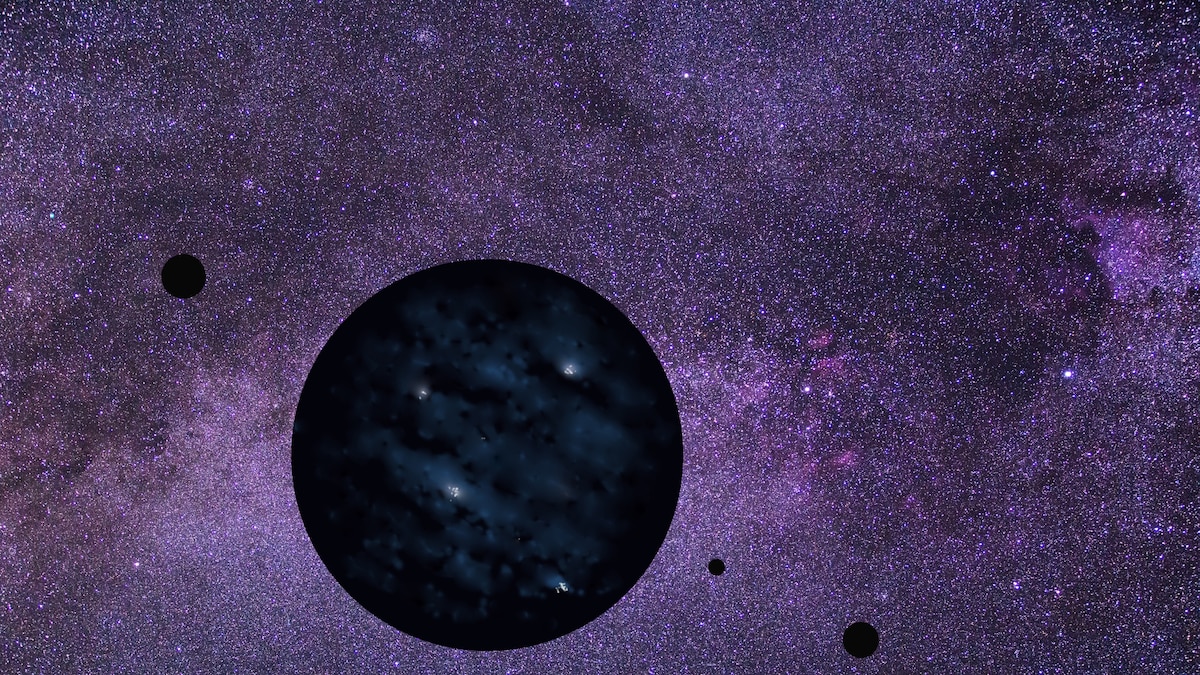
In the early 2000s, scientists were scanning the skies for faint objects when they first began to come across planets with no stars. To date, no moon has been detected around a free-floating planet.
When a rogue planet passes in front of a more distant star, light from the star bends as it passes through the gravity of the planet on its way to Earth. The planet in the foreground briefly amplifies the brightness of the background star, and astronomers can detect this spike in light through a technique called gravitational microlensing.
NASA’s Goddard Space Flight Center/CI Lab
Scientists mainly find evidence of rogue planets by watching them briefly magnify the light of a distant, unrelated star as they pass in front of it—known as gravitational microlensing. Those alignments are rare and may only last for a few hours or days, though.
Ground-based telescope networks detect these bright blips, but they must compete with weather, daylight, atmospheric distortion and gaps in data collection. But our luck may soon change. NASA’s new Nancy Grace Roman telescope will detect gravitational microlensing with a field of view that is 100 times that of the Hubble Space Telescope and scan locations every 12 minutes. It could find as many as 400 Earth-sized rogue planets.
China’s proposed Earth 2.0 mission, expected to launch in 2028, is also planning to look at tens of millions of stars in the Milky Way’s center and potentially detect hundreds more rogue planets. Then the Extremely Large Telescope, an observatory in Chile slated to begin work in 2029, can follow up on any discovered candidates to examine its temperature, atmosphere and chemistry.
As for visiting a rogue planet, “eventually people will launch rockets and go there,” says Gould. But for now, that remains the realm of science fiction. “Even to get to these planets…going at one-tenth the speed of light would take 100,000 years, so it’s a long-term project to find any more information,” he says.