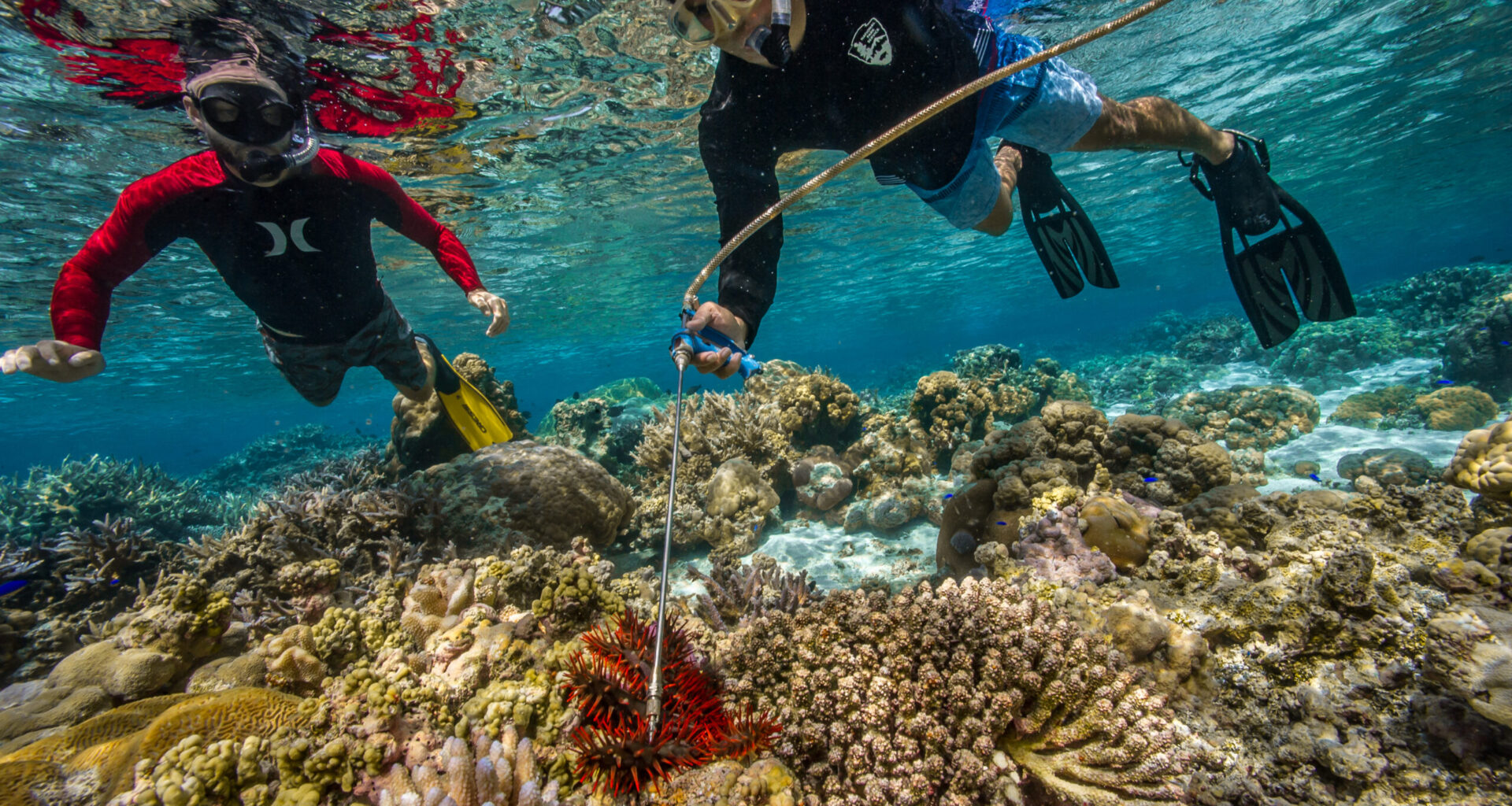
Crown of thorns starfish outbreaks rank alongside cyclones and coral bleaching as one of the biggest causes of coral cover loss on the Great Barrier Reef.
Yet, in a seldom silver lining, it turns out the programme designed to stop those outbreaks – controlling starfish numbers through lethal injections before their populations can explode – delivers more than reef protection alone.
New research has found that the $5.5 million crown of thorns starfish programme run in the Cairns Region of Far North Queensland in 2024-2025 generated a total economic output of about $20 million, including direct effects ($10.5 million), supply-chain effects ($4.9 million), and consumption effects ($4.8 million).
The programme also supported 61 full-time equivalent jobs, made up of 34.4 direct jobs, 13.5 supply jobs, and 13.4 consumption-effect jobs.
“This programme does more than protecting coral on the Great Barrier Reef – it employs young workers and delivers real financial and job-creation flow-on effects into the community, proving – the authors argue – that investing in conservation generates multiple positive and measurable outcomes for the community,” said Dr Rickard Abom, a co-author of the research paper and crown of thorns starfish programme manager from the Reef and Rainforest Research Centre.
Dr Henry Bartelet, who led the research while working as a research fellow at James Cook University’s Cairns Institute, said quantifying the socio-economic impacts of marine interventions like this had been overdue. “If we were talking about resource projects like coal mines, this sort of analysis is standard. But for reef interventions, this type of economic analysis hasn’t been done in Australia before,” he said.
“We wanted to know – when this money gets spent, how much actually sticks around in the community? This knowledge will assist policy makers in designing and implementing reef interventions, like the crown of thorns starfish programme.”