
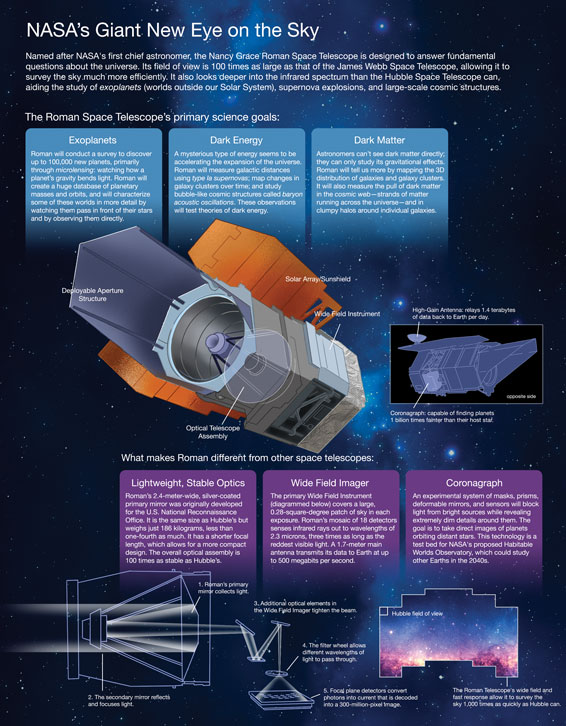
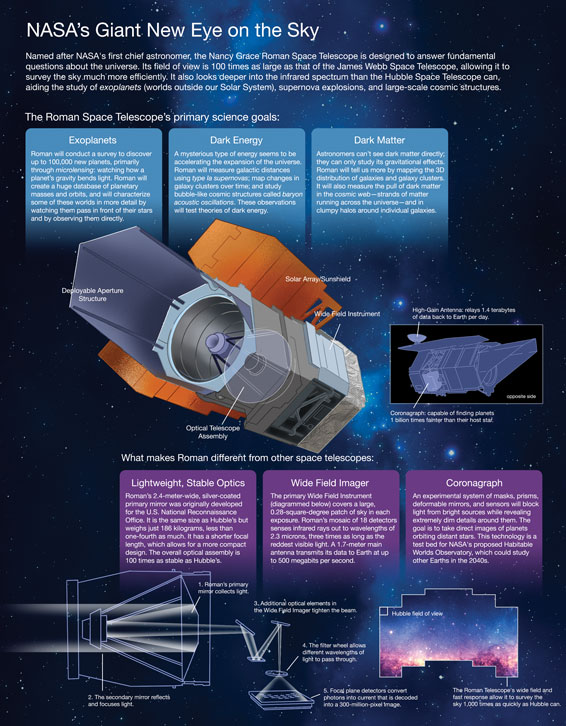
Named after NASA’s first chief astronomer, the Nancy Grace Roman Space Telescope is designed to answer fundamental questions about the universe. Its field of view is 100 times as large as that of the James Webb Space Telescope, allowing it to survey the sky much more efficiently. It also looks deeper into the infrared spectrum than the Hubble Space Telescope can, aiding the study of exoplanets (worlds outside our Solar System), supernova explosions, and large-scale cosmic structures.
Roman will conduct a survey to discover up to 100,000 new planets, primarily through microlensing: watching how a planet’s gravity bends light. Roman will create a huge database of planetary masses and orbits, and will characterize some of these worlds in more detail by watching them pass in front of their stars and by observing them directly.
A mysterious type of energy seems to be accelerating the expansion of the universe. Roman will measure galactic distances using type 1a supernovas; map changes in galaxy clusters over time; and study bubble-like cosmic structures called baryon acoustic oscillations. These observations will test theories of dark energy.
Astronomers can’t see dark matter directly; they can only study its gravitational effects. Roman will tell us more by mapping the 3D distribution of galaxies and galaxy clusters. It will also measure the pull of dark matter in the cosmic web—strands of matter running across the universe—and in clumpy haloes around individual galaxies.
Roman’s 2.4-meter-wide, silver-coated primary mirror was originally developed for the U.S. National Reconnaissance Office. It is the same size as Hubble’s but weighs just 186 kilograms, less than 1-fourth as much. It has a shorter focal length, which allows for a more compact design. The overall optical assembly is 100 times as stable as Hubble’s.
The primary Wide Field Instrument covers a large, 0.28-square-degree patch of sky in each exposure. Roman’s mosaic of 18 detectors senses infrared rays out to wavelengths of 2.3 microns, three times as long as the reddest visible light. A 1.7-meter main antenna transmits its data to Earth at up to 500 megabits per second.
An experimental system of masks, prisms, deformable mirrors, and sensors will block light from bright sources while revealing extremely dim details around them. The goal is to take direct images of planets orbiting distant stars. This technology is a test bed for NASA’s proposed Habitable Worlds Observatory, which could study other Earths in the 2040s.