
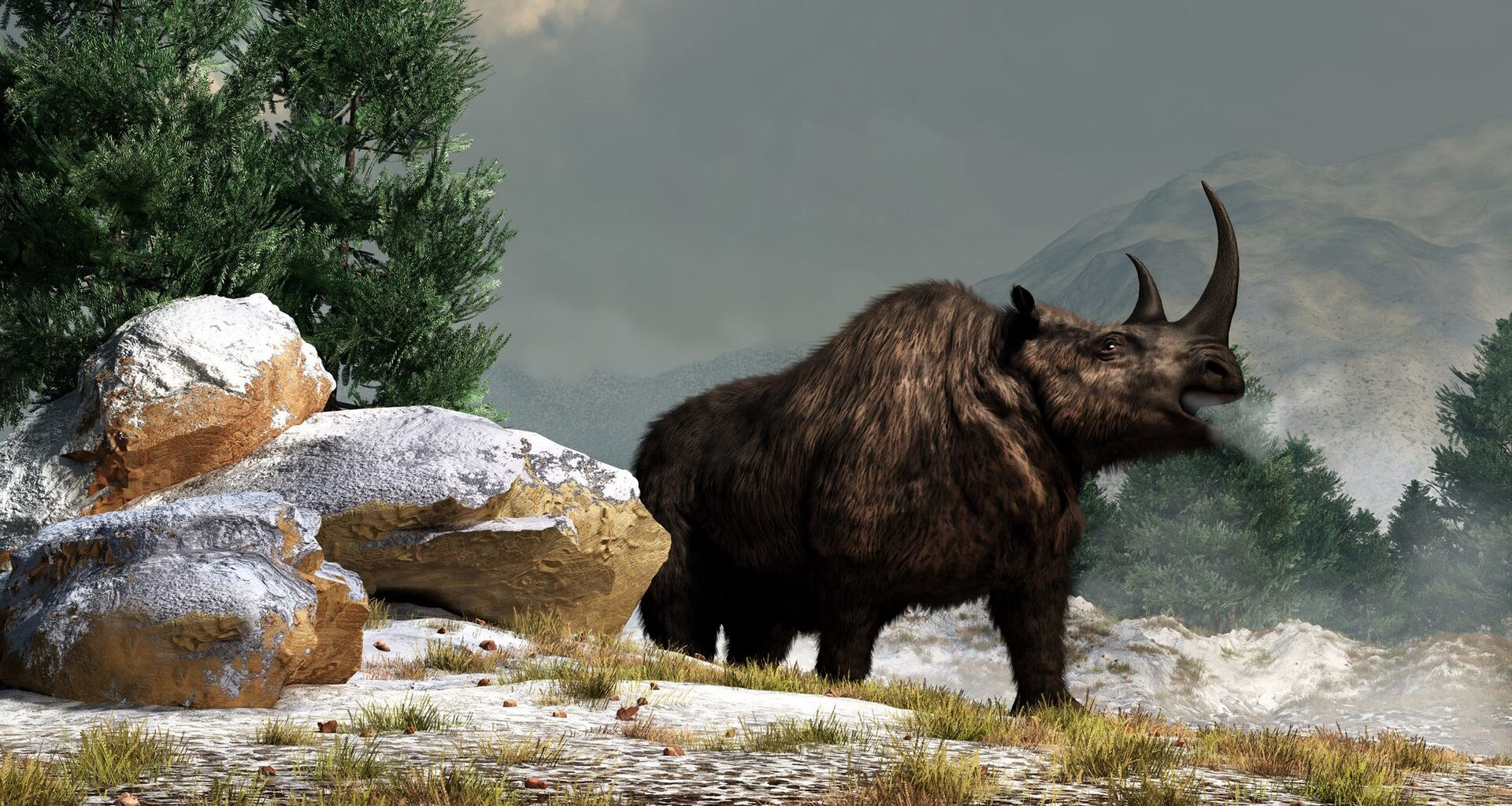
Woolly rhino DNA from 183 fossils traces most of the animal’s genetic variety to milder East Asia and the Altai rather than Siberia.
People most closely associate the woolly rhino with frozen Siberia, where its DNA also survives best. Until now, all three of the animal’s full genomes came from there.
A new study of fossils from across Eurasia finds that most of the animal’s genetic variety arose farther south, in the milder middle latitudes of Asia. The Siberian animals had the least of it. So an animal built for the cold did much of its evolving in milder country.
Xiao-Le Lei of Peking University and Jiaoyang Ruan of the Institute of Geology and Geophysics at the Chinese Academy of Sciences led the work. He Yu of Peking University is the senior author, and Love Dalén of the Centre for Palaeogenetics in Stockholm was on the team.
They screened 183 fossils. From 29 of them, the team read the short loop of DNA that passes only from a mother to her calf, and from 14 it read the full genome.
The bones came from East Asia, Europe and the Altai, where Siberia meets Central Asia. The oldest is more than 200,000 years old.
Siberian rhinos had the least variety
Four maternal lineages turned up across the continent. Two were common in East Asia and northeastern Siberia, and the other two were common in the Altai and Europe. Only the Altai had all four.
In the maternal DNA, the northeastern Siberian animals had the least variety of any region. In the full genomes, animals from East Asia and the Altai had more variation than those from eastern Europe or northeastern Siberia.
The oldest full genome came from a roughly 170,000-year-old animal found at Qinggang in northeastern China. That animal was ancestral to every later woolly rhino in the study. So East Asia is one possible origin of the lineages that spread across Eurasia in the last Ice Age.
That is the opposite of the woolly mammoth, whose genetic variety is traced to high-latitude Siberia. The rhino’s variety more likely arose in warmer country to the south.
Splitting began during a long climate swing
By the team’s estimate, all four maternal lineages trace back to one ancestor about 464,000 years ago, with a likely range of 409,000 to 527,000 years. They split from one another between about 464,000 and 417,000 years ago.
That stretch overlaps a drawn-out transition from a glacial period into a warm one, when the habitat model shows rhino country across Eurasia shrinking and breaking up. The date is also close to the age of the oldest known woolly rhino fossil, found in central Europe and dated to about 450,000 years ago.
One thing didn’t fit. Living rhinos keep to home ranges under 40 square miles (100 square kilometers), while an elephant can move about 620 miles (1,000 kilometers) in a lifetime. Yet the rhino lineages were sorted by region less tightly than the mammoth’s.
The authors offered two explanations. Rhinos live alone while elephant herds are built around mothers, or the range shrank and regrew so often that the pattern blurred.
In the Altai, suitable habitat persisted
The team also modeled where the rhinos could live, from 1,153 fossil sites and reconstructions of temperature, rainfall and plant growth for each thousand years of the past 500,000.
During the glacial period from about 191,000 to 130,000 years ago, suitable country stretched across the middle latitudes of Eurasia. When the last warm interglacial began about 130,000 years ago, that habitat vanished from much of East Asia and Europe.
Suitable country survived across central Eurasia, from the Urals to the Altai. The full genomes show populations in East Asia, northeastern Siberia, and eastern Europe shrinking at the same time.
Europe lost the most habitat and didn’t recover until about 70,000 years ago, which may explain why the eastern European rhinos had so little variation.
The Altai stayed suitable for at least the past 160,000 years, warm spells included. A roughly 102,000-year-old rhino from Denisova Cave in the Altai was ancestral to every younger animal in the study from the Altai, eastern Europe, and northeastern Siberia.
On the authors’ reading, rhinos spread back out from that refuge as the climate cooled again and east–west routes reopened.
Woolly rhinos bred with a close relative
Merck’s rhinoceros was the woolly rhino’s closest living relative in the late Ice Age, and the two species shared much of their range.
The signal of Merck’s DNA was strongest in the northeastern Siberian woolly rhinos. The one Merck’s genome available also came from there, so the authors think the two species mixed locally.
East Asian animals carried the signal too, and it grew stronger over time. That suggests the interbreeding began sometime between roughly 190,000 and 71,000 years ago and continued into the period between about 57,000 and 29,000 years ago.
One European result is harder to explain. Eastern European rhinos from the coldest stretch of the last glaciation, about 26,500 to 19,000 years ago, carried the signal, while an older European animal didn’t.
Merck’s rhinoceros was thought to have died out in Europe after about 115,000 years ago, so it shouldn’t have been there to interbreed.
The authors’ alternative is that the Merck’s DNA reached Europe by way of Siberian woolly rhinos moving to lower latitudes as the climate cooled. Genes did flow that way during the coldest stretch, into the Altai and eastern Europe.
Where did the woolly rhino come from?
The picture is thinnest where the species may have begun. The oldest known woolly rhino bones are European, and those early animals have been described as a separate subspecies. No genomes old enough to test that have been read from Europe.
Whether the east–west split in the maternal DNA reaches back to those early animals is still an open question. Frozen ground has made northern Eurasia the easy place to find ancient DNA. That bias leaves gaps.
The next step the authors named is more DNA from fossils in the middle and lower latitudes. DNA survives less well there, but on this evidence that’s where much of the woolly rhino’s history happened.
The full study was published in the journal Science.
—–
Like what you read? Subscribe to our newsletter for engaging articles, exclusive content, and the latest updates.
Check us out on EarthSnap, a free app brought to you by Eric Ralls and Earth.com.
—–