
In May 1981, The Darker Side of Human Nature, an exhibition of works by recent Ilam graduate Peter Ransom, appeared at the newly opened Gingko Gallery in the Christchurch Arts Centre. Among the attendees was Andrew Harrison, a second-year Canterbury student with a passion for prints and drawings. Immediately
taken with Ransom’s art, Harrison went home with a copy of the gruesome exhibition poster showing a self-portrait of the artist as a decapitated body, as well as a moody watercolour, The Suicidal Passenger, depicting a solitary woman in black in a tilting ship cabin.
Harrison was not alone in recognising a new artistic talent. Throughout the 1980s, Ransom’s exhibitions were favourably reviewed and his work was widely collected. Citing the influence of Edvard Munch, Henri de Toulouse-Lautrec and a host of European novelists, critics praised Ransom’s embrace of figurative art at a time when it was far from fashionable. Curators also took note; his prints and watercolours were acquired by the Robert McDougall (now Christchurch) Art Gallery and the National Art Gallery (now Te Papa).
Then, in 1989, Ransom stopped exhibiting. Years passed, the art world found new darlings and the artist behind the moody, literary images faded from memory. He retained his admirers, and his works would appear in public exhibitions from time to time. But no one seemed to know anything about him. Some two years ago, a Dunedin friend from the arts community stopped me and declared, “I’ve got a project for you. You need to find out whatever happened to Peter Ransom.” As it turned out, Andrew Harrison solved the mystery first.
Ransom in 2026: Still inspired by the great novelists. Photo / Supplied
Harrison, today a curator and architectural consultant, acquired more of Ransom’s works and even corresponded with the artist for a time. But he, too, lost touch with him. After years overseas, Harrison moved to Greymouth with his partner, Andy Ross, a weaver trained in the Shetland Islands who often runs events showcasing his impressive textile collection. After one exhibition last year, an attendee offered to show Ross a collection of her mother’s embroidery. “I walked up to her house,” says Ross, “and walked into her front room, and there was a picture on the wall I recognised. I pointed to it and said, ‘Oh, we’ve got that picture. It’s a Peter Ransom.’ She said, ‘Yes, he’s my brother.’”
Ransom, she told him, was alive and well and living in Japan. A flurry of emails and phone calls followed, and earlier this year, a selection of Ransom’s works appeared in a handsome exhibition of figurative art at Greymouth’s Left Bank Gallery, curated by Harrison and Ross. The exhibition included nine works from the 1970s and 80s but, enticingly, six recent drawings, all inspired by scenes from Marcel Proust’s In Search of Lost Time. Ransom had made the works four years earlier, but they’d never been exhibited. Now, however, through the efforts of Harrison and Ross, and with the support of Dunedin gallerist Brett McDowell, Ransom was making up for lost time.
A rich tradition
There is a memorable black-and-white photograph of a young Peter Ransom holding up a freshly produced print inspired by George Eliot’s 1870s masterpiece Middlemarch. The print is a remarkable and precocious achievement, but it’s difficult to imagine a less edgy or cool inspiration for an artwork created in 1979. It shows the unhappy couple at the centre of Eliot’s novel: the older scholar Edward Casaubon, who will never produce a great work of learning, and the devoted young wife Dorothea, who is slowly realising her husband’s limitations.
The bare room looks nothing like the sumptuous settings of traditional illustrations; its empty shelves and pointless ladder suggest a scene from an existentialist theatre production. Yet, it also evokes a famous description from Eliot’s novel, when, for Dorothea, “the large vistas and wide fresh air which she had dreamed of finding in her husband’s mind were replaced by anterooms and winding passages which seemed to lead nowhere”. The 22-year-old artist captured something profound about the melancholy relationship, the characters each entrapped in their own solitude.
It’s this literary side of Ransom’s work that initially fascinated me. We often forget most of the great novelists of the 19th century – Dickens, Eliot, Trollope, Hardy – worked closely with artists who created memorable images that appeared in the original printings of their works. That rich, collaborative tradition has faded from serious literature – superseded, perhaps, by the rise of film adaptation – though it still thrives in graphic novels and children’s literature. I was intrigued to learn of a New Zealand artist who turned to writers of the past for inspiration but whose own vision shone through in the resulting artworks.
Ransom’s 1979 etching based on Middlemarch: Mr Casaubon and the Ardent Young Dorothea. Photo / Supplied
In April, I drove to Greymouth to see the exhibition and meet Harrison, Ross and Ransom’s sister, Shar. I returned to Dunedin with the answers to many of my questions, as well, of course, as a copy of the Middlemarch print. Then in late June, on a sultry Tokyo summer afternoon, I had lunch with Peter Ransom at a traditional Japanese restaurant in Ueno Park. Now 68, he retains a youthful enthusiasm for his craft. Though he isn’t fluent in Japanese, he seemed at ease in his adopted country. Most surprisingly, though, the creator of those melancholy images from the 1980s seems happy.
A story of wooden spoons
Born in Palmerston North in 1957, Ransom was one of five children, including an older half-brother from his father’s previous marriage. When the budding artist, aged 6, was in hospital owing to complications from tonsil surgery, the family moved to Dannevirke. As a result, he never properly separated from his first home: when he was released from hospital, he found his belongings in a new house, in a different part of the country.
Ransom’s father was in the police force, later working as a contractor operating heavy machinery. He was a skilful draughtsman; Ransom fondly recalls him, every night, drawing ships or airplanes on a blackboard in his son’s bedroom. In the morning, Peter would try to copy his father’s work.
Not all of his childhood memories are so fond. “In those days,” Ransom says, “corporal punishment was the norm in most families. If we misbehaved, we’d get a whack. My mother used the wooden spoon and Dad used to use a leather strap.” One of Ransom’s most compelling early images, The Hiding, shows a woman about to strike a child with a large spoon. The two tiny figures are alone in an empty, Giorgio de Chirico-like landscape, with a row of tenement buildings the only witnesses to the impending violence.
But here, as in many of Ransom’s images, there is another, darkly comical layer of remembrance. “Having four children must have been a bit of a handful for my mother. And when she was setting the table, the wooden spoon would go down next to the knives and forks. So, when her back was turned, we’d spirit away the spoon. There was a ledge under the table, and we’d put it there. My mother was so distracted, she didn’t know that it had gone missing. And so she’d buy a new one. When we moved into our new house in town, and my parents lifted up the table, about four wooden spoons dropped out from under it. And my parents just hooted with laughter.”
Ransom’s The Hiding, 1981. Photo / Supplied
There’s a pun, then, in the print’s title: the child receiving a “hiding”, but behind it the story of the hidden spoons. An artful and slightly surreal representation of a remembered scene of pain concealed a related scene of youthful resourcefulness. Ransom is amused by this interpretation but insists the wordplay had never previously crossed his mind.
Ransom enrolled at Ilam, where he studied with the late master printer Barry Cleavin. “I couldn’t have had a better instructor in terms of learning about the technicalities of print-making.” It was a remarkable period for print art in Christchurch. Denise Copland was a few years ahead of Ransom; Jason Greig a few years behind.
The artist built up an impressive portfolio. Some pieces drew on literary sources, others came from Christchurch flatting life, including roommates, and multiple self-portraits. His artistry reached new levels of maturity – the gorgeous 1988 etching View conjures the work of Danish master Vilhelm Hammershøi.
Out to fallow
But talent and good reviews don’t pay the rent. “I’d look out my window and see people cavorting around and enjoying themselves on the weekend. And I would be serving them in the [Christchurch bar-restaurant] Dux de Lux. And I was thinking, you know, I’m sacrificing everything for my work.” So, in December 1989, Ransom departed New Zealand to take a position in Japan with an organisation assisting English instructors.
The goal was familiar: make enough money to buy a house in New Zealand, then get back to work as an artist. But months turned to years, years to decades. He moved from teaching English to a management position procuring apartments for English teachers. He married a Japanese woman, Eiko, who works in banking. They bought an apartment near Tokyo Bay and the two settled into a busy life. Tokyo became home.
The move to Japan inevitably affected Ransom’s standing in the New Zealand art world. Peter McLeavey, the influential Wellington art dealer, stopped showing his work. “He didn’t believe in representing artists who lived abroad,” says Ransom. Worse was to come. During his first visit back to New Zealand, in 1996, he and Shar visited a Christchurch gallery that was holding some of his work. “There was this really belligerent person. He said, ‘Your work has been cluttering up our gallery for years. Get rid of it right now.’”
The memory still stings. “At one time I had been the bee’s knees. And now, they were asking me to get rid of all my work. Luckily, Shar was with me, so we loaded everything up into the boot of her car.” Shar had limited storage space, so Ransom made the difficult decision to destroy many of his prints.
“There were about 30 works, but there were about 10 copies of each. And I only saved two or three.” It was a dark time. “You know, I thought I was well and truly forgotten.”
Peter Ransom, Augustin Meaulnes and Francois Seurel in their Attic Bedroom, 2026, pastel and ink. Photo / Supplied
Stars realign
Ransom’s love of art never diminished – he found a new outlet collecting Japanese prints – but decades passed before he returned to drawing. “In about 2022, something got into me. I thought, I’m going to produce work for a show. So that’s when I did that suite of six drawings.” The Proust-inspired works lay dormant for four years, awaiting a show. “When Andrew Harrison contacted me, I just happened to have them available.”
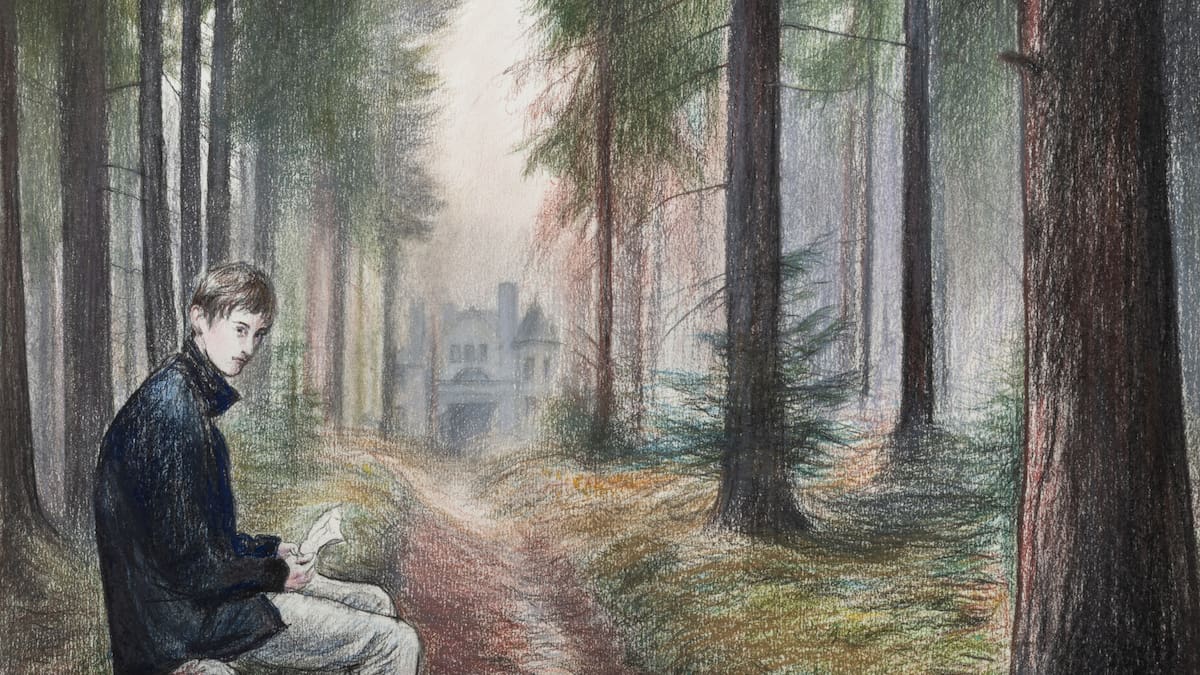
When Brett McDowell asked if Ransom had plans to produce more work, his mind turned to another classic of French literature, Alain-Fournier’s Le Grand Meaulnes (1913), often translated as The Lost Domain. The novel concerns Augustin Meaulnes, a young man boarding at a village school who, after getting lost in the forest, discovers a grand home where a wedding is about to take place. Meaulnes becomes obsessed with a young woman who lives there, but after returning to his school he is unable to retrace his steps and tell her of his feelings.
The book has long been a favourite of Ransom’s, not least for its central character’s search for past joys. Ransom points to the loss of his childhood home in Palmerston North as a kind of parallel to Augustin’s loss.
In Tokyo, Ransom brought out some of his new drawings. They’re instantly recognisable as his, but there is an unexpected warmth. They could be the work of a forgotten contemporary of Toulouse-Lautrec or Pierre Bonnard. In one, a determined Augustin holds the incomplete map he has created of the road to his lost domain. The grand building shimmers in the distance. It is surely no coincidence that the image of Augustin closely resembles a portrait of the New Zealand artist as a young man.
Augustin’s determination is also evident in the artist as an older man. “I feel I haven’t finished yet,” Ransom says. “I always knew that I had it in me. It’s just that the stars had to be aligned and the circumstances had to be right for me to really get back into it. When Brett reached out, I literally broke down and cried, because I knew this was it. This was the moment. It was all going to happen.”
Thomas McLean is a professor of English at the University of Otago. Peter Ransom’s Le Grand Meaulnes opens at Brett McDowell Gallery, Dunedin, on September 25.
SaveShare this article
Reminder, this is a Premium article and requires a subscription to read.
Copy LinkEmailFacebookTwitter/XLinkedInReddit
Tags:
- 1981
- again
- among
- Andrew
- appeared
- Art
- artist
- Arts
- Arts and design
- ArtsAndDesign
- ArtsDesign
- attendees
- Back
- Black
- body
- cabin
- Canterbury
- centre
- Christchurch
- copy
- darker
- Decapitated
- depicting
- Design
- Drawings
- Entertainment
- exhibition
- exhibits
- frame
- Gallery
- gingko
- graduate
- gruesome
- Harrison
- home
- Human
- IE
- ilam
- immediately
- IN
- Ireland
- moody
- nature
- newly
- opened
- passenger
- Passion
- peter
- poster
- prints
- ransom
- ransoms
- Recent
- secondyear
- selfportrait
- ship
- showing
- side
- solitary
- student
- suicidal
- taken
- the
- tilting
- watercolour
- well
- went
- with
- Woman
- works