
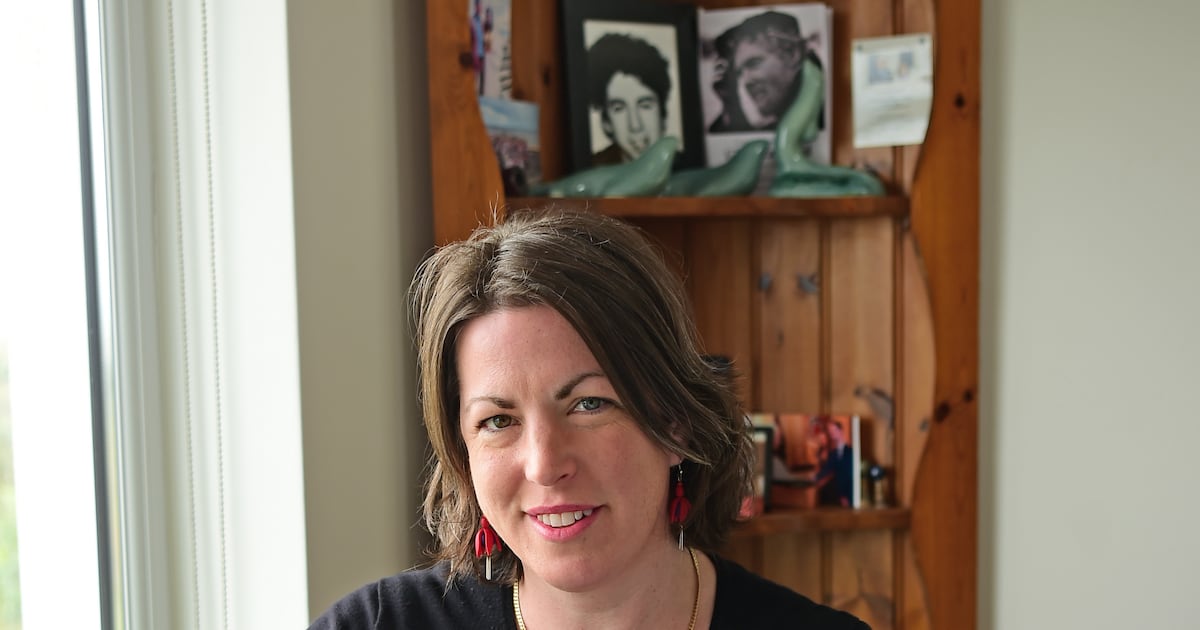
Like that ache felt by so many emigrants, Achill islander Orla Cafferkey always felt a visceral and magnetic pull back to her native place.
But it was the terrible news of her brother Finbar’s death on a battlefield in Ukraine in April 2023 that ultimately compelled her return home.
A graduate of the University of Galway and the London School of Economics, Cafferkey was at a crossroads in her life when, aged 32 in 2017, she set off on a solo trek along the Appalachian Trail.
On her third day hiking, on top of a mountain in Georgia she met Brendan Sedlak, a surgical assistant from Cleveland.
The pair completed the 2,200-mile trek together and within months were married and settled in a leafy suburb of the Ohio city where Sedlak had been raised.
In time their two boys were born. Finbar is now eight and Luan is six.
With Achill’s deep historical connections to Cleveland – more than 80 per cent of the Ohioan city’s Irish population can trace their origins to the Co Mayo island and its environs – it could be argued that Cafferkey was living in a home away from home.
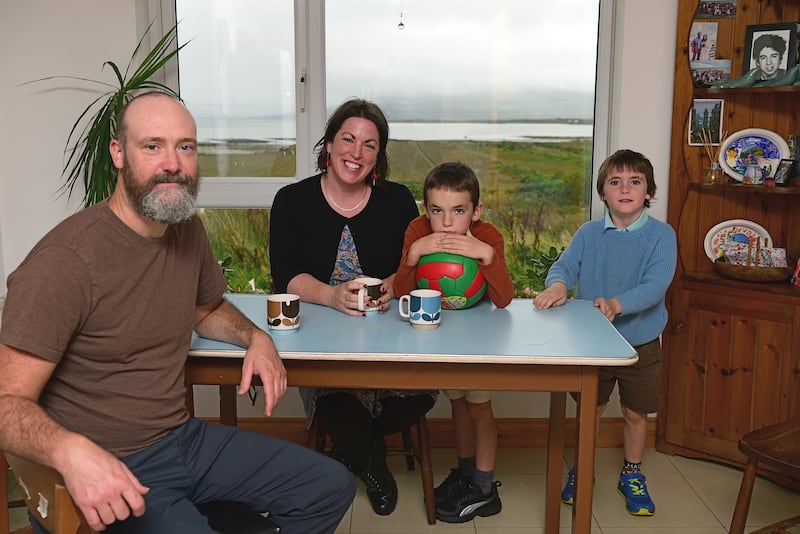 Orla Cafferkey with her husband Brendan and their boys Finbar and Luan. Photograph: Conor McKeown for The Irish Times
“On the kitchen table late at night, I would make lists, pros and cons, for and against, comparative costs of living, but the numbers on that notepad never added up in Achill’s favour,” she says.
“We were living in a great place to raise our two young children. But I couldn’t help it and I dared to want for more.”
Everything changed on April 19th, 2023, when she received a phone call from home. Her much-loved oldest brother Finbar was missing in action in Ukraine, presumed dead.
A lifelong activist for various causes, he was fighting alongside two other international volunteers with a Ukrainian unit in an attempt to keep a vital route to the city of Bakhmut open as Russians troops prevailed.
“When Finbar was killed we were told first his body was in a field. We were given a Google map pinpoint. During that time there was nothing,” she says.
“I wanted to do more than to go to that field and be with him, I would zoom in to that pinpoint and in my dreams I would tend to his strong, beautiful and now vulnerable body, close his eyes, take off his boots.
“Then after a month, we were told that his body had been moved to a morgue. DNA samples and dental records were sent. We waited six months for formal identification. Then we were told that actually his body was never found,” she says.
“To this day, nobody seems to know where his remains are.”
This tragedy made Cafferkey yearn for home even more.
“I was so fortunate that Brendan felt it too and totting up figures and balancing the pros and cons on a kitchen notepad didn’t seem to matter any more,” she says.
Having grown up as Gaeilge, often doing her homework on the bar of the pub her parents, Tom and Celine ran, she wanted her children to experience “the spontaneity, poetry and wildness” of the Co Mayo island.
While they were already being brought up bilingually and brought home as regularly as was feasible, Cafferkey wanted her two boys to experience “that time-travel feeling when you disembark on to an offshore island”.
“I wanted them to be out picking sméara dubha in September and to see duilisc drying on a flat sheet laid out on the summer grass,” she says.
Most importantly, Cafferkey wanted her two boys to have “a firm grip of the Irish language”.
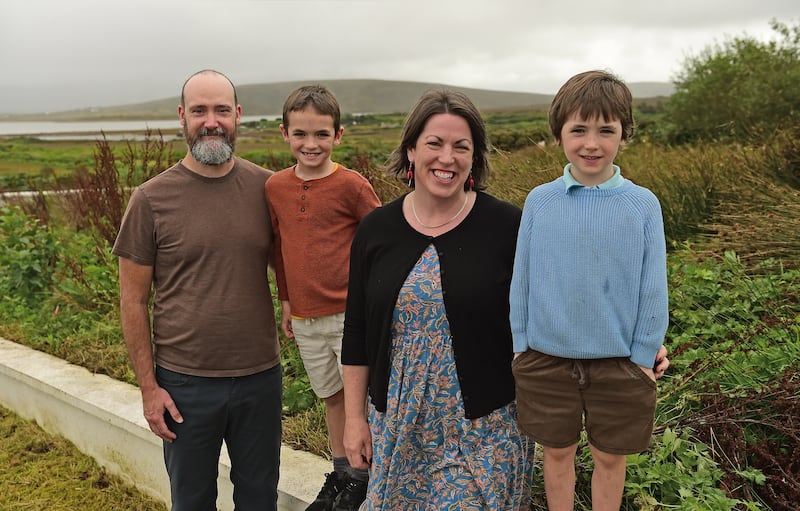 Orla Cafferkey and her family: ‘The move home has been a great one, and we are feeling very settled here.’ Photograph: Conor McKeown for The Irish Times
“With that, they will always be connected to the place and have a sense of belonging. Having the language is a homecoming in itself,” she says.
Beyond dealing with the trauma of the death of Finbar, the logistics of the transition home were relatively seamless.
“We were fortunate to find a home in the village of Ascaill, a couple of miles from where I grew up, as a relative was downsizing,” says Cafferkey.
“The boys attend Scoil Naomh Pádraig in nearby Sáile and I am lucky that my job, which is in fiscal compliance for the Government, allows me to work remotely for 80 per cent of the time.”
Brendan has changed tack completely with more time to co-parent while enjoying woodworking, gardening, learning Irish and playing guitar with four other locals in a band, The Pisreogs.
“The move home has been a great one, and we are feeling very settled here,” she says.
Cafferkey believes there are some issues that she feels the Government should address.
While she praises the fact that the only secondary school on the island, Coláiste Pobail Acla is very proactive about programming events and activities through Irish, it does not have an all-Irish stream.
“I feel that it should be a constitutional right that every child in the country, not least in the Gaeltacht, should have the opportunity to be educated entirely through Irish,” she says.
“We moved home to live in the Gaeltacht but there is no all-Irish secondary school option for them.”
But that is an issue for down the road.
Now, she loves nothing more than seeing her two young boys experience rambling adventures past the crumpled piles of stones where their great-grandparents once lived.