
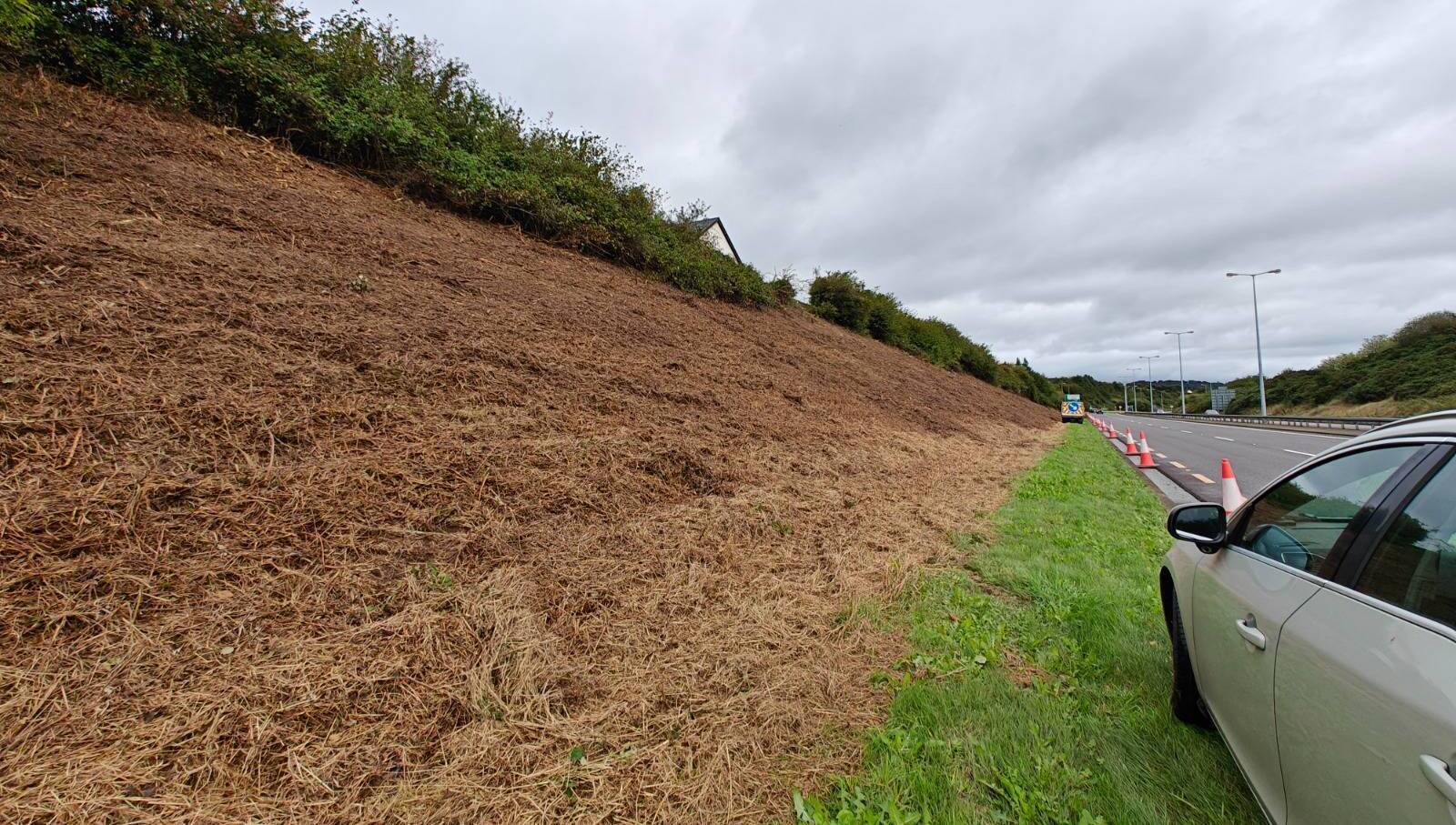
The clearing of vegetation growing alongside the N22 in Curraheen has been described by a leading Cork environmentalist as “an act of serious environmental destruction”.
The works, removing scrub along the grass margins on either side of the N22 link road from Poulavone to the N40 South Link Rd, south of the Killumney link east roundabout, began last week.
The northbound bank has been extensively cleared, and work on the southbound side is ongoing.
The works are being carried out by contractors working on behalf of Transport Infrastructure Ireland (TII), the State agency responsible for developing and maintaining Ireland’s national roads, greenways, and light rail transport networks.
A spokesperson for TII confirmed it was responsible for clearance of the vegetation adding the work was carried out because the scrub constituted “a fire hazard”.
Maria Young, co-ordinator of Cork city community-led eco group Green Spaces for Health and co-founder of the Cork Biodiversity Hub in Ballincollig Regional Park, said the grassy banks on either side of the N22 provided a habitat for multiple species of flora and fauna which, having survived — without incident — the hottest summer in years and heading into winter, was unlikely to now constitute a fire hazard.
“The contractors — who were very pleasant — said they were cutting the vegetation because it had gorse in in it, which they said was a fire hazard, and they had not been able to cut it in the summer because it had been the nesting season,” Ms Young said.
“That vegetation is dense, and it is full of all sorts of species, of which gorse is only one.
“There’s hawthorn and multi-species of plants, and this is a natural corridor connecting Curraheen with Carrigrohane.
“You may be sure there were plenty of animals living there — foxes, hedgehogs, birds, bats, and now there’s nothing. It’s absolutely ripped to the ground.”
Ms Young questioned why Ireland has signed up to the All-Ireland biodiversity pollinating plan and other such biodiversity measures when State agencies “destroy what little we have left”.
“This is an act of serious environmental destruction, and I would ask has there been any sort of environmental impact assessment report done on the consequences to wildlife of this sort of wanton destruction,” she said.
“It’s just heartbreaking, and it’s very hard to take seriously the claim that this is being done to tackle a fire hazard when we’ve just had the warmest summer on record.”