
In the seventeenth century, Seathrún Céitinn compiled a comprehensive history of Ireland from the earliest legendary times to the Anglo-Norman invasion in the twelfth century. His mix of myth, legend and historical record, known as Foras Feasa ar Éirinn (Foundation of Knowledge on Ireland), begins: “In the first place, we shall set down every name that was at any time on Ireland. The first name which was given to Ireland was Inis na bhfiodhbhadh, that is to say ‘Island of the woods’.”
He explains that the name arises from the fact that the first warrior to arrive on the island found it entirely covered in woodland apart from one wide clearing, Maigh nEalta (‘plain of the birds’). Over time, the settlers cleared much of the land, but there were also periods when the trees returned. Céitinn cites a proverb, Trí huaire do chuir Éire trí monga agus trí maola dhi (‘Three times Ireland put three coverings and three bare nesses off her’), meaning that over the ten thousand years of Ireland’s history, the island was naturally forested and felled on different occasions.
It’s no wonder that the name we called ourselves in our own language was ‘Gaels’ and that the language was an Ghaeilge. Gael means ‘forest person’ or ‘wild man’. It derives from the Old Irish goidel (‘wild man’ or ‘warrior’), from the Proto-Celtic root weidelos (‘savage’ or ‘woodsman’), which in turn is connected to weyd (‘wilderness’). Initially, this may have been a derogatory term used by others about us, but we adopted it wholeheartedly. Its meaning suggests that we regarded ourselves primarily as people of the unenclosed wilderness rather than as settled farmers.
We come from dank, misty woodland that, for much of our history, covered three-quarters of the island – this image of ourselves is a core element of early mythology, and yet it is challenged by recent studies of pollen deposits that reveal that large areas of the country were cleared at various points over the last six thousand years. The analysis supports the proverb, showing that the forests waxed and waned considerably in response to population levels, climate change, bog growth and various other factors. But across every epoch, from the Neolithic era to the Bronze Age through to the Iron Age and Middle Ages, woodlands were important symbolic ceremonial places. Our identity was bound up with trees.
Most notable is the way that people were compared to trees or were praised for their tree-like attributes in poetry and mythology. Words such as géag (‘branch’), buinneán (‘slender shoot’ or ‘scion’), slat (‘rod’), tamhan (‘trunk’ or ‘stem’) and bile (‘noble tree’) are used interchangeably for both people and trees. Common honorific terms in the oral tradition were craobh choscartha (‘triumphant branch’) or géag den chraoibh (‘branch of the tree’) and the practice continued into Modern Irish. A nimble warrior could be compared to a willow, hazel, birch or aspen. A prominent leader or chieftain was portrayed as a venerable oak, ash or yew tree.
In Duanaire Finn (an anthology compiled in the seventeenth century from far earlier sources), Fianna warriors were known as daoine mar daragh (‘people like oaks’). Cú Chulainn, the principal hero of the Ulster Cycle, is frequently compared to an oak in strength, resilience and fortitude. Genealogical poems also frequently refer to tree imagery, portraying ancestors as fréamhacha (‘roots’) and descendants as géaga (‘branches’). Indeed, families and clans were also likened to coillte (‘forests’), doirí (‘oak woods’) and craobhacha ghinealaigh (‘genealogical trees’).
These metaphors consciously drew parallels between a thriving family and the healthy ecosystem of a tree rooted in a particular locale, drawing nutrients from the soil to feed the network of branches, twigs, buds and leaves, while also providing nuts and seeds to feed animals and insects, creating leaf mulch in autumn to nourish the land and casting shade in summer to shelter the community.
In the early seventeenth century, the poet Fearghal Óg Mac an Bhaird praised archbishop Flaithrí Ó Maoilchonaire as A cheinnbhile chathrach Túama (‘O stately tree of the city of Tuam’), craobh do lubhghort leasa Té (‘branch of the orchard of the goddess Té’s fortress’) and tamhan úr ón Bhanbha bhráointe (‘fresh stalk from warm, moist lands of the goddess Banbha’).
[ Manchán Mangan: Indigenous people, Ireland and guardians of old loreOpens in new window ]
Not only were people praised for their tree-like qualities, but trees were also praised for their human characteristics. The seventh-century text Auraicept na n-Éces refers to the birch as feocus foltchain (‘faded trunk and fair hair’); the apple tree was said to possess brigh an duine (‘force of the man’); and the vine was tresim fedma (‘strongest of effort’). Niall Mac Coitir in his book about Irish trees claims that the birch was described in bardic poetry as finnbhean (or fhinnebhean) na coille (‘fair woman of the woods’). In the sixteenth-century poem Aidedh Ferghusa meic Léide (The Death of Fergus), Iubhdán, the king of the fairies, describes the willow as sáir (‘noble’), the rowan as caem (‘beloved’), the hazel as fan (‘limber’), the briar as déin (‘difficult’ or ‘spiteful’) and the yew as sinnser (‘patriarch’). He praises the ‘surly’ blackthorn as a ‘wanderer’ who shelters flocks of warbling birds in his ‘scanty’ body. There is a clear overlap between the human body and the elements of trees, with foliage presented as hair, sap as blood, bark as skin and branches as arms, legs and fingers.
This emphasis on the similarities between humans and trees offers a glimpse of how our ancestors regarded themselves as part of nature and could be understood within the same terms and frames of reference as the natural world. It’s a profound understanding, presented in a simple way. Often, we dismiss Irish lore as lacking in intellectual rigour or academic sophistication, not understanding that a worldview based on nature-rooted metaphors works in a more subtle, but equally sophisticated, way. Seeing ourselves in terms of the trees that provide everything from oxygen to fire, from food to tools, is not only a valid but also a profoundly resonant way of understanding the world. It roots us in the original sites of worship of our forebears – the sacred tree groves known as nemeta, where people sought a connection with the divine – and even further back, to the African scrub and rainforests that our ancestors first climbed down from to begin new lives on the ground.
It’s worth noting that the second name Ireland had (after ‘Island of the woods’), according to Seathrún Céitinn’s history, was Críoch na bhfuineadhach (‘Land of the end’), referring to the fact that Ireland was believed to be the outer limit of the known world. It was finibus terrae (Latin for ‘edge of the world’). Beyond it was an empty expanse. Nothingness. This notion is key to understanding many of the ideas in this book, and specifically how Ireland has held on to its old insights and practices relating to our relationship with the land and the spirits that animate it. We were an isolated outpost, clinging on to a liminal existence on the margins.
People had been living in England for thousands of years before anyone dared settle on the bleak, uninhabitable tundra of Ireland, which was still covered in parts by a millennia-old, one-kilometre-thick ice sheet. It’s why the Roman Empire called Ireland Hibernia, which possibly derives from the Latin hibernus, meaning ‘wintry’ – but it could also derive from a Greek version of an old Celtic name for Ireland. It’s why the early Christian monks from the Middle East and Rome made such an effort to establish a foothold here: they were hoping to summon into reality the promise of St Matthew and the writers of the Acts of the Apostles that Jesus Christ would return once the message of God’s love had been spread to the very ends of the earth.
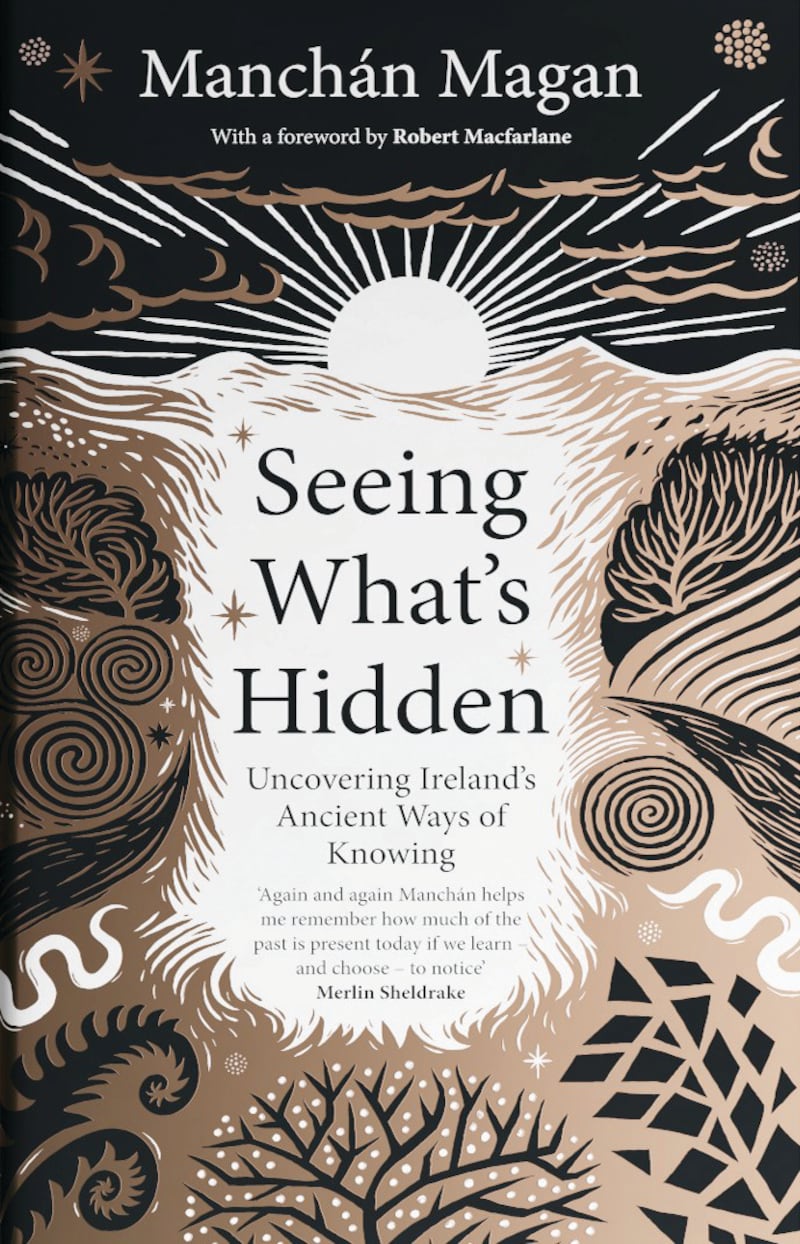 Manchán Magan’s final book.
Seeing What’s Hidden: Uncovering Ireland’s Ancient Ways of Knowing by Manchán Magan is published by Gill Books. It completes his trilogy that also includes Thirty Two Words for Field and Listen to the Land Speak.