
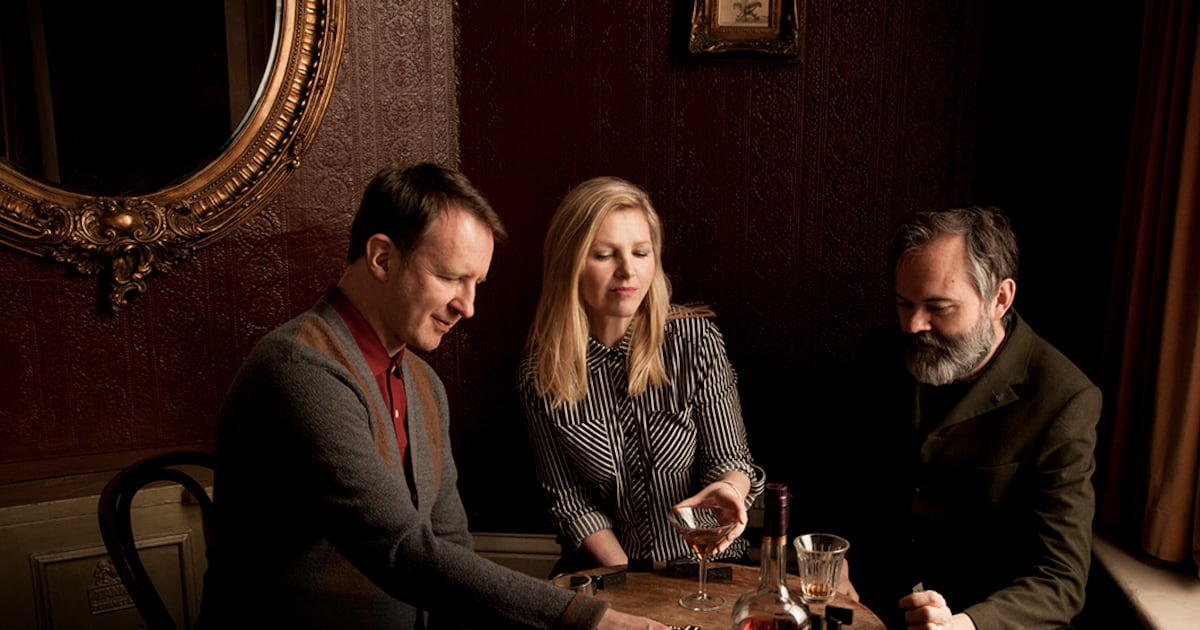
With my favourite band on the cusp of splitting up, it feels natural to think about the passage of time. The music of Saint Etienne, who bring their farewell tour to Dublin on Tuesday, has often seemed to be about exactly that.
Foxbase Alpha, their debut record, from 1991, featured an audio clip of the late Countdown presenter Richard Whiteley readying contestants for the conundrum clock. Hearing Colin Murray, the current host of the Channel 4 show, say the same words before the closing track of International, their final album, from 2025, was ineffably eerie.
I have responded to the imminent calling of time by Bob Stanley, Pete Wiggs and Sarah Cracknell the way any panicky woman in midlife should: by spending what’s left of my disposable income on Saint Etienne merchandise. I’ve got the Avenue T-shirt (scoop neck, amazing). I’ve got the You’re in a Bad Way sweatshirt (very cosy). Many years ago I had a slim-fit Finisterre T-shirt, but I swelled out of it – time will do that too.
While in the Yorkshire town of Halifax in June to see the first of their dates supporting Belle & Sebastian (my other favourite band), my friend and I danced until our feet were sore to some of Saint Etienne’s earliest songs, from the electronic mystery of Like a Motorway – their marriage of 19th-century folk melody and techno beat – to the delicate dreaminess of Spring, the Spanish-tinged melancholia of Pale Movie and the most perfect single of the 1990s, the Euro-pop heartbreak of He’s on the Phone.
Nothing Can Stop Us, which samples the 1960s shimmer of Dusty Springfield’s I Can’t Wait Until I See My Baby’s Face, might have been unidentifiable to students on this week’s episode of University Challenge, but here it was the opening salvo. Before the melody of the chorus floated over our heads I had both vowed to procure a gold bomber jacket just like Cracknell’s and slipped into a state of midsummer bliss.
Saint Etienne’s lyrical vignettes often allude to the ways in which the world has been coarsened by the combined ravages of finance and aesthetic philistinism. “Did you know they pulled the town hall down? / I don’t think you’ll recognise this town,” Cracknell and her duet partner, Tim Burgess, sing on I Was Born on Christmas Day. On Teenage Winter, a local charity shop finds itself competing with eBay, while the removal of a jukebox from the Hat and Fan pub elicits dismay.
But the best example comes from the languid Heart Failed (In the Back of a Taxi): “Sold the ground to a PLC / Moved the club out to Newbury / Sod the fans and their families.”
When you’re 17 you want people to like what you like – not everybody, obviously, but the cool kids in your orbit. Then you reach a place of maturity where you understand that your relationship with music is personal and more special for the fact that it can never be exactly the same as someone else’s.
So I thrust forward my CD of Good Humor, Saint Etienne’s 1998 album – all honeyed vocals and sun-drenched vibes – to help soundtrack a group road trip in the Australian spring. I had mutual raves with others who inhaled Bob’s books or loved the sad swoon of Hobart Paving or waited for the delayed gratification of the final “some day” on He’s on the Phone.
And a friend and I once strove to contain ourselves, in that giddy starstruck way, when we realised we were standing behind Sarah Crackenll in a queue for a hotel breakfast buffet.
But your favourite band is your favourite band because of the feeling they inspire inside, and that cannot be fully shared. With Saint Etienne it’s a delightful tingle, a constant effervescence, a refined pleasure.
I listen to Side Streets, a song about not being cowed by existential threats, and I don’t care if no one else I know has heard this gorgeous manifesto for life. I listen to the glittering Dive or the exquisite Last Days of Disco – “We just gotta go where it takes us / Any day we could vanish in a cloud of dust” – and it’s the trigger for a solo dance on my rug.
Then I listen to Music Again and know the sense of wellbeing it gives me hails from my first hearing of it by a pool on the first holiday I took after the pandemic. I listen to a nine-minute beauty called How We Used to Live and think about the years I spent wanting to quit my job and just, as that song’s refrain puts it, “sail away”. One day could be the day when it finally happens.
Music is self-renewing. It replenishes itself. As for Saint Etienne, we’ll always have Finisterre – just not, perhaps, in the form of a T-shirt in size S. The art of looking back while letting go is, like the band itself, underrated.