
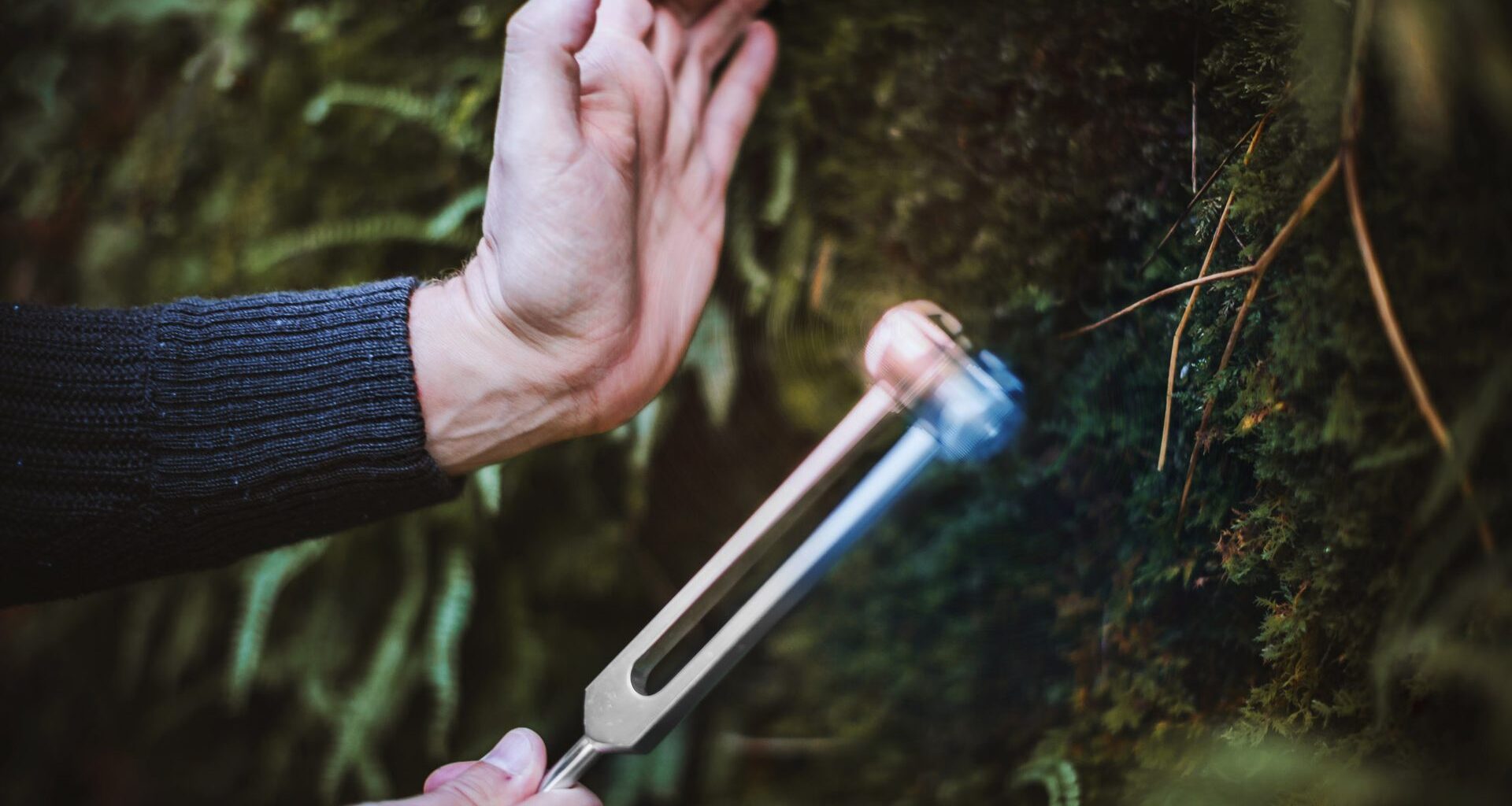
Quantum jumps of sound were recorded in a chip-sized crystal bar, and the same readings could catch errors inside a quantum computer.
Strike a bell and the ringing dies away by degrees, getting fainter until you can’t hear it. That’s how vibration behaves at any size a person can hold. Far below that size, quantum mechanics predicts something else entirely.
A vibrating object carries its energy in whole units and sheds them one at a time. Physicists have now watched one do it: a bar of crystal small enough to fit on a computer chip dropped from a single unit of sound to none.
“We have seen that vibrating objects can exhibit quantum behavior, which is the prerequisite for many of the operations needed by quantum computing and sensing,” said Amir Safavi-Naeini, an associate professor of applied physics at Stanford University, who led the work.
Sound comes in countable pieces
A quantum of light is a photon, a single particle. A quantum of sound is stranger, because it isn’t one thing moving. It’s a large group of atoms moving together, counted as one unit of energy.
Physicists call it a phonon. Catching one come or go isn’t a matter of looking harder. Measure where the crystal is at each instant, work its energy out from that, and what comes back is a smooth decay curve, the same one an ordinary oscillator gives.
The steps are in there. A measurement of position can’t show them.
Niels Bohr proposed jumps like these in 1913. Researchers first saw them in single trapped ions in 1986, then in light held inside a cavity in 2007. Sound stayed out of reach, because a phonon jump needs a long-lasting vibration, a tightly coupled detector, and fast, accurate readings.
Nobody had built all three into one device.
The crystal was stamped onto the chip
The vibrating part is a bar of lithium niobate, a crystal used in radio filters and optical hardware. Its middle is a block roughly a micron across, held at both ends by regularly patterned beams. Sound reflects off those patterns and stays inside the block.
Underneath is a superconducting circuit with a ground state and an excited state, like a single artificial atom. That’s a qubit, the component quantum computers store information in.
Building both halves on one wafer doesn’t work; the recipe for each degrades the other. So Takuma Makihara and Erik Szakiel, the two lead authors, made them separately and stamped the crystal down over the circuit. Raised pillars hold the bar 75 nanometers above the metal, about a thousandth the width of a human hair.
“We had to continually develop new processes to make this extremely long-lived, vibrating object and then integrate it with the qubit, which is our little electrical detector – without ruining either subsystem,” said Makihara, a recent Stanford doctoral graduate.
Shannon Harvey, a scientist at SLAC National Accelerator Laboratory, worked on the recipe for the circuit. Sound rings in the finished bar for 2.1 milliseconds, far longer than crystals of this kind manage.
Asking the qubit reads the sound
The qubit doesn’t listen to the bar. Its own frequency shifts by a set amount for every phonon in the crystal. A short burst of pulses turns that shift into one yes-or-no question: is the number of phonons odd or even?
Because the bar starts nearly empty, the question is whether it holds one phonon or none. Each round takes about 12 microseconds, more than a hundred times faster than the sound fades.
Safavi-Naeini described the method to Earth.com by email. “Basically we are measuring the state of the qubit repeatedly,” he said. After a jump, the answers come back ground far more often than excited.
One round isn’t enough. A single check is right only about two times in three, because the qubit loses its phase partway through. Six that agree in a row leave the team 85% confident there’s exactly one phonon.
Reading the bar also builds the quantum states it reads. “The measurements also ‘prepare’ quantum states,” Safavi-Naeini said. Keep only the runs whose answers all point to one phonon, and that’s what’s left.
Each run flipped at a different moment
After that setup, the qubit kept asking, 294 times in a row. The answers came back mostly excited for a stretch and then, abruptly, mostly ground. Each of those flips is a quantum jump of sound, and it landed at a different point in every run.
That randomness is the finding. An ordinary oscillator losing energy would change the answers gradually, a little more ground in each reading. What came back instead was one moment of change, with steady answers on either side.
Pool many runs and the jump times fall off exponentially, averaging 645 microseconds. A bar that has been ringing a while is no likelier to jump next than a fresh one.
Watching costs something. Left alone, the bar rings for 2.1 milliseconds; under constant questioning it keeps its phonon for 649 microseconds. Each check carries about a 1.3% chance of removing the energy, and almost every other one reads the bar and leaves it alone.
Error correction may be the payoff
In many quantum computer designs, a jump like this is an error, information draining away mid-calculation. Errors happening isn’t the hard part. Spotting the moment one happened is.
This detector reports the loss and leaves what’s left intact. Safavi-Naeini said the team can now build a quantum mechanical memory, and that repeated energy checks can flag errors in a way compatible with correcting them.
Next is a device with two bars on a shared qubit, checked together. Losing a phonon from either would surface as a flagged error rather than a silent corruption, which is what error correction needs.
Sensing may arrive sooner. A bar this small weighs less than a trillionth of a gram, light enough to register tiny masses. Safavi-Naeini’s group is working with Michael Roukes’s team at Caltech to identify proteins inside cells.
The researchers named two limits on how long the watching can run. Both are engineering, and better engineering could cut the 1.3%.
How many bars one detector can follow is what the next device has to answer. Safavi-Naeini’s lab has to build it first.
The full study was published in the journal Science.
—–
Like what you read? Subscribe to our newsletter for engaging articles, exclusive content, and the latest updates.
Check us out on EarthSnap, a free app brought to you by Eric Ralls and Earth.com.
—–