
I’m not fortunate enough to live in the wild – not yet, anyway – so when I’m home in Dublin, I take in whatever slices of the natural world I can find. In the evenings, I walk my dog through the local park, past trees whose familiar shape and presence I depend on. In all the nights I’ve walked these paths, one venerable tree – a knotty oak, of course – has lodged its way into my life. When I pass, I cannot shake a feeling, mad as it sounds, that it sees me.
On clear nights, the few stars that make it through the city’s haze of light pollution become visible. It’s relaxing, staring up. And then something moves at the edge of my vision, and I think it’s a shooting star, until I realise it’s something entirely unmagical: one of Elon Musk’s SpaceX satellites in orbit. He’s recently applied to put a million of them up there – the Muskification of our night sky has only just begun.
I walk up to the old oak and have an improbable feeling of recognition. The poet Mary Oliver wrote that her work was mostly “standing still and learning to be astonished”. Attention, she said, is the beginning of devotion. And so, with Oliver on my mind, I stand under the oak, letting myself love what I love, and never feel alone.
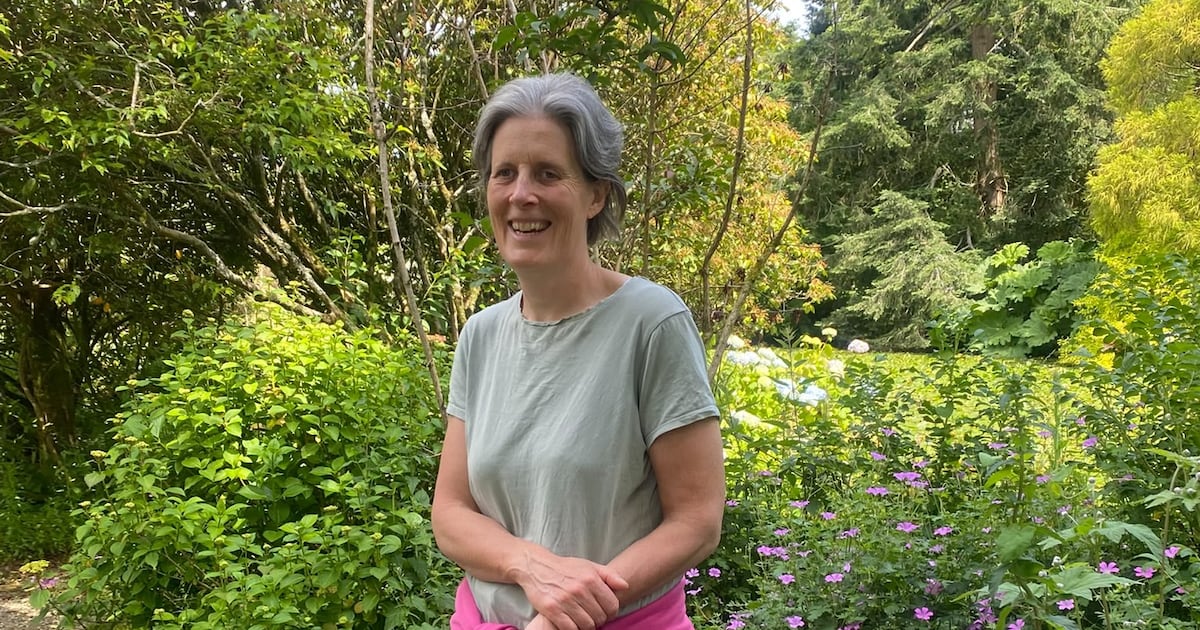
A few weeks ago, I spent time with Hannah Page Fox on her sheep and Christmas tree farm in Grangecon in Wicklow. Until last spring, her life was normal, with her husband and three daughters. There had been a few health issues the previous year, signs that might have been missed, but nothing that added up to anything. Then an acute bout of sickness landed her in A&E, and she was told she had stage four lobular breast cancer, with tumours that had spread and wrapped around her stomach. Six weeks in hospital followed, with months of nil by mouth, unable to swallow. She is still on treatment, and always will be.
We walked through an old rusted gate into a stubble field of harvested corn, up towards a ring fort, one of two on the farm, which has never been ploughed or touched. Many farmers still don’t plough ring forts, or fairy forts as they’re called. Page Fox and her husband Andy built a series of wood-fired saunas from old horse boxes and antique bathtubs pulled from the hedge, where they’d once been drinkers for the cattle, now fed by a spring. A woman who talks to fairies told her that the fairies wanted the land healed before they’d accept the sauna. The challenge? Walk the perimeter of the farm.
It’s a farm with no neat borders. Page Fox set off with a friend and two dogs. She walked through brambles, across streams, through ditches. It took three hours. Her dogs gave up and wandered home. She was still very sick, and it took everything she had. But she told me, “I have never laughed so much in my life”.
She had not known or noticed what was around her before. She saw a mushroom shaped like a fried egg – sunny side up – which she had never seen before. She stopped and realised how astonishingly beautiful it was. The perimeter walk, she said, was the turning point of her hellish year, marking the first time she really laughed. “I had forgotten how to live in it,” she says of the farm. “I was just living on it.”
I asked Page Fox whether it was too insensitive to ask whether some part of her tough year had also been a gift. “I’ve possibly had one of the best years of my life, because I’ve got rid of anything that didn’t matter,” she said. What went was the tidy house; what she wants is to be outside. She spent this March in the lambing sheds helping her brother, which she hadn’t had time to do in years, and she got out for the Christmas tree harvest. At night, she goes out and looks at the stars.
‘There are days where the tears still flow. There are days where I wonder what the future holds for my children’
— Hannah Page Fox, farmer
Lobular cancer is the second most common type of breast cancer, but it doesn’t behave like the kind so many of us are warned about. It often doesn’t form a lump at all. “It acts like a spider’s web,” Page Fox says. It threads through tissue rather than balling up, which can make it close to invisible on a mammogram. It’s particularly invisible in dense breasts. In one survey of breast radiologists, only a quarter said they were confident they could catch it on a screening mammogram in a dense breast. Roughly four in 10 women of screening age have dense breasts, yet BreastCheck does not currently measure density, record it, or tell you yours.
Her days aren’t all serene. “There are days where the tears still flow,” she said. “There are days where I wonder what the future holds for my children.” But she’s been more hopeful lately than in a long time. On October 13th, she’ll travel to Leinster House with the #TellMeMyBreastDensity beingdense.com campaign for women to be told their breast density after a mammogram. “I love life. I love nature. I love being in this world,” she told me. “I’m not ready to leave it. Not for a long time.”