
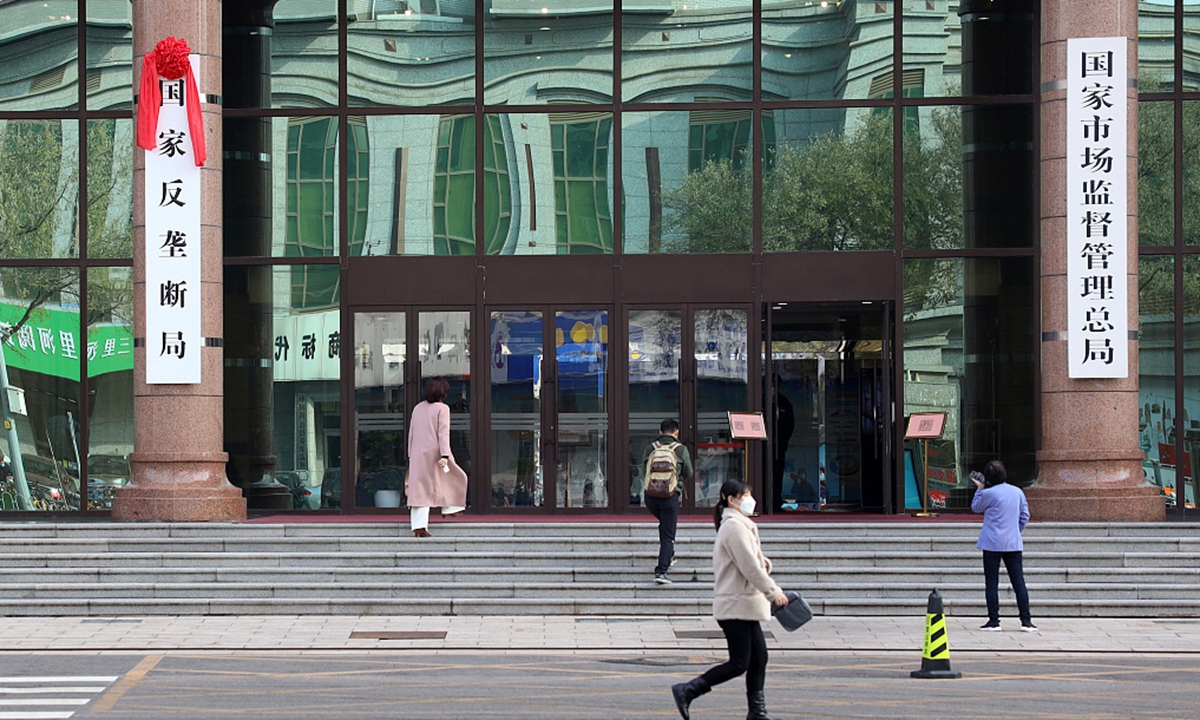
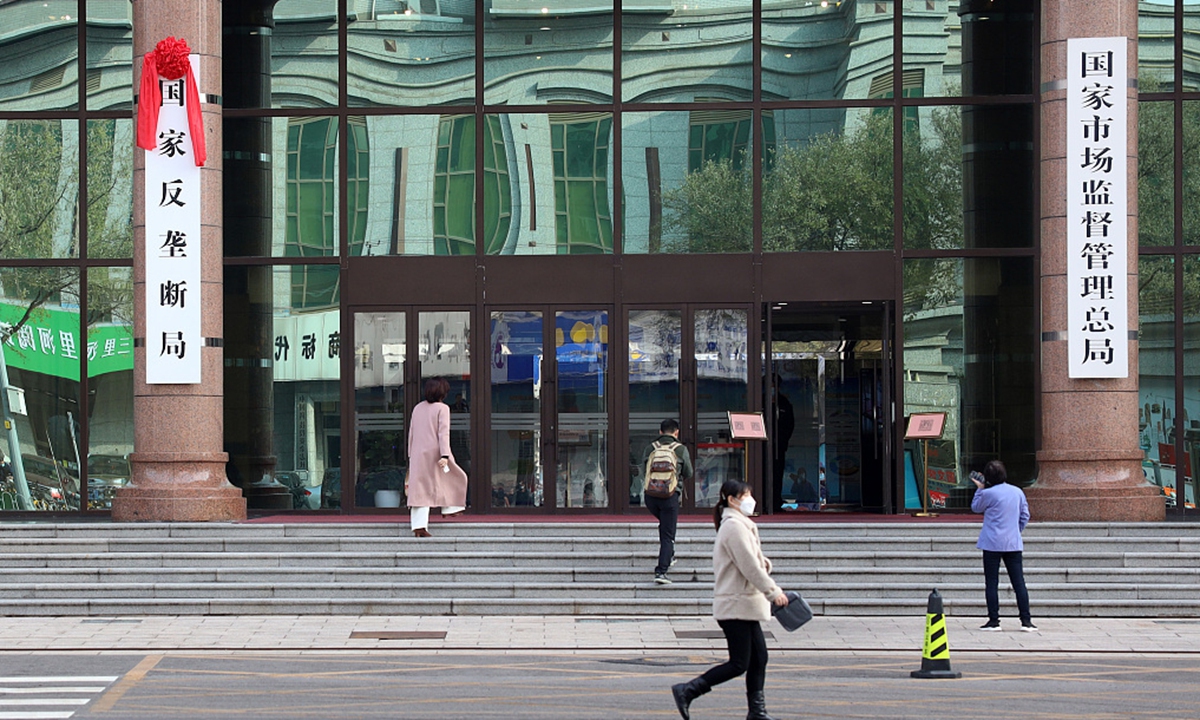
Photo shows the nameplate of National Anti-monopoly Bureau, which is in the same building of the State Administration for Market Regulation in Beijing. Photo: CFP
During the 15th Five-Year Plan (2026-30) period, Chinese market regulators will use standards, price enforcement and quality supervision to curb “involution-style” competition on the market, while tightening antitrust and anti-unfair competition enforcement, an official said on Sunday.
“Rather than exhausting themselves in a fierce price-cutting competition, we will steer companies toward raising quality and efficiency,” said Shu Wei, spokesperson and deputy administrator of the State Administration for Market Regulation (SAMR), China’s top market regulator.
Shu made the remarks at a press conference on advancing the high-quality development of market regulation during the 15th Five-Year Plan (2026-30) period on Sunday in Beijing.
He said that the authorities will take the lead in conducting cost and price inspections of firms that engage in malicious low-price competition and disrupt the order of production and business, and will “deal with them strictly in accordance with the law.”
Chinese regulators will also push to implement rules on pricing conduct on internet platforms, keep regulating price competition on e-commerce platforms, study and issue interim provisions on a price-supervisor system, and press companies to take primary responsibility for price compliance.
Work on revising the Price Law will be accelerated during the 15th Five-Year Plan (2026-30) period, and rules on stopping sales at unreasonably low prices will be studied and drafted. Relevant industry associations will be guided to set cost-calculation standards, so as to put in place a “1+1+N” legal framework against predatory price-gouging, Shu noted.
In terms of antitrust and anti-unfair competition enforcement, Shu said that Chinese regulators will make use of modern technology to monitor market operation and warn of monopolization activities, and raise the quality and efficiency of business acquisition and merger reviews.
“As for online platform companies, oversight of data, algorithms, traffic and platform rules will be strengthened, and the platforms will be required to better fulfill their ‘gatekeeper’ responsibilities, while promoting the healthy growth of the platform economy,” Shu stressed.
Chinese market regulators will also improve market-access administration, refine the basic and generally applicable legal rules on registration, deepen reform of the registered-capital subscription system, and further cut institutional transaction costs, so that companies and entrepreneurs find it “easier to enter the market and less burdensome to get things done,” Shu said.
China is ramping up efforts to combat unfair competition. Since the beginning of the year, the SAMR has launched 16 special campaigns focusing on stronger regulatory enforcement, deeper platform governance and tighter regulation at the source, with 39 expected outcomes identified. The campaigns have made positive progress, according to the SAMR.
As part of its intensified crackdown on market competition irregularities, the SAMR has investigated a series of food delivery “ghost shop” cases. According to information released by the regulator, seven e-commerce platforms – Pinduoduo, Meituan, JD.com, Ele.me (Taobao Flash Sale), Douyin, Taobao and Tmall – were fined and had illegal gains confiscated totaling 3.597 billion yuan ($540 million).