
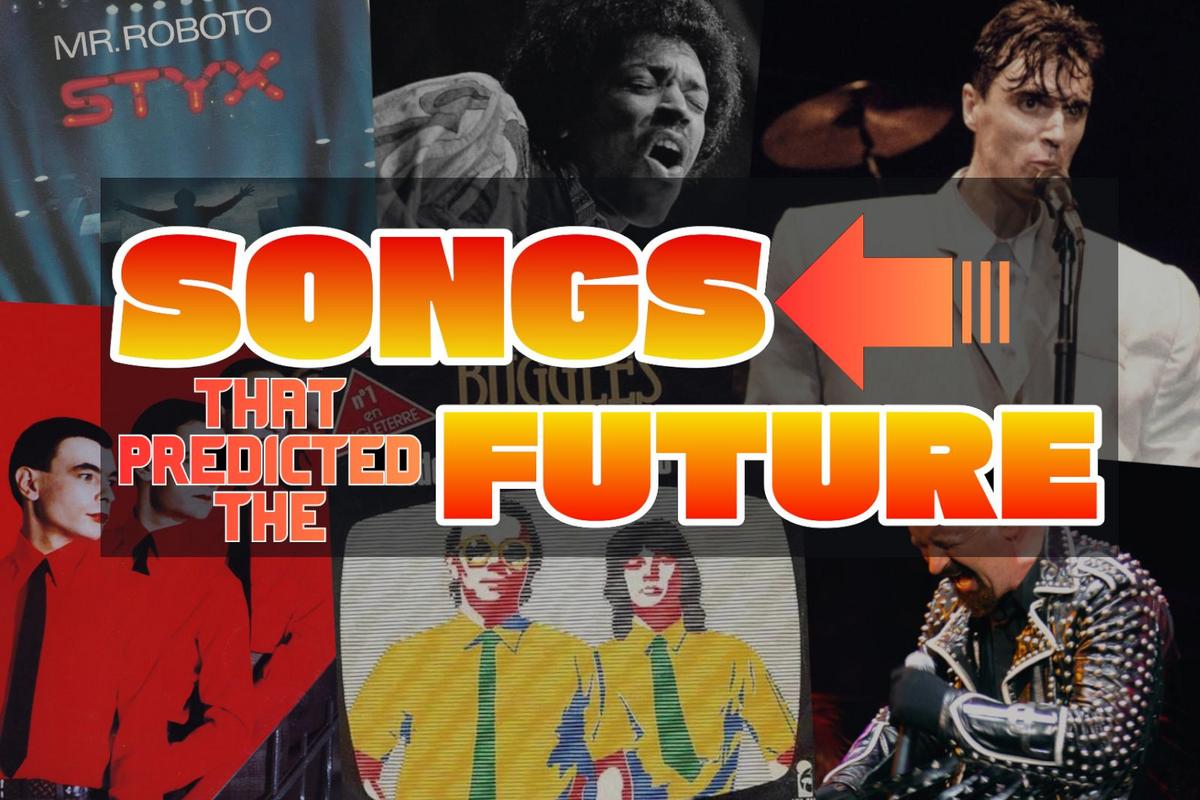
The future is now, and we’ve got a collection of classic rock songs to prove it.
A wide variety of artists have written futuristic-themed lyrics, only to have their predictions come true decades later. These bands — including Styx, Pink Floyd, the Who and Jimi Hendrix — didn’t poses some kind of crystal ball. Instead, they looked at the social and cultural landscape around them, then imagined how things could evolve over the passage of time.
So how did these classic rock acts forecast the future? In a word, bleak. Apparently predicting a world full of rainbows and happiness isn’t much fodder for rock song creation. Instead, we see many ominous themes popping up in these tunes, including technology’s impact on society, the rise of government surveillance and the prevalence of anxiety and paranoia.
Here are 15 examples of classic rock tunes that accurately predicted the future.
Styx, ‘Mr. Roboto’
Styx’s 1983 hit “Mr. Roboto” may be the most famous prediction of technological distrust. As the story goes, frontman Dennis DeYoung was inspired by a documentary about robots replacing workers in car factories. “I looked at that and I went, ‘Oh my God, yeah! That’s what can happen with technology. Humans? Who needs ‘em,” he recalled. The singer built upon that concept, envisioning a world where man is replaced by machine. Musically, the song featured a synth-heavy sound – futuristic at the time, but dated by today’s standards. Still, it’s the overriding theme of AI’s command over society that rings true today.
Pink Floyd, ‘Welcome To The Machine’
A world where algorithms tell you what to like, data is controlled by big corporations and humans live in a state of constant surveillance – sounds like a pretty accurate description of modern society, but it’s actually the concept for Pink Floyd’s 1975 song “Welcome to the Machine.” Roger Waters initially designed the tune as a sharp criticism of the music industry, but his rejection of corporate greed and predictions of AI algorithms – like in the lines, “Welcome to the machine / What did you dream? / It’s all right, we told you what to dream” – feel eerily prescient.
The Buggles, ‘Video Killed the Radio Star’
There’s something uniquely poetic about a song that is directly involved in the future that it predicts. In 1979, pop group the Buggles foreshadowed the music video revolution with their classic tune “Video Killed the Radio Star.” It wouldn’t be until two years later that MTV launched and, effectively, fulfilled that prophecy. Naturally, when the cable network debuted on Aug. 1, 1981, the first video they aired was for “Video Killed the Radio Star.” Sure enough, MTV soon became the industry’s dominant force, replacing radio for worldwide influence. Of course, the story doesn’t totally end there. Decades later, MTV is on life support, having been replaced by even further evolving technology. Maybe it’s time to reunite the Buggles for a new tune called “YouTube Killed the MTV Star.”
The Who, ‘Relay’
Originally written to be part of the unfinished Lifehouse rock opera, the Who eventually released “Relay” as a single in 1972. That means it arrived about two decades before the World Wide Web, and yet the song’s lyrics certainly foretold something eerily similar. Pete Townshend wrote about information moving “twice as fast as on any freeway,” and even warned about disinformation with lines like: “Don’t believe your eyes, They’re seeing only lies.”
The Who, ‘Won’t Get Fooled Again’
“Meet the new boss, same as the old boss,” Roger Daltrey memorably proclaims on the Who’s 1971 hit “Won’t Get Fooled Again.” The classic track follows a theme of power, revolution and corruption, where people put their faith in new leaders, believing they will usher in change – only to watch them repeat the same mistakes of the regimes that came before them. A simple history book can show you many examples of this cycle which came after the Who’s iconic hit, including the collapse of the Soviet Union and the Arab Spring.
King Crimson, ’21st Century Schizoid Man’
Leave it to Robert Fripp to turn a stark prediction of humanity into an engrossing prog rock tune. The opening song on King Crimson’s 1969 debut album In the Court of the Crimson King, the song forecasted many of the issues that plague society today. Topics like psychological alienation, heightened paranoia, corporate greed and unending war are all covered within the song’s lyrics. Example: “Death seed, blind man’s greed / Poets’ starving children bleed / Nothing he’s got he really needs.”
Jimi Hendrix, ‘Up From the Skies’
In many ways, Jimi Hendrix felt like he was from another world – and on this track from 1967’s Axis: Bold as Love the guitar great embraced that perspective. The lyrics are delivered from the point of view of an alien visiting Earth. The observations from Hendrix’s alien echo today – “I heard some of you got your families, living in cages” sounds a lot like ICE detention centers, while “The smell of a world that has burned / Well, maybe, maybe it’s just a change of climate” certainly wreaks of global warming. Now that we think about it, if any rocker was a time traveller, it was probably Hendrix. Maybe we shouldn’t be so surprised.
Zapp, ‘Computer Love’
In today’s world, the predominant way to meet a romantic partner is via dating apps and websites. Such a concept would have sounded foolish back in the ‘80s, yet that didn’t stop the funk group Zapp from creating their 1986 hit “Computer Love.” In the opening verse, frontman Roger Troutman declares: “I’ve been searching for someone / Who can share that special love with me / And your eyes have that glow / Could it be your face I see on my computer screen.” Decades later, the dating world is ruled by Tinder, Bumble, Hinge, Match and the like.
Kraftwerk, ‘The Robots’
Artificial intelligence has infiltrated modern society in ways few could have predicted, yet pioneering German electronic band Kraftwerk seem to have seen it coming. Their futuristic 1978 single “The Robots” predicted a world where humans depend on robot labor – there are Russian lyrics that translate to “I’m your servant, I’m your worker.” Kraftwerk even took the theme further when playing the song in concert, replacing themselves with remote-controlled robots during the performance. Looking at that now – in an era when companies announce sweeping layoffs, only to replace humans with AI – Kraftwerk’s concept hits close to home.
The Clash, ‘London Calling’
In the ‘70s, the public was only just becoming educated about the dangers of pollution. Still, concepts like global warming may have been talked about in scientific circles, but the theory – and its potential impact – was not common knowledge to the public. It’s fascinating, then, that the Clash broached the topic of climate change on their 1979 hit, “London Calling.” Evidence is found right in the famous chorus, as Joe Strummer sings, “The ice age is comin’, the sun’s zoomin’ in / Meltdown expected, the wheat is growin’ thin / Engines stop runnin’, but I have no fear / ‘Cause London is drownin’ and I live by the river.” Climate change has only become a larger global issue in the decades since “London Calling” was released.
Talking Heads, ‘Life During Wartime’
Is it possible David Byrne can see into the future? There’s certainly evidence to support that theory. In a 1979 interview, the Talking Heads frontman predicted food shortages, gas crises and political disinformation. He also said that computers would be “the size of wrist watches” and a “central television bank” that hooks up to your computer – sure sounds like the Apple Watch and Netflix to us. With his head firmly planted in the future, Byrne penned “Life During Wartime,” the lead single from Fear of Music. The singer wrote from the perspective of a revolutionary living in a dystopian future. “We got computers, we’re tapping phone lines / I know that that ain’t allowed,” Bryne sings at one point, his words reflecting modern society’s surveillance state. The frontman also sings about gun violence and starvation – a couple of other modern hardships. The fact that he tackles such heady topics over an incredibly catchy dance beat is simply icing on the cake.
Zager and Evans, ‘In the Year 2525 (Exordium & Terminus)’
Many of the examples on our list predicted the future (at least somewhat) by accident. This 1969 hit from pop rock duo Zager and Evans took a much more purposeful approach. The song looks hundreds of years into the future and makes stark predictions about humanity. Pharmaceuticals control our minds (“Everything you think, do and say / Is in the pill you took today”), natural resources have bled dry (“I’m kinda wonderin’ if man is gonna be alive / He’s taken everything this old earth can give”) and humans are unable to survive without machines (“Your legs got nothin’ to do / Some machine’s doin’ that for you”). Though the future they sing about is grim, is it really that far from where we are today?
Radiohead, ‘Fitter Happier’
In the ‘90s, computer technology became an important part of everyday life. This was the era when home computers became commonplace, as the information age dawned. Radiohead, one of the most forward-thinking bands of its time, embraced technology while also recognizing its potential threat. The group’s 1997 album OK Computer covered topics such as anxiety, consumerism and social alienation – all of which would only be heightened in the post-millennial world. Still, it’s their album cut “Fitter Happier” that offers arguably the most jarring glimpse of the future. Utilizing a computerized voice, the lyrics run through an ominous checklist, naming things like “more productive,” “regular exercise at the gym” and “a safer car” – all aspects of life that we have now turned over to AI.
Judas Priest, ‘Electric Eye’
Between doorbell cams, cell phones, facial recognition and Flock Cameras, the world has never felt more under surveillance. Decades before these things became a part of everyday life, Rob Halford wrote from the perspective of a satellite camera, spying on society. With lyrics like, “You think you’ve private lives, think nothing of the kind / There is no true escape, I’m watching all the time,” Judas Priest’s “Electric Eye” captures the anxiety and paranoia of constantly being watched – a stress many of us feel today.
Rage Against the Machine, ‘Sleep Now in the Fire’
Unlike many of the other artists on our list, Rage Against the Machine wasn’t imagining some kind of deep dystopian future. The band was known for being much more of-the-moment, delivering politically charged rock that dealt with the issues and controversies plaguing America at the time. So how did they end up on our list? Well, it’s not for lyrical content, but for a music video. For their 2000 clip for “Sleep Now in the Fire,” Rage Against the Machine famously performed for a crowd of fans outside the New York Stock Exchange, before police shut the whole thing down. At one point, a shot in the crowd shows a man holding a sign that says Donald Trump for President – startling considering Trump was focused more on his real estate than political aspirations at the time.
Rock’s 100 Best ’80s Albums
Music in the ’80s is typically associated with the neon-tinged synthpop of MTV’s early era, but there was much more to this wildly varied decade.
Gallery Credit: Nick DeRiso