
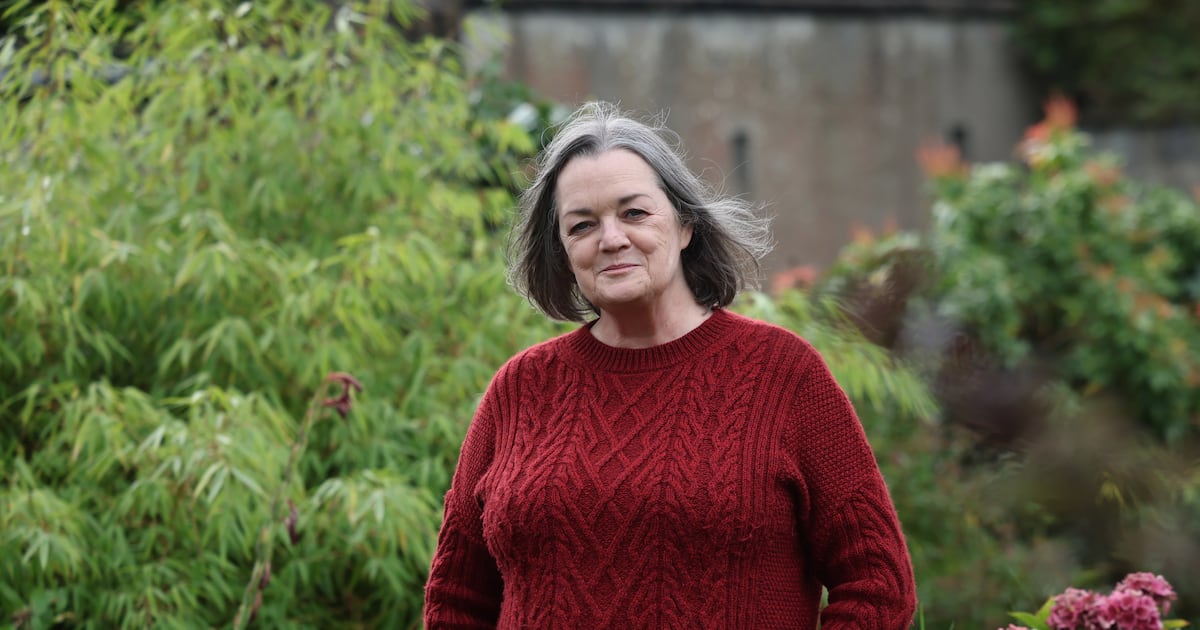
‘My granny was in a bomb explosion when I was four. She was on her way from our pub to the bank to make a lodgment when a bomb exploded and a big piece of glass cut her jugular vein. An off-duty British soldier saved her life. One of my uncles didn’t recognise her, because her face was blown open. He went back to the pub and said there’s some poor woman up there in a terrible state, dead.
“She’d lost a lot of blood, her heart kept stopping and she had all these surgeries and skin grafts, maybe 400 stitches. And she woke up with some wee man standing over her, saying ‘Missus, what was in your handbag?’
“He said that they nearly had to break her arms to get the handbag off her because she wouldn’t let go of the money. She used to tell that story really proudly.
“She was very glamorous. She was wearing a fur coat, so that kind of protected her body. She had a line and loads of little nicks, but they did a brilliant job on her face.”
Louise Kennedy is a born storyteller, with a particular gift for finding the saving grace of humour in the midst of trauma – the traumedic art.
Like Róisín, the protagonist in her new novel, Stations, she left the North when she was 12, moved with her family to the South but never truly settled before emigrating to London for a spell. She has lived in Sligo for 20 years and is happy there but will forever be a blow-in. “I don’t know how to be in the world except as an outsider. My home place doesn’t exist any more.”
Sligo and its hinterland served as the backdrop for most of The End of the World Is a Cul de Sac, her brilliant short-story collection, from 2021. Her native North came alive in her award-winning, bestselling debut novel, Trespasses, from 2022, a Troubles love story made into a Channel 4 series starring Gillian Anderson.
Stations, which is her second novel, starts off in a Kildare town much like Naas, where she moved from Holywood, Co Down, after one loyalist attack too many on the family pub. But it quickly shifts to London, where Kennedy lived long enough as a young woman to capture its essence.
Stations is a love story, too, albeit an unrequited one, but it is as much about family and friendships, shadowed by abuse and addiction yet leavened by wit and warmth. It also proudly takes its place alongside If I Could Read the Sky, by Timothy O’Grady and Steve Pyke, and The Grass Arena, by John Healy, both namechecked in the text, and JM O’Neill’s novels Duffy Is Dead and Open Cut as part of the London-Irish story. “I am operating in some kind of tradition,” Kennedy says.
‘There was a lot of anxiety in our house. The phone would ring, and it might be that a bomb had just gone off in the pub’
— Louise Kennedy
The Grass Arena’s opening line – “My father didn’t look like he would harm anyone” – echoes chillingly through Stations.
Starting in 1982 and spanning 25 years, it tracks the relationship of Róisín and Red from their schooldays in Kildare to a London squat and beyond, sometimes estranged but always entwined.
There are many autobiographical elements in Stations – jobs Kennedy has done, places she has lived, meals she has cooked. “I couldn’t imagine a character just moving through some kind of bland space. I need to put them in a place I know to be able to generate it or for anything to happen.”
There are definitely parallels between Róisín’s background and hers, Kennedy says. “She lived in a town near the sea, like I did, and moved to the South at 12 in 1979, like I did, and was spectacularly unpopular in school, like I was.
“But they left the North because her father was in the RUC, so I actually think I need to get a T-shirt made that says, ‘My dad was never a peeler’. He was an accountant in a firm on the Newtownards Road, the only Catholic in a very large workforce, so he had to look under his car for different reasons.”
The book’s title is suggestive of the transport hubs where key scenes play out but also of social standing and the depiction of Christ’s Passion.
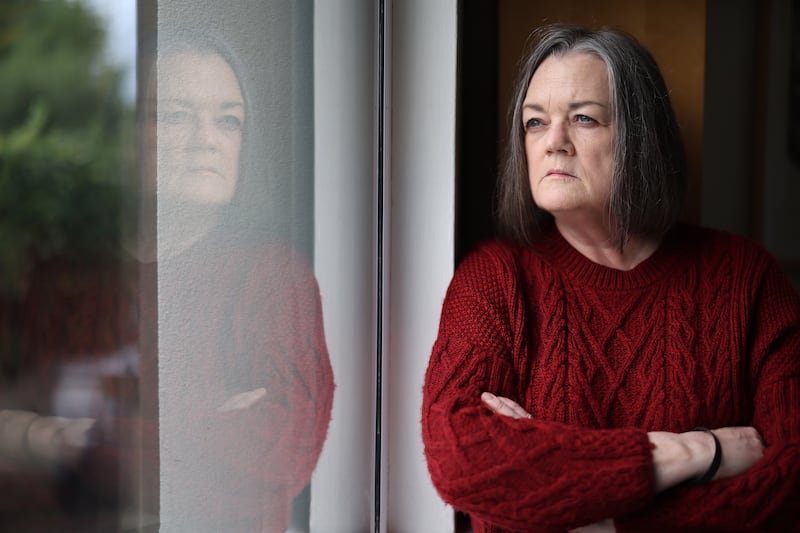 Louise Kennedy at home in Sligo. Photograph: Dara Mac Dónaill
“Róisín is certainly getting ideas above her station, going to Henley regatta, so there are class things and maybe something about mobility or aspiration as well. And I guess there’s that thing about the Stations of the Cross, stumbling and falling and keeping going. The book was called Red for a while, and the German publisher is going to call it Red.”
Kennedy has a degree in social studies from University College Dublin, and Pierre Bourdieu’s concept of cultural capital is a ghost at Stations’ feast. Róisín’s love rival Octavia turns up with Christmas leftovers, culinary capital in the form of rich crumbs from the table of her Tory-MP father. Róisín, on the other hand, conjures up delicious meals from base ingredients: grey mince and ketchup for want of tomato puree – rags to rich ragu.
[ Louise Kennedy on her career change: ‘At 45 I thought I was finished’Opens in new window ]
Kennedy spent almost 30 years as a chef, training alongside Irish Sloane Rangers at Alix Gardner Cookery School, then working at Bon Appetit in Malahide and Elephant & Castle in Temple Bar, opening Garravogue in Sligo for Jay Bourke and Eoin Foyle, then starting her own place there with her husband, Stephen, The Silver Apple, named for the Yeats verse – “notions, even then”.
She worked at Hodges Figgis in the 1990s for a couple of years and used to cater for book launches. ) “One party ended up being so mental there was wine spilled all over the till. I think we might have got in trouble for that, because I don’t think it was supposed to have been that much fun.”
After we talk, Kennedy treats me to a delicious home-made lunch: quiche with bacon, scallions and Coolattin cheddar with orzo, tomatoes, pesto and Cnoc Liatroma goat’s cheese, followed by raspberry-and-almond cake.
“My dream would have been to be a charcutier in Lyon. I used to get these organic ducks delivered and would use every single bit. I’d render the fat, make confit, take the breast off the bone, keep the hearts and put them on rosemary skewers and grill them, duck liver pate. I made rillettes with whatever was left on the carcasses and stock. I had grease up to my elbows.”
‘I am not one of those people who’s managed to carry people with me for years and years’
— Louise Kennedy
But cooking was also a way of dealing with anxiety by living on her nerves.
“I used to get really bad panic attacks. Some of it maybe went back to how awful it was in [secondary] school, but I started having sleeping problems when I was about seven or eight.
“There was a lot of anxiety in our house. The phone would ring, and it might be that a bomb had just gone off in the pub. If there was a loud noise you’d go to pieces.
“No one ever used the word ‘trauma’ then. I was really interested in food, and cheffing gave me a way of being able to support myself. You just turn up with your uniform and bag of knives and either you were shite or you weren’t.”
So it’s little wonder that food enriches Kennedy’s writing. The dinner party in Trespasses is a standout scene. In Stations there is great poignancy when Róisín is given “a few Golden Wonders. The ones your father set”, which she offers to cook for a friend.
“I didn’t know if I’d got away with that. I just wrote that and was bawling and crying and then I thought, Jesus Christ, what are they going to think, getting very emotional about the spuds?”
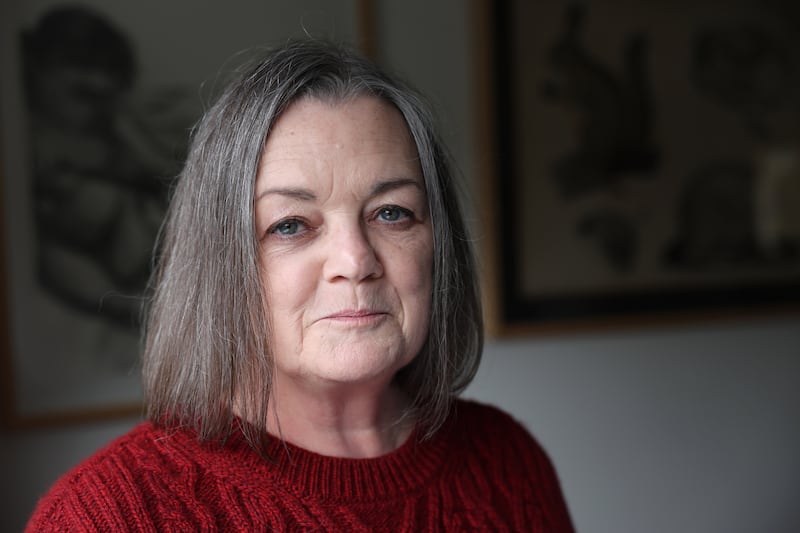 Louise Kennedy at home in Sligo. Photograph: Dara Mac Dónaill/The Irish Times
Does Kennedy ever laugh when she’s writing as well? “So okay, a lot of the response to this has been, ‘I am devastated, crying my eyes out.’ I’m going, ‘Does nobody think it’s funny?’ Because I was roaring laughing at certain times.”
For the record, I laughed when Róisín said her father “would be best represented by a pint of Tennent’s and a letter from the Child Support Agency” and, later, “I can’t say a good word about him, it’s like a form of Tourette’s”. And the description of Barry’s girlfriend, who “looked like a postulant but roared ‘Slap me, hai’ as she came, a demand that carried all over the house.”
Another significant reference in Stations is the Rake’s Progress series of satirical paintings by William Hogarth, which chart the downfall of Tom Rakewell, and which Róisín and Red see on a visit to Sir John Soane’s Museum, one of Kennedy’s favourite places in London.
“It’s magic, but you’d have to be in the whole of your health to go there, because there’s just so much stuff.”
Is there an obvious parallel between Tom Rakewell’s decline and Red’s? “I think so. It starts off kind of beautiful. Maybe he’s having a premonition of what might happen to him.”
Stations spans a quarter of a century. How challenging was it to handle the passage of time?
“It was murder. The first couple of drafts I had too many scenes. I was carrying a lot of backstory. My editor said, ‘Just put a date on each chapter.’ That meant I didn’t have to use any backstory, and I hoped that it would be okay just to drop the reader in and it’s, like, you leave off in 1989 and then it’s 2007. I didn’t want to have passages like, ‘In the meantime, Róisín did this and she got divorced.’”
A funeral scene helps because a lot of characters gather for it.
Is there an argument for letting the reader do a bit of work?
“I think so. People aren’t stupid. I sometimes get resentful when things are explained to me too much. The really hard bit was trying to age Róisín. She starts off in her teens, and there’s a big jump to where she’s, like, 40, and she can’t be slamming doors. I guess maybe my curiosity was, has she learned anything? Is she still fighting with everybody? Is her head still up her backside, blaming other people for things that she had a hand in as well? Does she regret anything?”
One thing that surprised Kennedy was the reappearance of Barry, a peripheral character who becomes central. “Barry was maybe the biggest surprise to me because he was so real to me. It was really weird. Like, I was walking around for about four months thinking I was having an affair. He was so vivid to me. It was really ridiculous.”
Kennedy’s husband needn’t worry, though. “Barry is still a bit of a dose.”
‘I have any kind of mental or emotional stress, or when it’s really warm, I can’t function at all’
— Louise Kennedy
Like Kennedy, Róisín is an outsider at school too. She first appeared in Belladonna, a story in Kennedy’s debut collection.
“I liked the voice and the fact that she was smart, but not as smart as she thought she was. Children in an adult world just don’t really get it. I liked her character because she’s not really that likable. So I guess this is her, maybe a year or two later, and I gave her a friend.
“I am interested in relationships, not just romantic ones. I’m interested in families, in friendships. I think maybe I find that fascinating because it’s something that eluded me for a lot of my teens, like I have one friend who I knew in secondary school. I am not really in touch with anybody from primary school. I am not one of those people who’s managed to carry people with me for years and years.”
The second strand, which Kennedy wrote in the year that she started writing, features practically unchanged in Stations, a poignant scene where Róisín is about to head home from Victoria coach station when she meets a much older Irish immigrant in a bar. Not every Irish writer can as credibly set their work across the Irish Sea.
“I did live in London, but I think it’s just about paying attention. I think I also have a really good memory. I have a sister who’s got an even better memory than me who was with me in London at the same time.”
Kennedy was diagnosed with melanoma and had surgery in 2019, the same year she was shortlisted for the Sunday Times short story award. She was shortlisted again the following year. In 2021 her debut collection was published and the cancer returned, now stage four, “so they had to bring out the big guns: immunotherapy”.
In January 2022, four months before Trespasses came out, Kennedy was hospitalised after a severe reaction. “In about four days I’d gained 5kg, all fluid. I’d my head in a basin of ice water to reduce the swelling. My skin was like marzipan, itchy, coming off like paste. My pituitary gland had exploded. I hadn’t produced any cortisol for 10 days.
“That damage is permanent, so I have to take steroids every day and carry a syringe. But if I have any kind of mental or emotional stress, or when it’s really warm, I can’t function at all.
“It made it really hard to write the book. I lived on adrenaline all my life from kitchens. I was just brilliant at producing that burst of energy. It’s probably not very good for you, but I can’t do any of that now.”
When Kennedy started writing, did that replicate the buzz? “No. I think that was a different thing, probably the complete opposite. I’m probably using a different part of my brain, mucking about with language.”
Kennedy has a dry, deadpan wit and a refreshing frankness, so it’s no surprise to learn that when, at a dinner party, she found herself sitting beside Gillian Anderson, who told her how much she liked the mother in Trespasses, the writer asked if she’d play the role.
“I was full of wine,” Kennedy says, but also serious illness is a good antidote to razzmatazz. “I think maybe I was very lucky in that I was either doing things like that or I was in Galway on a public oncology ward. Because there were two very extreme things going on, I didn’t really think a lot about it. Maybe also I’m a bit too old to be really impressed by that stuff.”
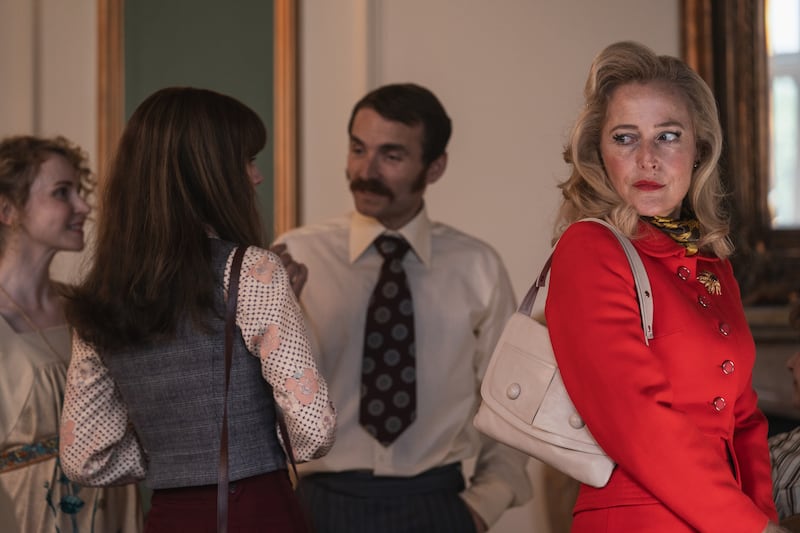 Trespasses: Gillian Anderson with Lola Petticrew and Martin McCann in the TV adaptation. Photograph: Peter Marley/Channel 4
Until her friend Niamh Mac Cabe, author of the recent short-story collection Four Night Seas, dragged her to a creative-writing workshop run by the Irish-American author Una Mannion in 2014, Kennedy had no notion of becoming a writer, despite having worked in bookshops in Naas and Dublin and then as a librarian after she was burned out as a chef. Except, as is so often the case, a good teacher had planted a seed that lay dormant for decades.
“Miss McKenna used to do really amazing things. No child had a lot of cultural capital in this wee Catholic primary school in Holywood. One day she played a Mozart horn concerto and got us to write something. Another time she pinned Monet’s poppies to the blackboard and she was wildly encouraging.
“Years later she told me I had written something that was lovely. I remember thinking, maybe really briefly, God, I’d love to be a writer. I probably thought it was like something magical. Must be f**king mental, actually, is what I think now.”
Kennedy did a PhD in creative writing at Queen’s University Belfast, which included a dissertation on the writer Norah Hoult, whom she had discovered in Sinéad Gleeson’s anthology The Long Gaze Back. She singles out two books as “really extraordinary”: Hoult’s debut short-story collection, Poor Women, and There Were No Windows, a novel set in London during the Blitz.
[ Why has Norah Hoult been overlooked?Opens in new window ]
She had a lonely life, Kennedy says. “I cried a lot going through her archive,” the bulk of which was a 40-year correspondence with an English writer and literary editor.
“There was an identity thing as well, where she didn’t feel that Irish and didn’t feel very English either.”
Did Kennedy identify with her?
“Over time I did, because she was kind of on my shoulder to an extent when I was writing the short stories, some of which were part of my PhD.”
Despite her stellar start as a short-story writer, Kennedy feels that form is behind her.
“I find short stories so hard now. And nobody buys them. Who is going to give you a decent contract for short stories?”
She is a bit behind schedule – “Last year nearly killed me, trying to finish Stations” – but is seven chapters into her next novel, “set in a coastal place in the west in 1994, the summer of Riverdance and also the ceasefire. It’s about a glamorous Irish-American couple landing into a village and the unsettling effect they have on the locals – and one woman in particular.
“Something started to happen with the short stories. Some shouldn’t have been short stories – like definitely In Silhouette could have been a novel; there’s enough in there. Certainly the last story in the collection, Garland Sunday. I wrote 60,000 words for it, not linear but still. It wasn’t until I had written a novel that I thought that should have been a novel.”
Belladonna was never going to be a novel – it’s probably the shortest story in the collection – but she saw the potential to develop not the plot but its central character, Róisín.
I did a Q&A with Kennedy when Trespasses was published, and I was struck by how steeped her answers were in the North for someone who had moved south in 1979. The public event that affected her most was that year’s trial of the Shankill Butchers. The most beautiful book she owns is her grandfather’s copy of Ernie O’Malley’s On Another Man’s Wound. Her favourite fictional character is Joe Logan, in Jennifer Johnston’s Shadows on Our Skin. The books that made her laugh were anything by Sam McAughtry, and the book that moved her to tears was Bear in Mind These Dead, by Susan McKay.
“I think there’s maybe something about the age that I was when we moved. There were things that I had become very aware of when we lived in the North.”
If the North was a cold house for Catholics, who were treated like a despised minority, the South’s Ber rating for refugees was not so hot either.
“I do think there was a suspicion and sometimes hostility for northerners in the 1970s and 1980s. When Tiede Herrema and others were kidnapped, our house and other houses of families from the North would always have been searched first.
“There was that suspicion at an official level, but there was also the day-to-day stuff, like the day that Bobby Sands died. A girl from the year ahead of me came up to me at break and said, ‘I wish the rest of you murdering northern bastards would starve yourselves to death as well.’”
Kennedy’s mother was 19 when she had her, and in 1981 she went into labour the day Sands died.
“I was tormenting her to call [my brother] Bobby, and she wouldn’t. I wrote a short story about it called Hunger.” He was instead named John, after their father.
Kennedy lost her accent a long time ago, but her inner voice is northern. She is also a gifted mimic.
“I think writing kind of settled something in me, because the voice in my head is completely northern. So I feel like myself when I write in a way that I probably don’t when I’m speaking in my southern accent.”
Stations is published by Bloomsbury Circus on Thursday, September 24th