
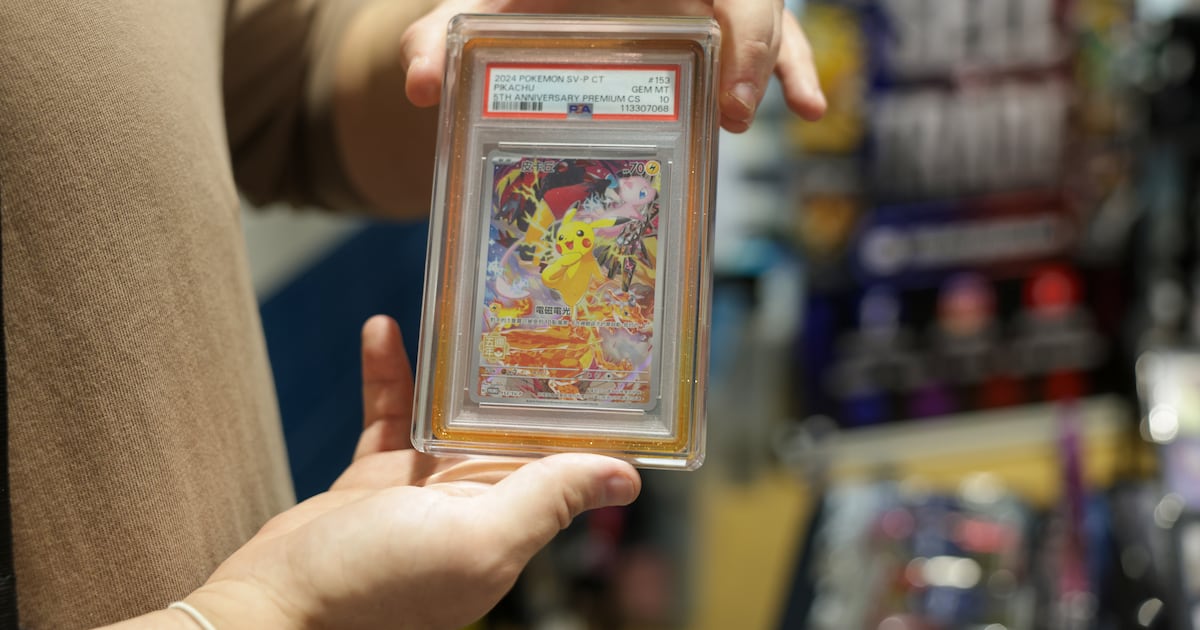
Sam Shields lifts up a hefty glass display case with a trading card sealed inside. “This is a €3,000 euro card because it’s a special Chinese exclusive promo,“ he says. ”I have a few cards that are in the €3,000-€7,000 range.”
Shields is one of five vendors at a Pokémon-trading-card event in card store Atlantic Collectables in Dublin. During the pandemic, he returned to his childhood passion of collecting Pokémon cards and started as a vendor last year.
“Five, six years ago I put about €20,000 into sealed Pokémon boxes,” he says. “I bought them all for about €100-€120 a box. Today those boxes range from around €700-€2,500.” The hobby has proved profitable and covered the down payment of his apartment.
Some of the rise in popularity in Pokémon cards can be attributed to the company’s marketing. This year marked 30 years since it released its first trading cards.
In an effort to build excitement in the run-up to the anniversary, Shields says, “Pokémon deliberately pulled back the amount of cards they were making” and went from producing “12 billion a year down to less than 10 billion a year – and that corresponded with a surge in popularity again”.
The popularity has also been aided by organic online content. “This hobby specifically, it’s heavily influenced by influencers,” says Shields, who also says a 30-anniversary brings with it an age profile that has some economic advantages as “people around my age, in your mid-30s, we all played the Pokémon cards as kids, but now we all have adult money”.
After operating online for four years, Enzo Patriarca opened Atlantic Collectibles in Dublin 12 last year. The business started selling and trading sports cards, but “we brought Pokémon in when we opened the physical store, and I’d say it represents 40 per cent of our revenue already”.
The business sells new packs of Pokémon cards as well as individual cards that range in price from €3-€700. Patriarca sends the more expensive cards to be authenticated “by a company called PSA [Professional Sports Authenticator]. They’re the biggest graders in the world. So, basically, a card gets graded from one to 10 based on its condition.”
Interest in Pokémon trading cards has surged in recent years, with graded and rated cards valued at a total of almost €9 billion. Last year PSA graded nearly 20 million cards – Pokémon cards made up about 11 million of those.
In December, PSA graded 193,600 Pikachu cards, featuring the most popular of the Pokémon characters. The cards themselves may not be rare, but the condition, as judged by the PSA, can have a dramatic influence on the estimated value.
Collectors estimate PSA could grade 15 million Pokémon cards this year, although US tariffs have meant the business has paused receiving cards from Europe.
For 20-year-old Dubliner Christian Butner, collecting is a lifelong passion. “I grew up [with] Pokémon, so I just love it. It’s for the love of the game for me,” he says.
He bought his favourite card four years ago for €250, a rare Mega Gengar EX from about 2015-2016. He estimates the card today is worth €800. He has seen how collecting has become “like a stock option for some, people are investing in [Pokémon cards] over crypto.”
Two years ago Leaving Cert student Daniel Ecock went into his attic to assess his old Pokémon collection. He estimated it was worth €2,500, but today he believes the same collection would be worth €10,000.
Last August he started trading as Glitch Cards. He says: “My goal is, when I get into college, to scale the business up a lot.”
Ecock should have opportunities with card-trading events continuously popping up across Dublin. “There’s two this weekend,” he says. “Last weekend, I think there was four or five just in Dublin alone. So, it’s blown up massively.”
Emma Robinson trades Pokémon cards at pop-up events although it started as a passion for her. “I’m a Kanto girl through and through, so that would be like the original Pokémon cards that came out back in the 90s,” she says.
Robinson says some headline numbers may appear huge but the margins can be relatively fine. “There is that little room for profit,” she says. “People think most vendors make a lot of money, but it is quite low.”
 Daniel Ecock of Glitch Cards and his friend Christian Butner at the pop-up Pokémon trading show in Atlantic Collectibles. Photograph: Enda O’Dowd/The Irish Times
The interest from collectors has seen huge demand in shops in Dublin, with some limiting the number of packets sold to each customer. Robinson has seen this herself. “It’s impossible to buy Pokémon cards in Ireland at the moment,” she says.
Shields has seen the downside to the increased demand. At a recent in show in Dublin his car was broken into and thieves made off with between €3,000 and €4,000 worth of Pokémon cards. “That was a big setback, but it’s getting that way when there’s lots of money involved.”