
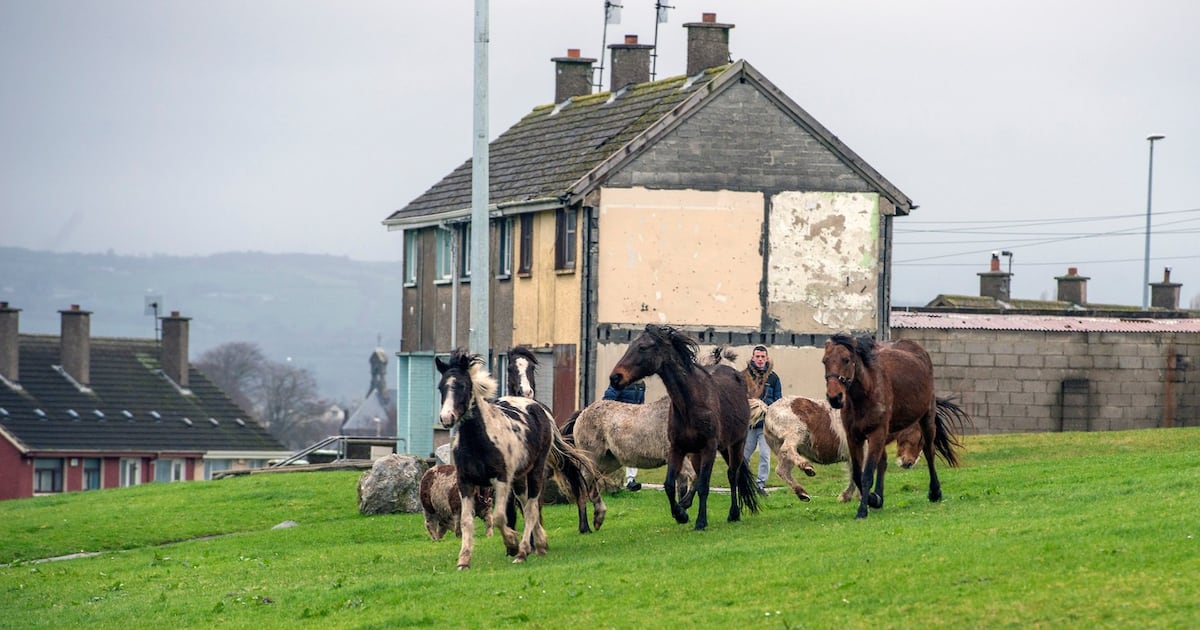
More than 300 stray horses were seized by eight local authorities in the past 18 months, mostly in urban areas of Limerick and Dublin, new figures show.
Limerick City and County Council said stray horses posed a “considerable challenge” particularly in urban areas of Limerick city, and that it needed assistance from gardaí during horse seizure operations.
South Dublin County Council said it had engaged in “significant operational activity” in relation to stray horses so far this year.
Figures released by eight local authorities under Freedom of Information laws show 311 stray horses were seized by councils in Dublin, Limerick, Cork, Waterford and Galway in the 18 months to end of June.
Most stray horses were reclaimed by their owners, rehomed or sent to animal welfare charities, but about 9 per cent − 29 animals − were euthanised between January 2025 and June 2026.
In Limerick, 96 horses were seized in the 18 months to the end of June, 70 of them during 2025.
A spokesperson for Limerick City and County Council said about a third of the horses seized were Shetland ponies, and the rest were classed as standard equines. All were rehomed or reclaimed by their owners.
“Due to previous incidents involving resistance to enforcement activity, all seizure operations require Garda support and are frequently conducted during night-time or early morning hours. As a result, the availability of Garda resources can directly impact the number of enforcement operations that can be undertaken,” they said.
While the number of horses seized in Limerick fell from 200 annually in 2016 and 2018 to 70 last year, “this should not be interpreted as a corresponding reduction in the number of stray horses”, the spokesperson said.
[ Horses being left to ‘rot and die in city estates’, Limerick TD tells DáilOpens in new window ]
“Rather, it reflects the operational, legal and resource challenges associated with horse seizures and enforcement.”
South Dublin County Council (SDCC) seized 46 horses in the 18 months to the end of June. Most were rehomed or reclaimed but eight were euthanised.
A spokesperson said this figure reflected successful seizure attempts, and “should not be interpreted as the total number of reports received or investigated relating to horses unattended on public lands”.
The council – which includes areas such as Clondalkin, Tallaght and Saggart – said reports of unattended horses fluctuated every year but “there has been significant operational activity in this area during 2026”.
Fingal County Council seized 43 horses over 18 months, more than a third of which – 16 animals – were euthanised.
Dublin City Council, including the city centre, Crumlin and Ballymun, said it seized 40 horses; nine in 2025 and 31 in the first half of 2026. All were reclaimed or transferred to an animal welfare charity.
A spokesperson said activity was higher this year because Dublin City Council appointed a new contractor to “enact on the enforcement of the Control of Horses Act 1996”.
Dún Laoghaire Rathdown County Council seized and rehomed seven horses in south Dublin in 18 months to mid-2026.
Waterford City and County Council seized 36 horses in the same period. Nine of these were euthanised and the remainder were rehomed or reclaimed by their owners.
Cork County Council seized 41 stray horses over the same period. All were rehomed or reclaimed. Cork City Council did not provide data or respond to request for comment.
Galway City Council and Galway County Council said they seized just one horse each in the 18 months.
Galway City Council said stray horses were “no longer a significant issue” in Galway city.
A spokesperson said: “In many cases matters can be resolved through engagement with horse owners without the need for seizure. The seizure of a horse is considered a measure of last resort.”