


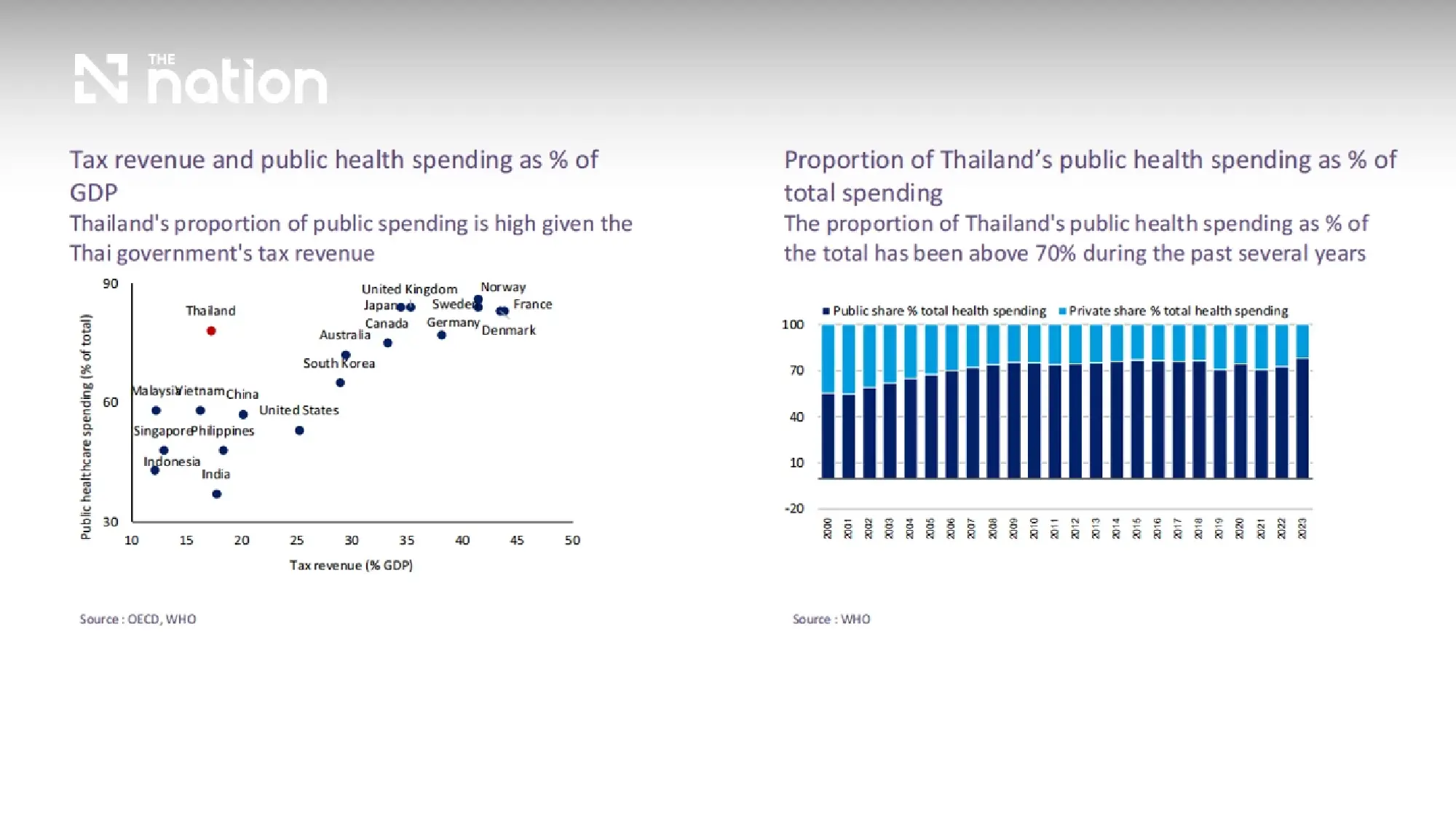
Private health insurance, meanwhile, remains strikingly underdeveloped. Only 6.4 per cent of Thais hold voluntary private cover, against an OECD average nearer 30–40 per cent, and insurance finances just 4 per cent of total healthcare spending nationally.
In private hospitals, only 16–30 per cent of patients pay via insurance, with the remainder paying out of pocket. Yet premiums have grown at roughly 9 per cent a year since 2019, a trend KKP believes will accelerate as the state pulls back.
“Instead of the government supporting so much, insurance will play a bigger role — that’s why we believe both insurers and private hospitals have greater opportunity ahead,” Teerapol said.
Sector under pressure, but “cheapest in a decade”
The near-term picture for listed hospital operators has been less rosy. Thailand’s healthcare index has fallen roughly 6 per cent this year, hit by insurers tightening inpatient claims criteria, a sharp 60–80 per cent drop in revenue from Cambodian patients amid border tensions, and a slowdown in Middle Eastern medical tourists during regional conflict earlier in the year.
KKP argues the resulting valuation reset — sector price-to-earnings multiples have fallen from around 30 times to roughly 20 times, against 29 times for regional peers in Singapore and Malaysia — represents the most attractive entry point in a decade, with dividend yields rising to 4–5 per cent from 1–2 per cent previously.
The firm expects earnings to trough in the third quarter before recovering as Cambodian volumes stabilise and Gulf travel normalises.
Among individual names, KKP rates Bangkok Dusit Medical Services (BDMS) a “buy” with a target price of 23.50 baht, citing its diversified patient mix, including a 30 per cent share of international patients. Bumrungrad Hospital (BH), with 60–70 per cent international patients concentrated in Middle Eastern markets, carries a 230 baht target.
Praram 9 (PR9), Bangkok Chain Hospital (BCH) and Chularat Hospital (CHG) also carry “buy” ratings, targeting 24.50 baht, 13.00 baht and 2.00 baht, respectively.
Learning from abroad
KKP’s analysis points to a menu of reforms already tried elsewhere in the OECD that Thailand could adapt.
Norway has tightened cost-effectiveness criteria for new treatments funded publicly, shifting some financing to private insurance; Finland and Japan have raised patient co-payments; Israel, South Korea and Chinese Taipei have shifted more care into outpatient settings to reduce costly hospital admissions; and several European countries have consolidated hospital networks to cut duplication.
Digital reform is another recurring theme.
KKP’s report highlights that closing gaps in claims data — reducing so-called “phantom billing” — and investing in preventive healthcare could ease pressure without cutting benefits outright.

Medical tourism and wellness as growth levers
Beyond the fiscal story, KKP points to medical tourism as a structural tailwind.
Thai treatment costs run 20–30 per cent below Singapore’s and 50–60 per cent below those in the United States and Europe, underpinning growth of around 9–10 per cent annually.
The Middle East and CLMV markets remain core sources of demand, while Indonesia and China are flagged as emerging opportunities.
Wellness-focused businesses, which require fewer medical staff than acute care, are also highlighted as carrying higher margins than traditional hospital operations, with the global wellness market itself expanding at nearly 10 per cent a year.
Taken together, KKP’s analysis casts Thailand’s healthcare financing predicament less as a looming crisis than as the opening chapter of a structural shift — one in which private capital, rather than the state, increasingly underwrites the country’s rising cost of staying healthy.