
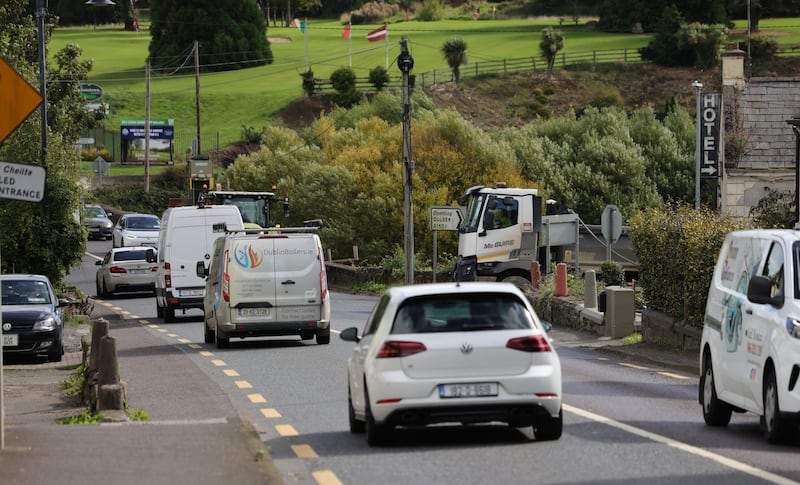
At rush hour on the banks of the river Nanny, a few kilometres south of Drogheda, traffic crawls through Julianstown along its arterial thoroughfare, the R132.
Though it is home to only 700 residents, the Co Meath village is surrounded by some of Ireland’s fastest-growing communities.
Meath ranked second for population growth in the 2022 census, up 13 per cent on its 2016 total, with populations exploding in the likes of Bettystown, Laytown, Grange Rath and Donacarney.
The upshot for Julianstown is an average of 22,000 vehicles per day pass through, according to data from Transport Infrastructure Ireland, which oversees the State’s road network.
While many of these cause rush-hour congestion, residents are more concerned about offpeak hours when vehicles drive freely and at greater speed.
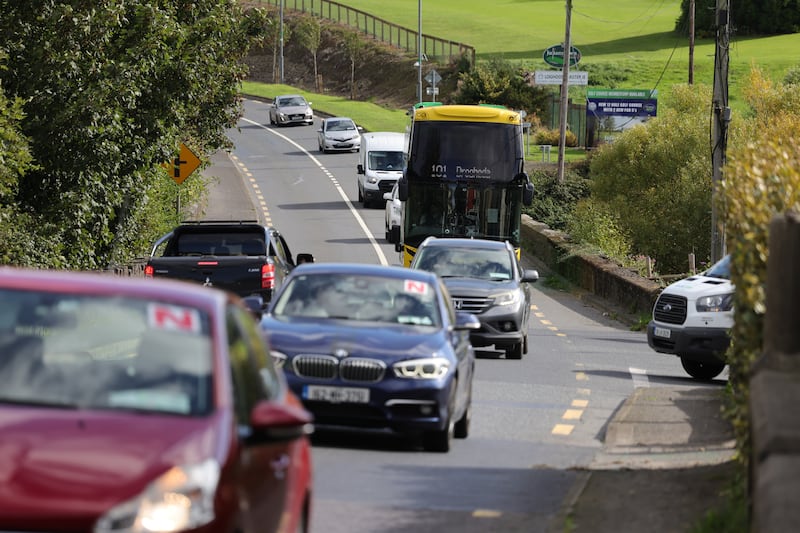 Heavy traffic makes its way through the Co Meath village of Julianstown. Photograph: Bryan O’Brien/The Irish Times
“My main concern would really be the speed of the traffic and slowing it down,” says local resident Emer Brennan.
“I just feel that every time we step outside our door to travel to and from school, or wherever we’re going, people are not adhering to the speed limit.”
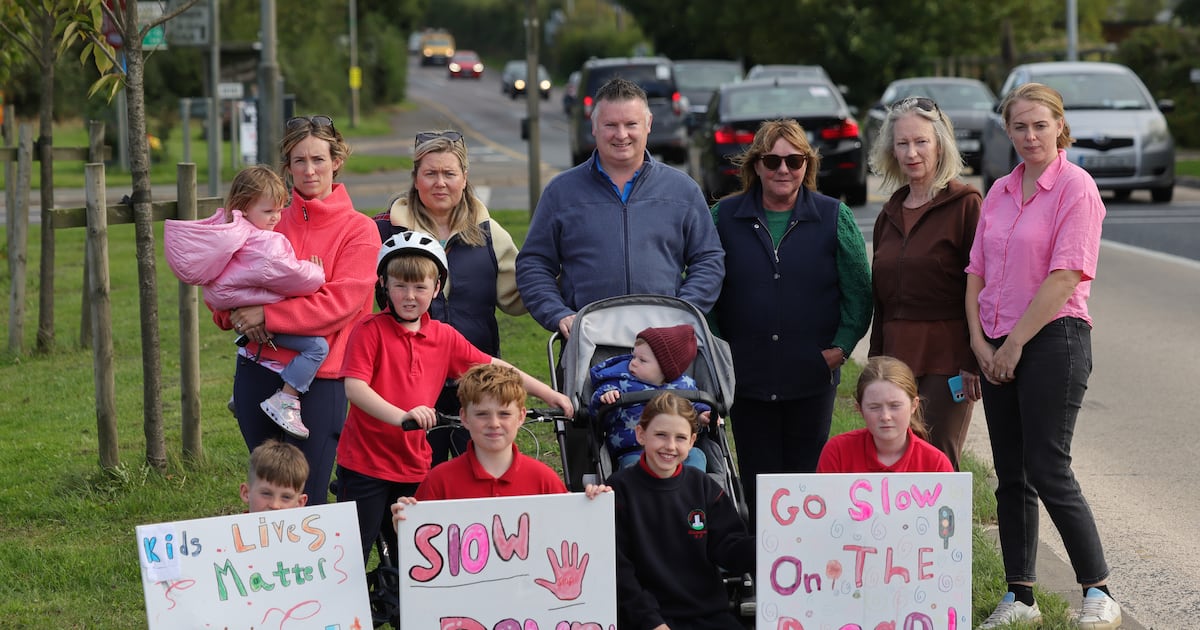
Brennan grew up in Julianstown and is raising four children in the village with her husband, Richard Brennan, who is the chair of a campaign group called Yes to Julianstown Traffic Relief, No to Another Bypass.
The lengthy title details the dispute at the centre of the community: residents want traffic problems solved, but many are unhappy with Meath County Council’s approach.
In July, the council held a public consultation on the second phase of its Julianstown traffic-relief scheme.
It presented four options to tackle congestion, each of which involved the construction of a bypass of some description to the west of the village.
Many residents say the problem is a lack of access to the M1, part of which forms the existing Drogheda bypass, completed in 2003. The motorway runs parallel to Julianstown, but a large number of commuters have to pass through the village to get to it.
Meath is the county with the highest proportion of long commutes – defined as a journey of one hour or more – according to data from the 2022 census.
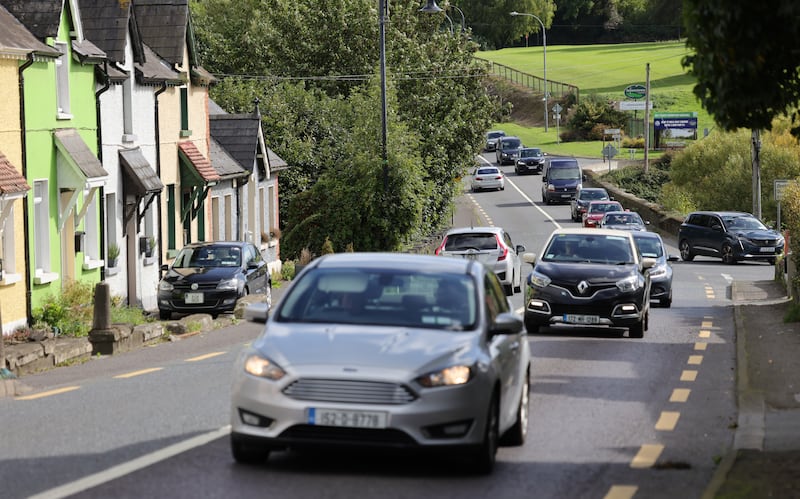 Traffic passing through Julianstown, Co Meath, earlier this month. Photograph: Bryan O’Brien/The Irish Times
“What a lot of local residents have felt,” Richard Brennan says, “is that providing a better link option to the M1 is the least disruptive option. The problem is access to the M1 at the end of the day.”
Western bypass options would cut through farmland and existing local roads, Brennan says, adding that anywhere from five to 10 houses could be affected.
Many locals remember the construction of the M1 and the impact it had. “They don’t need to do that again a second time to try to solve the same problem,” Brennan says.
The M1 toll plaza, Brennan says, is “the elephant in the room”. Those driving southbound through Julianstown can avoid it, and he believes that, were it repositioned, some commuters from towns north of Julianstown would take alternative routes to access the M1.
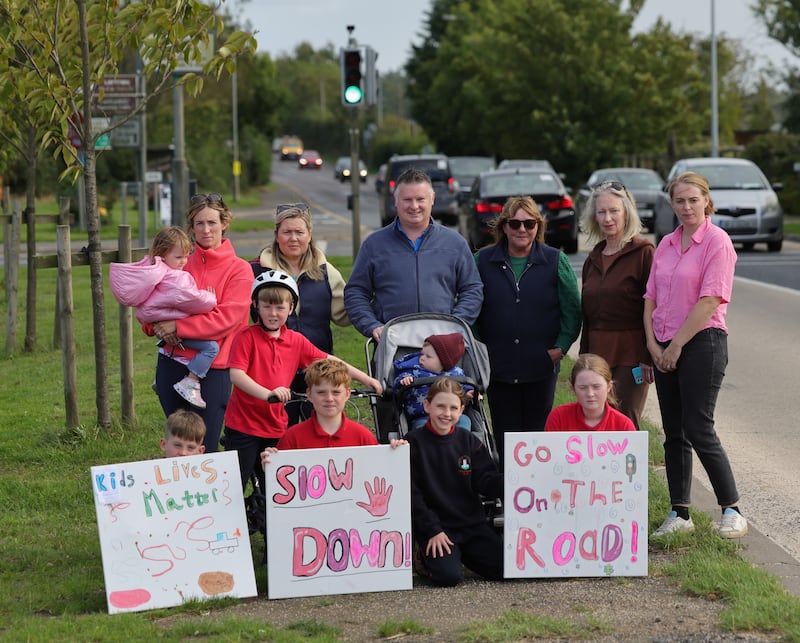 Julianstown resident Richard Brennan (centre) and other locals who are concerned about traffic volume in the Co Meath village. Photograph: Bryan O’Brien/The Irish Times
Potential solutions to heavy traffic are up for debate, but Brennan has been disappointed by the approach Meath County Council has taken, and what he perceives as a lack of communication with residents.
The window granted for public consultation on the traffic-relief scheme was brief, locals feel, and there was a lack of detail on the options being presented, including ambiguity around the maps highlighting proposed routes for a bypass.
With the community voicing its discontent, a majority of councillors backed a motion of no confidence in the options presented during the consultation period.
Madeleine Woods, another local resident, says people in the area have for a decade been told upgrades to the village’s road safety infrastructure cannot be carried out until Uisce Éireann completes planned work on its local network. She sees footpaths and speed bumps as immediate priorities.
“Nobody can leave their children,” Woods says. “Kids live on both sides of these roads; none of them can cross the road without a parent. These are fifth- and sixth-class children that should be given that independence.”
 Julianstown is in a valley, with roads sloping downwards. Photograph: Bryan O’Brien/The Irish Times
As well as the traffic-relief scheme, a traffic-calming scheme for Julianstown has been in effect for several years, but necessary improvements have not materialised.
Just before this school year began, a yellow box junction was repainted outside the gates of Whitecross National School and some coloured tarmac was added just before the existing pedestrian crossing at the school.
A temporary digital speed checker is also positioned on a footpath, flashing to show motorists their speed as they pass, but speeding remains a big problem, particularly when larger, heavy goods vehicles come down the R132.
Julianstown is in a valley of sorts, with the road sloping down towards the village on either side, and traffic often accelerates through from both directions as a result.
“I’ve rang different entities to try to get a speed van out,” Woods says, bemoaning a general lack of Garda presence in the area. “They say it’s outsourced and nothing to do with them. It really is the forgotten village.”
“We need that road slowed down,” says her father, Tom Woods. “I’m just hoping it’s not one of mine, because there’s going to be a child knocked down at that school.”
Strains on local infrastructure are felt in a variety of ways as housing developments continue to be approved in surrounding commuter towns.
“We had three electrical outages in the area last week,” Madeleine Woods says. “The infrastructure on any level isn’t there, so we are all bracing ourselves for the winter now.”
Emer Brennan adds: “Everybody is just really concerned that all of these outages are related to the excessive building, pushing the already-present infrastructure to its absolute limit … We’re already at the pin of our collar.”
“The point is they’re not putting in the foundations in the infrastructure before they expand,” Richard Brennan says.
Fianna Fáil councillor Stephen McKee tabled the motion of no confidence at the recent public consultation on the traffic-relief scheme. Having grown up in the area, he acknowledges the “inability of infrastructure to keep pace with the rapid population growth”.
McKee says another part of the issue is a lack of investment in Drogheda, which is a hub just across the county border for communities in east Co Meath.
“You effectively have Drogheda and east Meath becoming a commuter belt area,” he says.
“[There’s a] lack of local jobs; everybody’s trying to get to Dublin. Thankfully, some people can work from home, but it’s having a major impact on the quality of life of residents as well.
“They spend a lot of time in traffic. Young people with young families. They don’t have the time for getting involved, as much as they’d like to, locally in community clubs and so on because a lot of them are spending hours commuting.”
Some €300,000 was allocated to the traffic-calming scheme several years ago, according to McKee. He says there is a “huge infrastructure deficit” in the area and suggests the issues affecting Julianstown – an absence of footpaths and local amenities, for instance – are replicated across commuter towns in the area.
On its website, Meath County Council lists a contract awarded to Systra Ltd, with a value of €431,860, for phase two of the Julianstown traffic-relief scheme, which expired in August.
The council says it “cannot comment on individual contracts”.
A council representative says all submissions received in relation to the recent public consultation will be considered “alongside technical assessments, environmental studies and traffic modelling”.
The council anticipates that another public consultation “on an emerging preferred option” will take place later this year.