
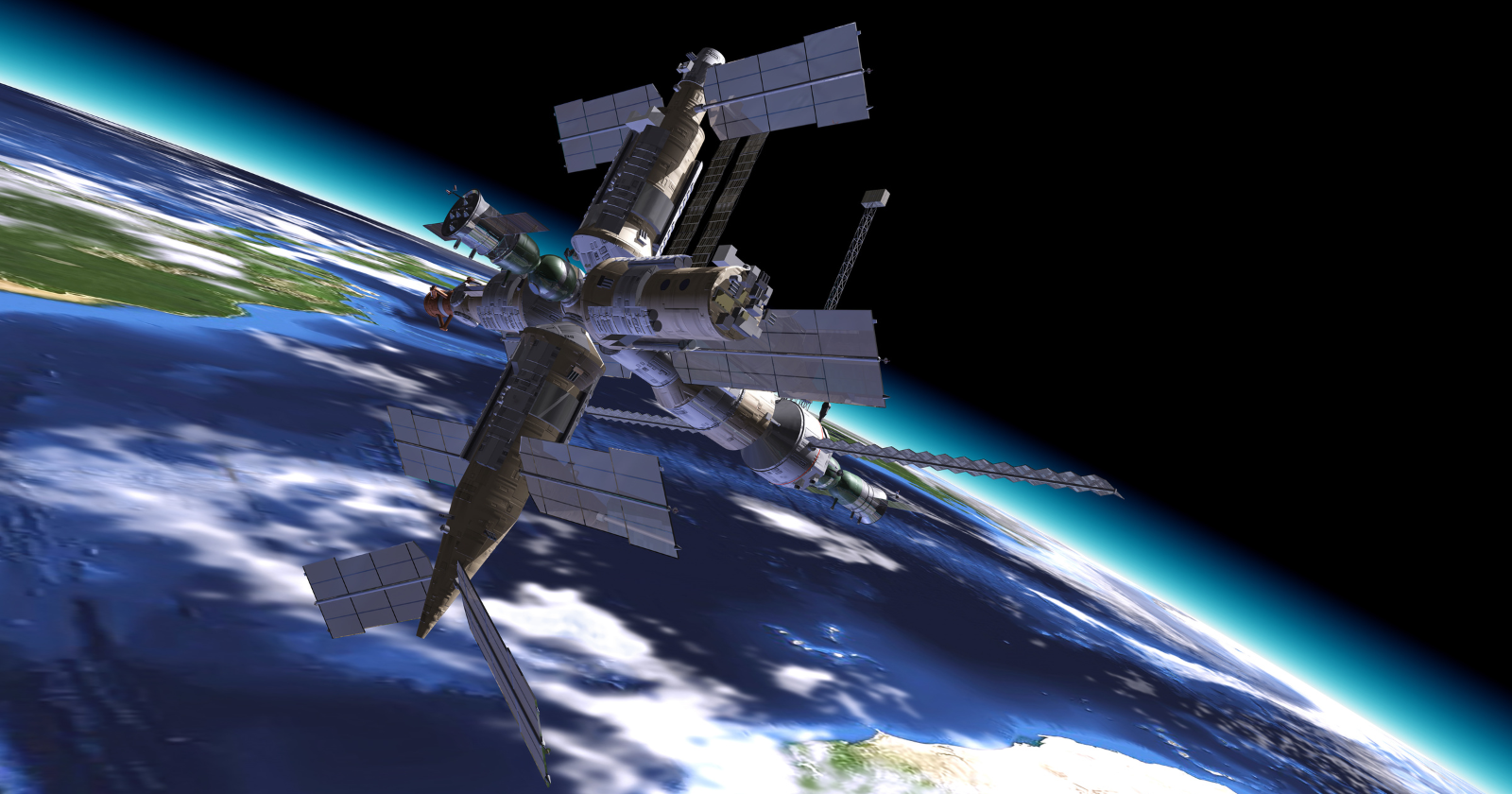
In March 2001, one of the largest objects humans had ever put in orbit was about to fall out of the sky, and a fast-food chain saw a marketing opportunity in the wreckage.
The object was Mir, the Russian space station — about 130 tonnes of hardware that had circled Earth for 15 years. Russia had run out of money to keep it up, so engineers were steering it down for a controlled, fiery death over the empty South Pacific. And floating out there in the ocean, waiting for it, was a giant bullseye that said “Free Taco Here.”
The bullseye in the sea
The stunt was pure Taco Bell. The company built a 40-by-40-foot vinyl target — its bell logo ringed by a bullseye, the words “Free Taco Here” in bold letters — and anchored it in the South Pacific about ten miles off the coast of Australia, along Mir’s expected re-entry path.
The promise: if the core of the plummeting space station struck the target, every single person in the United States would get a free taco. Roughly 280 million people. The company set up a countdown clock on its website and fed a hungry international press corps four days of coverage, tying its brand to what news anchors were solemnly calling one of the great celestial events of the era.
It was a promise engineered to be impossible to lose — and, almost certainly, impossible to pay out.
Why the insurance was the smart part, not the scared part
The detail everyone remembers is that Taco Bell bought an insurance policy against a direct hit. It’s tempting to read that as nerves — as if the company genuinely feared it would owe America ten million tacos. The truth is closer to the opposite, and it’s what makes the stunt a small masterpiece.
What changed in the universe since you were born?
Six sourced measurements. No predictions. No astrology.
Taco Bell hired a Dallas firm called SCA Promotions — a company whose entire business is insuring exactly these kinds of prize offers. For a modest premium, SCA takes on the risk of a giant payout that is extremely unlikely to happen. And a piece of a space station hitting a 40-foot raft in the open Pacific was about as unlikely as promotions get: the target was a speck, the ocean is unimaginably vast, and Mir was coming down along a track thousands of miles long.
So the insurance wasn’t fear. It was the mechanism. It let Taco Bell dangle a genuinely enormous prize — free tacos for the entire country, an estimated $10 million liability — while its actual exposure was just the small, fixed cost of the premium. The company got to look daring and generous while a specialist quietly absorbed a risk that was never going to materialize. That is the whole trick of prize-indemnity marketing, performed here on a planetary stage.
Mir missed, obviously
On March 23, 2001, Mir blazed back into the atmosphere and broke apart, its surviving fragments splashing down in the South Pacific — closer to Chile than to Australia, and nowhere near the taco raft. The bullseye bobbed, un-struck. No free tacos for America.
Nobody at Taco Bell was surprised, or sorry. The company had never needed Mir to hit the target; it had needed the world to spend four days talking about Taco Bell and a space station in the same sentence, which the world dutifully did. As a fallback, the chain rolled out its real promotion — the one it had wanted to push all along — a “consolation” deal of two tacos for 99 cents. The falling space station was just the world’s most expensive attention-getter, and Taco Bell got to use it for the price of a vinyl sheet and an insurance premium.
The genius of aiming at the impossible
Strip the stunt down and it’s a clean lesson in how modern marketing actually works, which is why people still tell the story a quarter-century later.
Taco Bell risked almost nothing and bought enormous, global, free publicity — the kind money can’t easily buy directly — by attaching itself to a genuine, once-in-a-generation news event and making a promise it was statistically guaranteed not to have to keep. The insurance policy, the part that sounds like caution, was really the engine of the audacity: it converted a terrifying-sounding liability into a fixed, trivial line item, freeing the company to be as bold as it liked.
The Russians spent 15 years and billions of dollars building Mir, and its final act, on the way down, was to serve as a free billboard for a taco chain that had wagered a coupon it knew it would never have to honour. Mir aimed for an empty patch of ocean and hit it. Taco Bell aimed for the front page and hit that. Only one of them was ever really trying to miss.
About this article
This article is for general information and reflection. It is not professional advice. For your specific situation, consult a qualified professional.
Follow Space Daily on Google
Add us as a preferred source to see more Space Daily reporting in Google.
Standards
Space Daily articles are edited and fact-checked before publication. We use AI tools in the newsroom. See our editorial standards and masthead.