
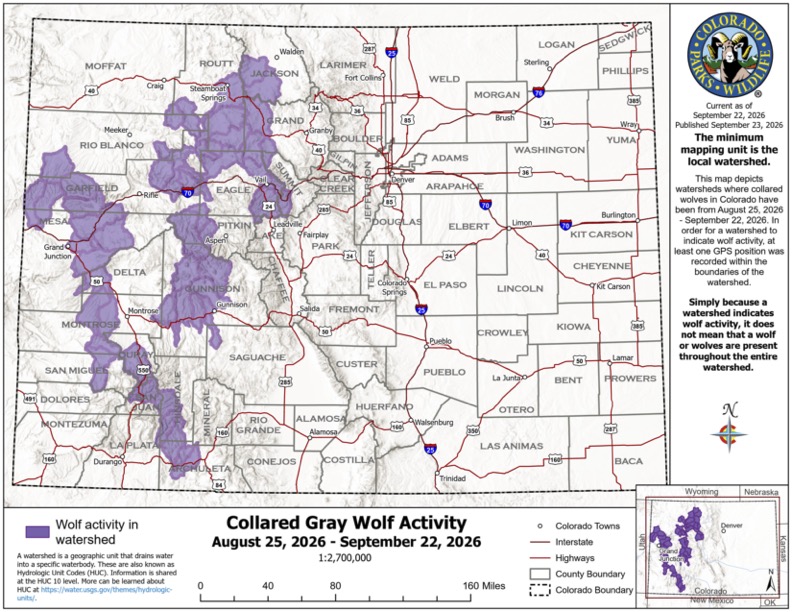
Colorado’s collared gray wolves explored across the Western Slope in September, with movements extending south through the San Juan Mountains as pack activity persists in the north.
This is according to Colorado Parks and Wildlife’s monthly wolf activity map, which highlights the watersheds where collared wolves were located between Aug. 25 and Sept. 22.
The latest map shows continued activity in the northwest in watersheds spanning portions of Jackson, Routt, Grand, Summit, Eagle, Rio Blanco, Garfield, Pitkin, Delta and Gunnison counties.
The northwest region is currently home to Colorado’s four reproducing packs: the Piney Ridge Pack in Eagle County — the only new pack to form this year — as well as the One Ear Pack in Jackson County, the Copper Creek Pack in Pitkin County and the Three Creeks Pack in Rio Blanco County.
While these packs’ pups have left the den sites and are starting to venture “short distances with other pack members,” they largely remain near “rendezvous sites,” where adults bring them meat, according to Parks and Wildlife.
Compared to the previous month, the latest map shows activity extending south into watersheds through Mesa, Montrose, San Miguel, Ouray, San Juan, Hinsdale and Archuleta counties.
If a watershed is highlighted, it means that at least one GPS point from one wolf was recorded in that watershed during the 30-day period. GPS points are recorded roughly every four hours. This can lead to gaps between the highlighted watersheds, as wolves can travel large distances in short periods of time.

While pack wolves stay tethered to a territory, lone “disperser” wolves often travel long distances in search of food and mates.
Parks and Wildlife estimated that Colorado had around 32 wolves as of March 31, around half of which are collared. This count included 18 adults and 14 yearlings that were born in 2025. It did not include the number of wolf pups born to its four reproducing packs this spring.
Since March 31, six uncollared wolves have died, the vast majority of which were killed by Parks and Wildlife in response to repeated livestock attacks by several of the state’s packs. The exception is the death of an uncollared wolf in northwest Colorado in July, which is still under investigation.
The euthanization of these wolves is used as a tool by Parks and Wildlife to try and discourage wolves from predating on livestock when packs or individuals are connected to three confirmed attacks on livestock in 30 days, and when producers are attempting to mitigate or reduce conflict.
Prior to this year, the agency had only killed one wolf in Colorado in an effort to reduce conflict between livestock and wolves. The rise in wolves being killed — spiking with three in a week in September — has drawn criticism about how it could impact the state’s nascent wolf population as well as concerns about its efficacy.
This year, Parks and Wildlife has killed an uncollared, lone wolf in June, a yearling from the One Ear Pack in August and a second yearling from the pack four weeks later in September as the attacks on cattle continued. The same week in September, it killed yearlings from the Copper Creek and Three Creeks packs.