
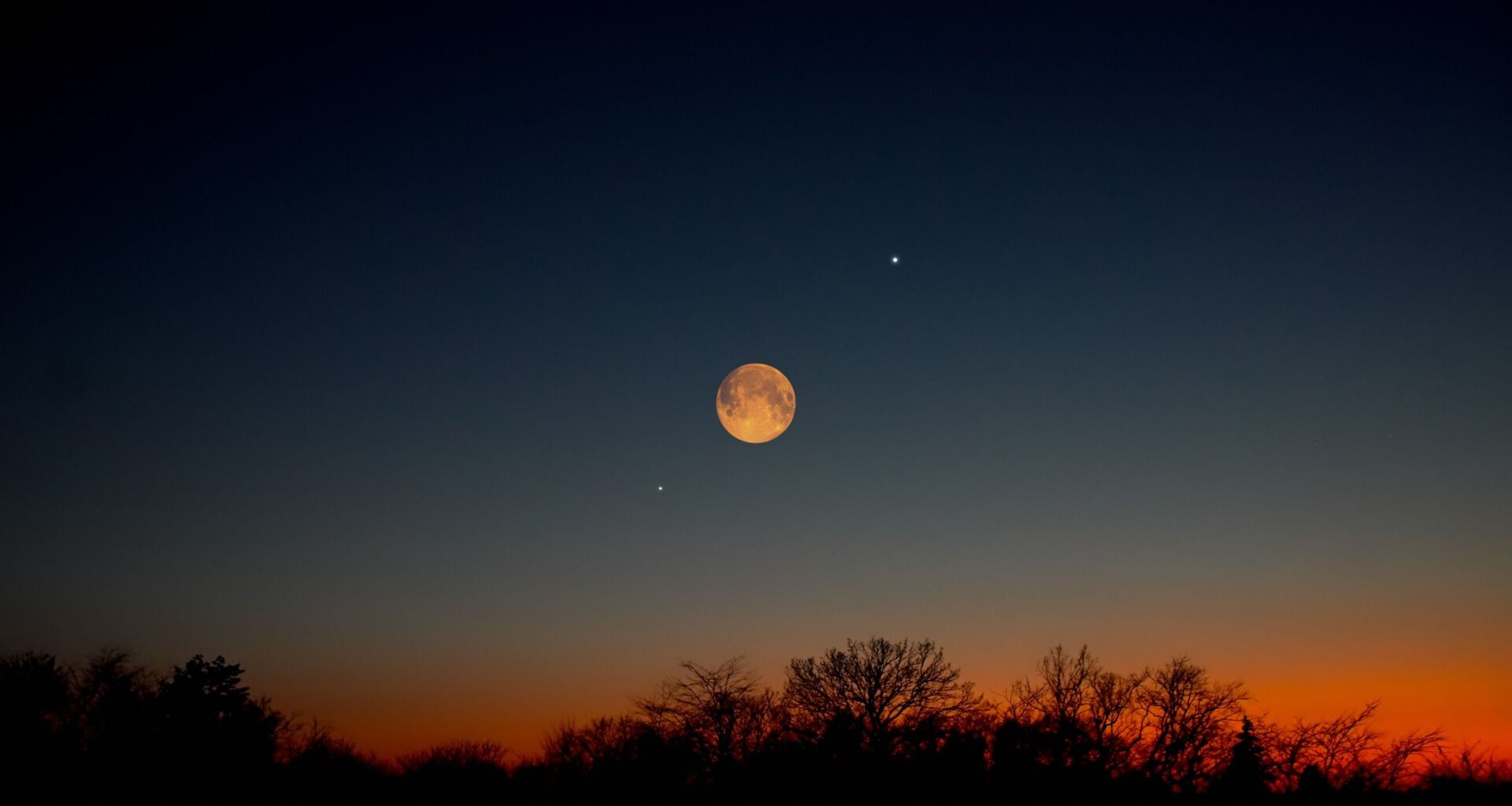
On Saturday evening, September 26, skywatchers can use the full Harvest Moon to identify Saturn, one of the most striking telescopic sights in the night sky.
The moon will serve as a clear guide because it turned full only hours earlier. This year’s September full moon is also the Harvest Moon — the full moon that falls closest to the Autumnal Equinox.
As I have noted over the years at Space.com, Saturn doesn’t immediately stand out from the stars in the way some other planets do. It lacks the dazzling brilliance of Venus or Jupiter and the fiery orange-yellow color of Mars.
To the unaided eye, Saturn appears as a bright yellowish-white “star.” Shortly after 9 p.m. local daylight time, observers looking about one-quarter of the way up from the east-southeast horizon may notice it without realizing they are seeing the solar system’s ringed planet.
On Saturday evening, the moon will be positioned almost directly above Saturn.
You may like
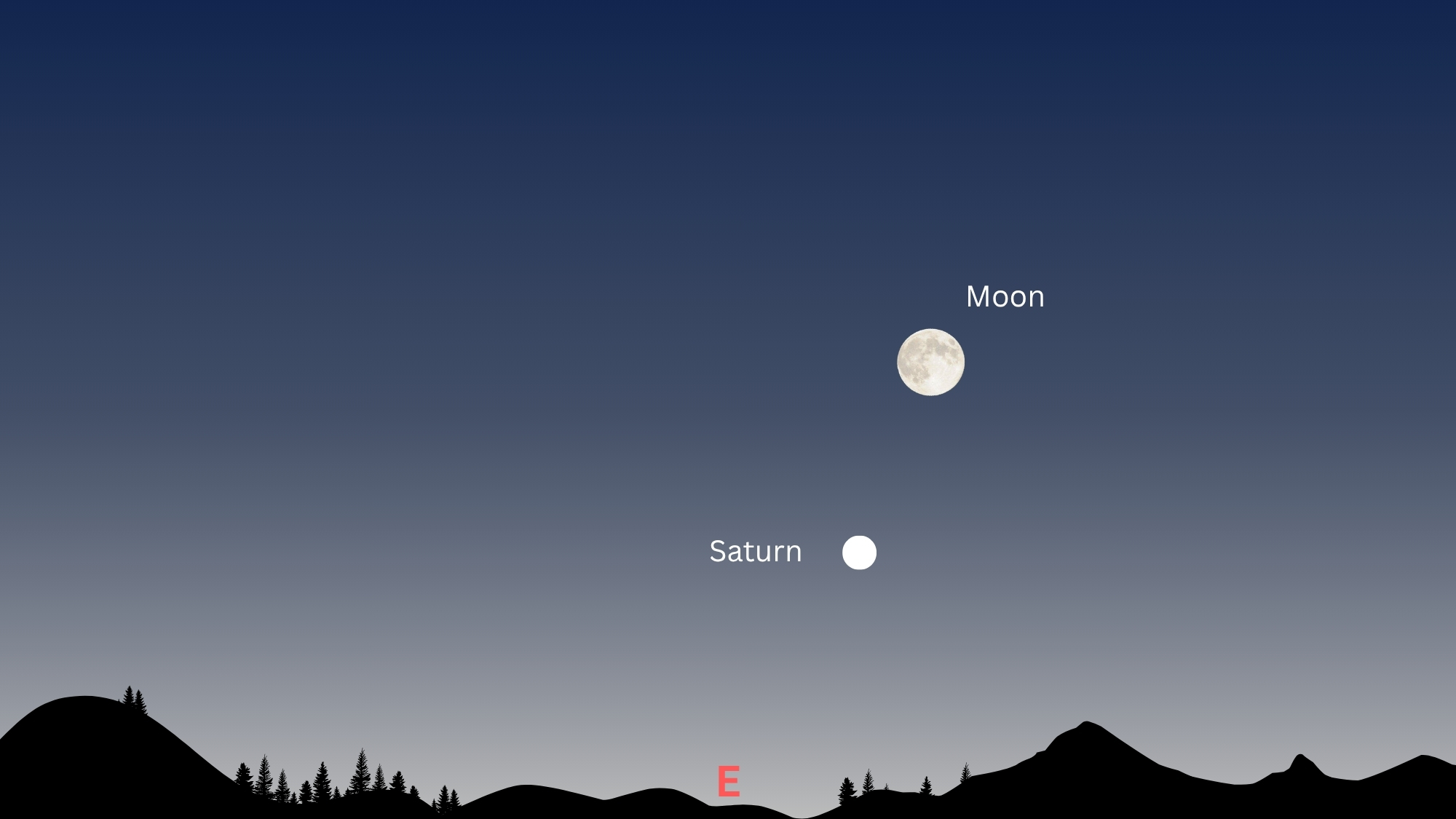
Look east on Sept. 26 to catch Saturn shining below the full moon. (Image credit: Created in Canva Pro)
If skies are clear, the evening will offer an excellent opportunity to view both Saturn and the moon through a telescope.
Begin with the moon. A full moon can appear flat and one-dimensional, and its brightness may temporarily dazzle the eye. Saturday’s moon should be especially bright, with Tycho among its most notable features. This prominent impact crater in the southern lunar highlands, named after Danish astronomer Tycho Brahe, appears as a bright spot with rays of material stretching across much of the moon’s lower limb.

Another prominent impact crater is Copernicus, located slightly northwest of the center of the moon’s Earth-facing hemisphere. It is easy to identify when sunlit and, like Tycho, is marked by brilliant rays extending from its center. Under high illumination, the rays of Tycho and Copernicus are so dominant that they can make other features more difficult to locate.
After observing the moon, turn your telescope toward Saturn. A clenched fist held at arm’s length spans roughly 10 degrees, so Saturn will appear about two-thirds of a fist, or 6 degrees, below the moon.
Saturn’s famous ring system has become more visible since March 2025, when the rings appeared edge-on from Earth and their inclination briefly narrowed to nearly zero. Since then, their angle has gradually increased to about 8 degrees, and on Saturday any telescope with an eyepiece magnifying at least 30-power should reveal them.
What to read next
Viewing conditions will improve in the years ahead. By this time next year, the rings will be even easier to see, and through a moderate or large telescope they should appear even more impressive to experienced observers.
During the winter of 2031—2032, the southern face of the rings will be most exposed to both the sun and Earth. At that time, the rings will be tilted at a maximum of 26.8 degrees in our direction, a perspective known as maximum Saturnicentric latitude. Saturn will also be near the part of its orbit that brings it closest to Earth, shining at magnitude -0.5, more than twice as bright as it appears now. Among the stars, only Sirius and Canopus will shine brighter.
One final perspective note: the moon and Saturn will appear close together in Saturday’s sky, but they are far apart in space. The moon will be 233,000 miles (375,000 km) from Earth, while Saturn will be nearly 3,400 times farther away at 785 million miles (1.263 billion km).
Joe Rao serves as an instructor and guest lecturer at New York’s Hayden Planetarium. He writes about astronomy for Natural History magazine, Sky and Telescope, The Old Farmer’s Almanac and other publications.