
An editorial note re: The Journal and The 42’s reporting on the Uefa Nations League matches between Ireland and Israel is available to read here.
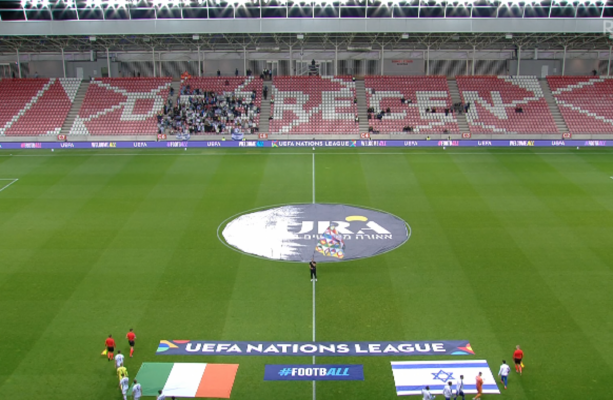
RTÉ’S BROADCAST OF the Ireland v Israel football match in Hungary this evening began without any introduction or continuity announcement about the controversy surrounding the match.
The 42 first reported on 11 September that RTÉ would be significantly curtailing its coverage of the match and would not be using its own employees on screen.
RTÉ subsequently confirmed that there would be no studio punditry and no RTÉ commentary of the game, with the commentary instead provided by Uefa’s global coverage.
While these decisions were reported in advance of the game, they were not aired before or during the broadcast.
This evening, RTÉ broadcast began less than 10 minutes before the match kicked-off and began immediately after the credits of the previous programme, wildlife programme China’s Wild Guangdong.
The sudden beginning to the broadcast of the Uefa feed was because RTÉ had confirmed that there would be no advertising or sponsorship around either game.
RTÉ had also stated that a “minimal technical team” would be used by the national broadcaster for the fixture.
Trade union Siptu earlier this month welcomed this broadcasting approach and said it would support the right of its members in RTÉ to “conscientiously object to playing any role in the sportswashing of the genocidal state”.
The fixture, which is part of Uefa’s Nations League, has been completely overshadowed by the questions of whether Ireland should fulfil the fixture and Uefa’s failure to impose sporting sanctions on the Israeli Football Association.
RTÉ said it was broadcasting the Uefa feed due to a decision to fulfil its “contractual obligations” while limiting commercial activity around the game. The broadcaster has been continuing to provide news coverage of the game and the events surrounding it.
The Journal and The 42 also decided to treat tonight’s match and next week’s corresponding fixtures primarily as significant news stories.
In the 10 or so minutes pre-kick off and during play, the Uefa global feed broadcast on RTÉ 2 made no reference to controversy around Israel’s participation.
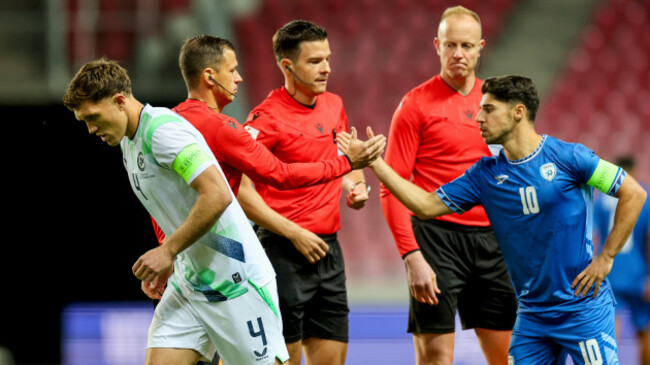
Ireland’s Dara O’Shea after shaking hands with the German officials ahead of the match but not the Israel captain. Ryan Byrne / INPHO
Ryan Byrne / INPHO / INPHO
The commentator did not mention that Ireland’s captain Dara O’Shea did not shake hands with his Israeli counterpart as part of the standard pre-game formalities.
The Irish players bowed their heads during the Israeli national anthem and wore black armbands during the game; neither was commented upon.
Similarly, the commentator did not explain the absence of Ireland’s goalkeeper Gavin Bazunu from the matchday squad.
Bazunu said in a statement yesterday that he would not take part in the match “based purely upon my personal belief that the killing of innocent people is wrong”.
Because of Bazunu’s withdrawal, defender Jimmy Dunne was listed as a goalkeeper in the Ireland squad, as rules dictate that three goalkeepers are required.
Mentioning this quirk, the Uefa commentator said: “Ireland’s reserve goalkeeper Gavin Bazunu has chosen to make himself unavailable, so defender Jimmy Dunne will take his place on the bench.”
The game in Debrecen, Hungary is notionally the ‘home’ fixture for Israel but only a small allocation of tickets was made available by the Israel Football Association for its own fans.
No tickets were made available to Irish fans for the match but on a number of occasions the broadcast coverage cut to about 10 people who were cheering for Ireland.
The commentator said that these people had “made the trip” but again did not explain the significance behind the extraordinary circumstances.