
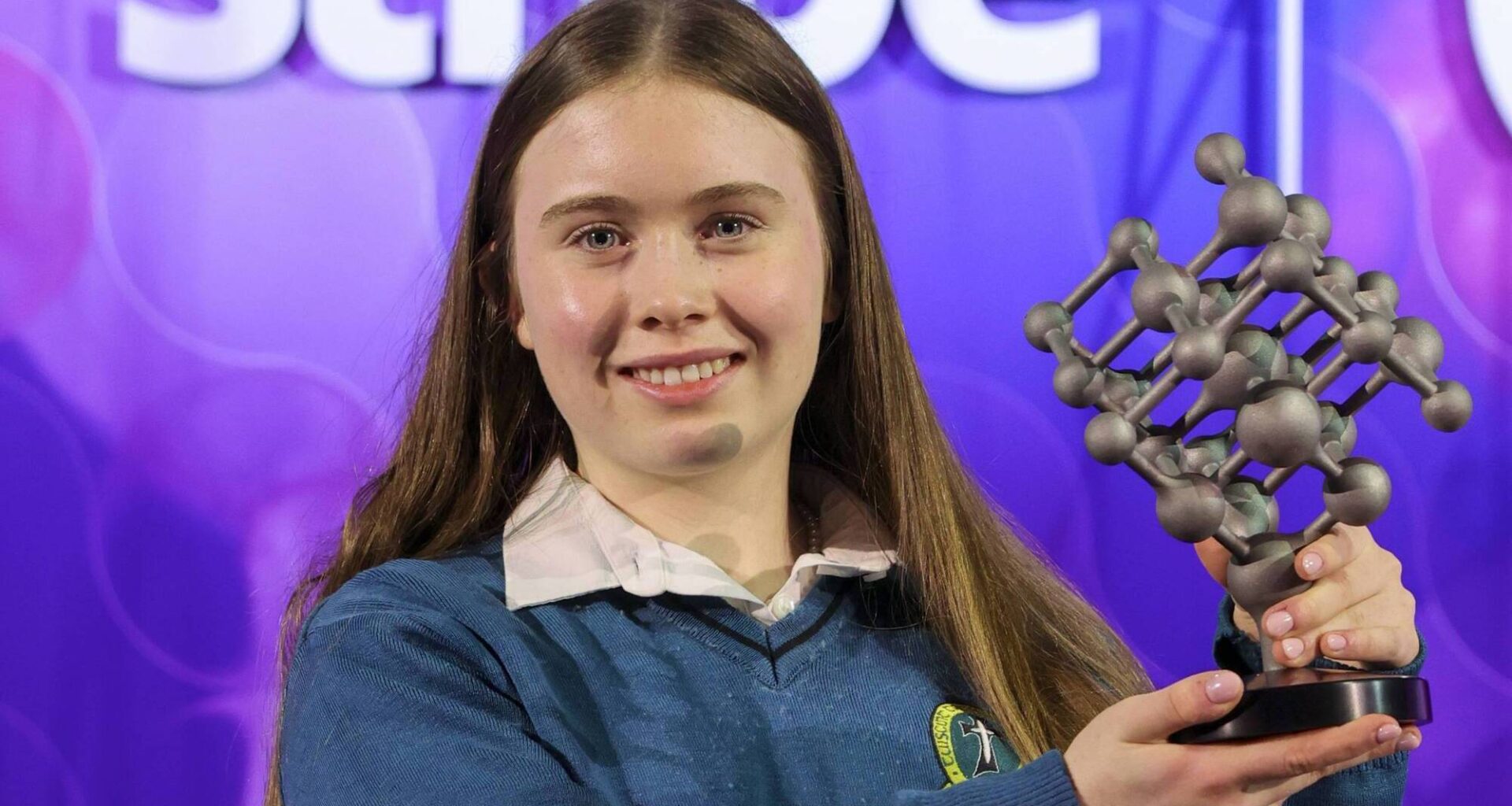
Young Scientist and Technology Exhibition winner Aoibheann Daly has been awarded a top prize while representing Ireland at the EU Contest for Young Scientists (EUCYS).
At the closing ceremony in Germany this weekend, Ms Daly, a student at Mercy Secondary School Mounthawk in Tralee, received the Special Jury Award for Youth, a core prize awarded directly by the European Commission.
The prize represents the highest recognition for the best scientific projects presented during the contest.
She received the honour for her project, ‘GlioScope: Multi-task Deep Learning and Causal AI for Glioma & Glioblastoma Profiling’, which was her winning project at the 2026 national event.
Through the project, Ms Daly aims to use artificial intelligence to help doctors diagnose and treat brain cancer and improve patient care.
Aoibheann was also chosen to participate as a finalist at the Regeneron International Science and Engineering Fair 2027 in Los Angeles, California.
The EUCYS competition took place in Kiel, Germany. More than 140 young scientists from 36 European and international guest teams showcased their research across a range of scientific disciplines.
“Receiving a core prize at EUCYS and being selected as a finalist for Regeneron ISEF 2027 is an incredible honour,” Ms Daly said.
“To represent Ireland on the European stage was already a privilege, and I’m hugely grateful to the Stripe Young Scientist & Technology Exhibition, my teachers, family, and everyone who supported me along the way.”
Mari Cahalane, EUCYS national organiser for Ireland, said she was “delighted” to see Aoibheann receive a core prize at EUCYS.
“This highlights the consistently outstanding quality of projects emerging from Stripe YSTE, and the exceptional scientific talent nurtured across Ireland.”
Alison Ahern, of the international financial tech giant Stripe, said that from the moment Ms Daly presented her project, it was “clear that her work combined scientific rigour, innovation, and real-world impact.”
“To see that recognised on the European stage is a proud moment for Irish science, and reflects the extraordinary standard of young scientific talent in Ireland, which we at Stripe are honoured to play a small part in.”
Aoibheann’s research with Glioscope aims to help doctors predict what genetic mutation is likely to be present from a simple MRI brain scan, in order to make quicker treatment decisions and reduce risk for the patient.
As there are no good methods currently to identify such mutations, doctors must rely on samples of brain tissue, which carries a high risk of bleeding in the brain for patients, as well as being slow and expensive.
Head judge for the Health and Wellbeing category, Professor Catherine Darker, said: “Brain cancer is a devastating condition for people. Glioscope, developed by a 15-year-old student, is an extraordinary achievement.”