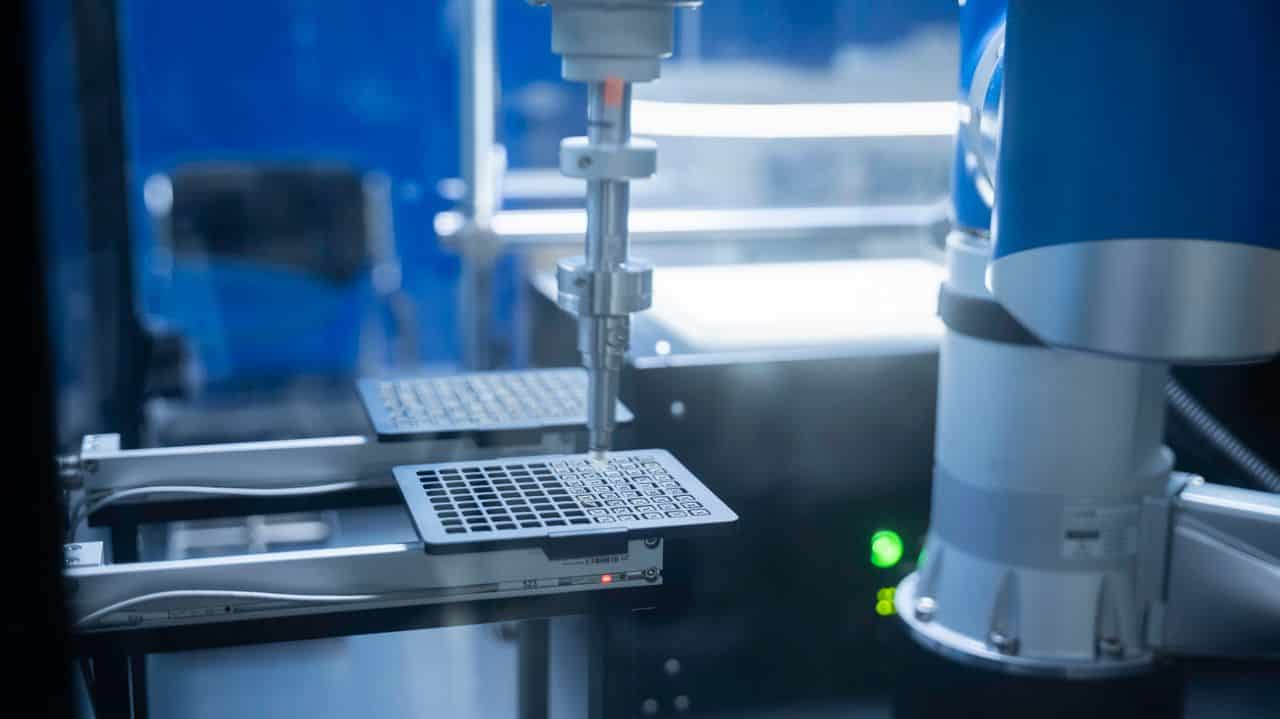
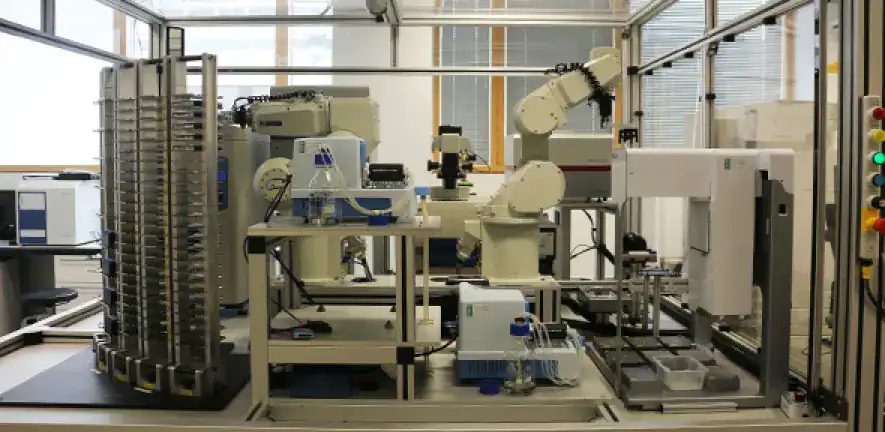
 Eve, the “AI researcher”. Credit: Chalmers University of Technology
First, AI came for the writers. Then the coders and artists. Now it appears to be eyeing scientists too.
Researchers at Chalmers University of Technology in Sweden have built an AI system that can do something far more consequential than summarize papers or suggest recipes. It can generate scientific hypotheses, design experiments, hand those instructions to automated lab equipment, and then interpret the results.
That does not mean scientists should hang up their lab coats. Humans still set the agenda for the automated experiments, impose safety limits and decide what the findings actually mean. But the new system shows how quickly AI is moving from being a tool scientists use to something that can carry out chunks of the scientific process itself.
The newly described system is part of a broader push toward “self-driving laboratories”—labs where software and robotics can keep experiments moving with surprisingly little human intervention.
Older Robot, Newer Brain
The idea of automating science experiments predates ChatGPT by decades.
In a 2004 Nature paper, Ross King and his colleagues described an early “robot scientist” that generated hypotheses about yeast genetics, chose experiments, physically performed them and interpreted the results. King later developed Adam, which his team described as the first robot to autonomously discover new scientific knowledge, followed by Eve, a machine built largely for drug discovery. By 2015, Eve was screening compounds for neglected tropical diseases.
The new work uses Eve’s laboratory infrastructure but adds newer AI techniques.
The system started with a database containing about 60,000 relationships describing yeast genes, metabolism, and traits. Pattern-finding algorithms turned those relationships into hundreds of logical rules and nearly 2,000 possible hypotheses involving amino acids.
×
Thank you! One more thing…
Please check your inbox and confirm your subscription.
Large language model agents then helped turn selected hypotheses into practical experimental plans. One agent proposed a plan, another chose among variations, and another converted the winner into instructions the laboratory equipment could execute. The researchers used GPT-4o for these steps.
Robotic systems grew the yeast, added chemicals and nutrients, tracked growth, and analyzed the cells’ metabolites. The resulting data flowed back into the system.
 An automated experimental framework enabling end-to-end biological discovery—from hypothesis generation to data integration. Credit: Journal of the Royal Society Interface
What Scientists Missed
Some of the AI’s predictions did not hold up when tested in the lab. Those failed experiments were still kept in the system’s database, so they could inform later hypotheses instead of being lost.
Other experiments produced real, and sometimes unexpected, biological effects.
Adding glutamate, for example, made yeast significantly more vulnerable to spermine, a compound that can interfere with cell growth. The researchers say this interaction had received little previous attention. The system also found an unexpected interaction between arginine and caffeine.
Perhaps more revealing was what happened when one prediction went wrong.
The AI first tested whether adding glutamate would make yeast more vulnerable to formic acid. Formic acid itself strongly stressed the cells and suppressed their growth, but glutamate did not have the expected effect. Instead, the yeast became slightly more resistant to the acid, and a control amino acid produced an even larger protective effect. That told the researchers the original hypothesis was wrong—and that something else in the cells was probably driving the response.
The system then used the metabolic data from that failed experiment to look for other molecules associated with survival under formic-acid stress. It ranked several candidates and selected aminoadipate, the highest-ranked compound that the lab could readily test, as the basis for a new hypothesis.
In a follow-up experiment, aminoadipate partly rescued the yeast from formic-acid stress, improving growth by about 7% per millimolar of the compound. The authors say this protective effect had not been demonstrated before.
That feedback loop is the important part: experiment, evidence, revised hypothesis, another experiment.
Similar ideas are spreading beyond biology. In 2023, researchers unveiled Coscientist, an LLM-driven system that planned and performed chemistry experiments, while the A-Lab autonomous laboratory used AI and robotics to synthesize inorganic materials. The Chalmers work pushes the same trend deeper into systems biology.
Autonomous, But Not Entirely Alone
 Researcher Ievgeniia Tiukova working with Eve. Credit: Chalmers University of Technology
The robot is not yet an unattended scientist.
Humans still prepared some materials, occasionally moved plates between machines, transferred files, and reviewed proposed experiments for safety. The authors also found that the language models sometimes became confused by more complicated hypotheses, including the direction of biological effects.
That makes the system less a replacement for scientists than an unusually tireless laboratory partner or technician.
“Human scientists remain essential for defining research priorities, interpreting broader scientific significance and ensuring ethical oversight,” King said in the Chalmers announcement.
For now, humans still decide what questions are worth asking. But machines are becoming increasingly capable of handling what happens after that question is posed.
The study was published in the Journal of the Royal Society Interface.