
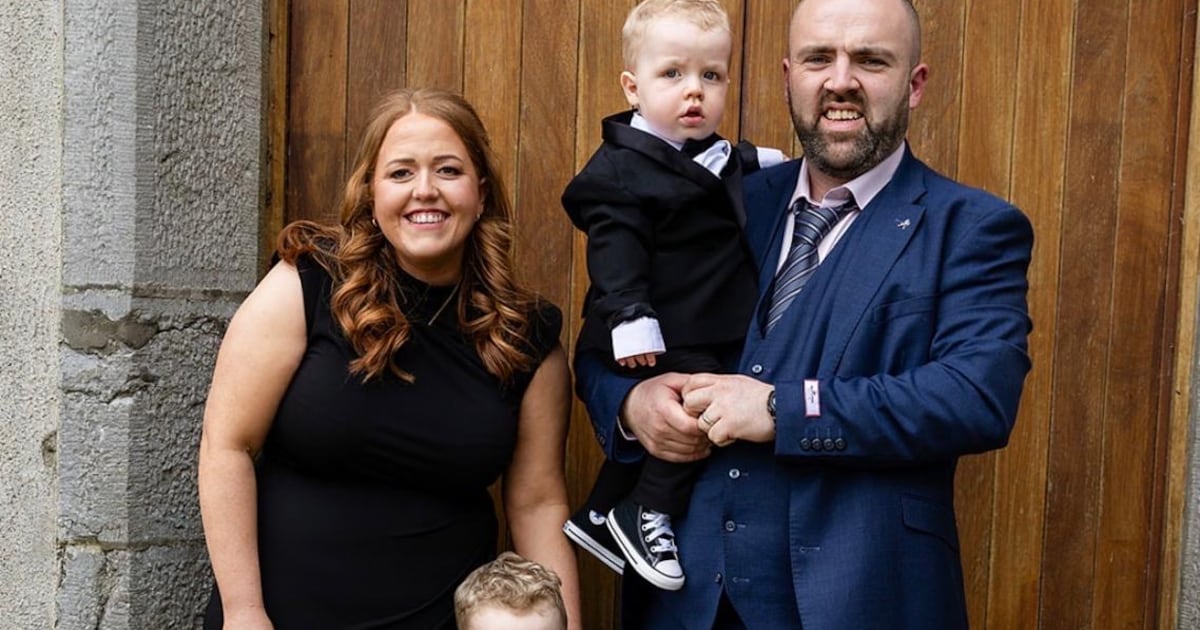
A woman whose son contracted bacterial meningitis as a baby, which will result in lifelong impacts on the child’s health, has highlighted the importance of parents trusting their gut if they suspect their children have contracted the condition.
Helena Power (37), from Ballyroan in Co Laois, said “we will live with the impact of meningitis forever more”, in advance of World Meningitis Day on October 5th.
She gave birth to her first baby, a boy named Tom, in July 2021, but became ill a week later. Power attended the Midland Regional Hospital in Portlaoise and found out she had group B streptococcus (GBS) sepsis, a type of infection. After a few days of antibiotics, she was discharged.
One night, when Tom was around three weeks old, he did not sleep and had a high-pitched cry. He also had reflux and Power decided to bring him to the GP.
She had “a huge instinct” that Tom was unwell despite him not having any other symptoms such as a high temperature or a rash. She brought him to the hospital, under the GP’s recommendation. There, Tom’s blood was drawn and a lumbar puncture was performed.
By this stage, she said he was also vomiting and his hands were “freezing”.
“The word meningitis came up and I was like absolutely stuck to the floor.”
She said that in the space of one day she could see an increased sensitivity to light in her son and how his head went backwards as if there was a weight on his head.
He was transferred to the intensive care unit (ICU) at Children’s Health Ireland (CHI) Temple Street in Dublin, and she and her husband, Kelvin, were formally told that Tom had late-onset Group B streptococcus meningitis, which is the swelling of the membranes that cover and protect the brain and spinal cord.
After receiving this news, she said they didn’t know what the future held. It was a “devastating time” for the new parents.
“It’s not just us that’s impacted by this … it’s my family, it’s Kelvin’s family,” said Power. “I remember saying to Kelvin, like … let’s take this day by day.”
Tom spent two days in ICU and a week in Temple Street.
“It’s an out-of-body experience … you’re just like you’re surviving.”
He then spent another three weeks in the Midland Regional Hospital and was on antibiotics for a further six weeks after getting home.
She said it’s “no coincidence we both were sick” but added that it cannot be proven that her GBS sepsis and Tom’s meningitis came from the same infection.
“It is definitely a mother’s instinct … I just knew something was wrong.
“Trust your gut and … act when you feel you need to,” she advised.
In January, Tom was diagnosed with hydrocephalus, which is a build-up of fluid in the brain putting pressure on the brain, and a shunt was fitted.
Power said hydrocephalus is a “lifelong illness” which can be caused as a result of meningitis. “We have to be extremely vigilant with Tom.”
“He’s impacted for life, like, that does not go away,” she said.
She and her husband were “worried” about him hitting milestones. “We were told, like, you know, we don’t know what damage this has done.”
However, last month, he started primary school and “is absolutely flying it”.
She said it was “a big relief” for him to start school.
“It’s just after everything Tom’s been through, he’s had, like, two major surgeries, one with getting the shunt in, one with [the] shunt revision, you know, he is as resilient as ever.”
She described him as a “wild” five-year-old, adding that he plays football and hurling.
Power praised the support of Siobhán Carroll of ACT for Meningitis, a national meningitis awareness and support charity. The charity was founded by Siobhán and Noel Carroll following the death of their four-year-old daughter, Aoibhe, to meningitis.
It was set up in 2011 to raise awareness, provide education and free support to families and individuals affected by meningitis.
[ How do I spot if my child has meningitis?Opens in new window ]
Meningitis can develop very quickly and anyone of any age can contract it but babies and young children, teenagers and young adults are among the groups at greater risk, as well as older adults.
Signs and symptoms can include a high temperature, severe headache, vomiting, stiff neck, sensitivity to light, aches and pains, rapid breathing, cold hands and feet, confusion, drowsiness, difficulty waking, seizures and a rash that does not fade under pressure.
For babies, symptoms can include refusing feeds, irritability, an unusual high-pitched cry, a bulging soft spot or being floppy or difficult to wake.